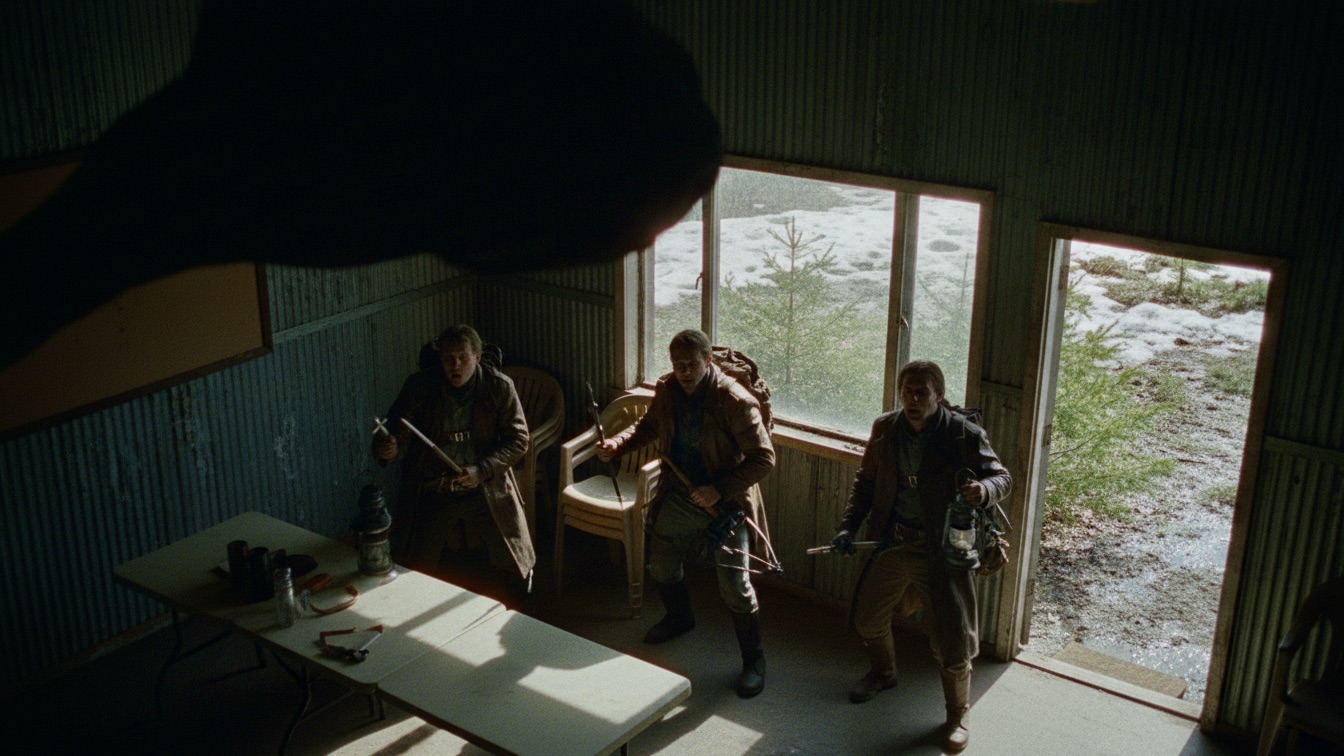
The narrative opens in the claustrophobic, decaying environment of a 1970s community hall, where three individuals—Sandra, Devon, and Mike—are stationed to monitor a biological anomaly. The atmosphere is thick with tension and the smell of failure, exemplified by Devon’s burnt venison chili and the group’s bickering. As an unseasonable spring thaw turns the surrounding landscape into a treacherous slush, Mike reveals that the ice shelf containing the anomaly has collapsed. This environmental shift triggers the creature’s awakening, which is signaled by a violent analog alarm and a massive heat signature on their scanners.
Panic ensues when the team discovers their primary containment weapons, the EMP rifles, are non-functional because a power surge tripped the circuit in the dilapidated building. Devon reacts with aggression toward Mike, whose negligence led to the equipment failure, while Sandra struggles to maintain tactical order. The situation escalates as the massive entity passes directly over the hall, plunging the room into darkness and silence while the structure groans under its weight. Once the creature moves toward a nearby highway filled with civilian traffic, the team is forced to abandon their failed technology. They head out into the mud with kinetic shotguns and manual spikes, hoping to intercept the beast before it reaches the asphalt.
A central theme of the story is the inevitable triumph of entropy and nature over human structures and technology. The community hall itself is a symbol of decay, described as a rotting wooden shed that is fundamentally unsuited for its high-stakes purpose. This physical rot mirrors the failure of the team’s sophisticated gear, which is rendered useless by the primitive electrical wiring of the building. The spring thaw acts as the primary catalyst, suggesting that natural cycles are indifferent to human containment efforts and will eventually reclaim what has been frozen or suppressed.
The narrative also explores the theme of human incompetence and the fragility of modern systems. The failure of the EMP rifles is not due to a complex scientific error but a mundane oversight caused by Mike’s distraction and the building’s aging infrastructure. This highlights a terrifying gap between the magnitude of the threat—a Class-Four biological anomaly—and the flawed individuals tasked with managing it. The transition from digital scanners to manual kinetic slugs represents a regression from advanced civilization to a more primal, desperate state of survival.
Finally, the story touches upon the psychological weight of isolation and the breakdown of social cohesion under pressure. The characters are trapped in a liminal space where the boundaries between the mundane, such as eating bad chili, and the existential, such as facing a prehistoric monster, have blurred. Their interpersonal conflicts serve as a distraction from the looming threat, illustrating how easily humans can succumb to infighting when faced with overwhelming fear. The "plastic folding tables" of the title serve as a metaphor for this fragility, providing a thin, unstable surface upon which they attempt to organize their defense against the infinite.
Sandra serves as the pragmatic anchor of the group, embodying the archetype of the weary professional who uses routine to stave off panic. Her focus on cleaning her kinetic shotgun while the others argue suggests a deep-seated need for control in an environment that is rapidly destabilizing. She is the first to recognize the gravity of the situation when the ice shelf is mentioned, and her physical reaction—the blood draining from her face—betrays the terror she suppresses to remain a leader. Her leadership style is cold and directive, prioritizing the mission over the emotional outbursts of her subordinates.
Psychologically, Sandra appears to be suffering from the "cognitive static" of long-term high-stress monitoring. She is acutely aware of the sensory details around her, such as the rhythmic dripping of the roof, which indicates a state of hyper-vigilance. Despite her fear, she possesses a strong sense of duty that overrides her survival instinct, as seen when she immediately prepares to hunt the creature after it passes. She understands that they are the only barrier between the anomaly and the public, and she accepts this burden with a grim, stoic determination.
Devon represents the "Id" of the group, characterized by his volatile temper and his tendency to project his anxieties onto external objects and people. His obsession with the quality of the chili and his immediate aggression toward Mike are defense mechanisms designed to mask his feelings of inadequacy. He is a man who relies heavily on his tools and his physical presence, and when the EMP rifles fail, his sense of identity is momentarily shattered. His violence toward Mike is a manifestation of his need to find a scapegoat for a situation that is fundamentally beyond his control.
Beneath his bravado, Devon is clearly terrified, as evidenced by the cold sweat and his silence when the creature passes overhead. He is a character defined by his reactivity; he does not plan so much as he responds to the immediate stimuli of the environment. However, he is not a coward, as he quickly gears up to follow Sandra into the mud. His arc in this chapter is one of moving from petty, misplaced anger to a focused, albeit desperate, combat readiness. He requires a clear enemy and a clear objective to function, finding his footing only when the threat becomes physical rather than theoretical.
Mike is the embodiment of the "rookie" whose modern distractions lead to catastrophic consequences. His reliance on his phone and his failure to properly check the equipment meters suggest a lack of maturity and a fundamental disconnect from the reality of their mission. Psychologically, he seems to be in a state of soft denial, hiding behind a screen to avoid the grim reality of the rotting hall and the melting ice. When the crisis hits, his transition from casual negligence to paralyzing fear is instantaneous and profound.
His character serves as the emotional pressure cooker of the scene, as his mistakes provide the catalyst for the group's internal collapse. He is visibly traumatized by the creature's proximity, weeping and clamping his hands over his mouth to maintain silence. However, under Sandra's harsh command, he shows a glimmer of resilience by forcing himself to move and gather the mud spikes. Mike represents the vulnerability of the uninitiated, illustrating how quickly the "civilized" mind can be broken when confronted with the primordial and the monstrous.
The pacing of the narrative is masterfully handled, beginning with a slow, grinding tension that mirrors the "high, drilling screech" of the aluminum ladle. The author uses the mundane details of the setting—the smell of bleach and wet dog, the squeak of styrofoam—to ground the reader in a reality that feels uncomfortably tangible. This slow build-up makes the sudden transition to the "analog shriek" of the scanner and the subsequent appearance of the creature feel earned and impactful. The narrative rhythm mimics the heartbeat of the characters, accelerating from lethargic boredom to frantic, breathless action.
Sensory details are the backbone of the story’s atmosphere, particularly the use of sound and smell to convey dread. The transition from the rhythmic "drip, drip, drip" of the leaking roof to the "massive thumping" of the creature creates an auditory landscape of escalating threat. The smell of ozone and copper provides a visceral, almost metallic taste to the fear, elevating the creature from a mere animal to a supernatural or highly advanced biological force. These descriptions bypass the intellectual mind and appeal directly to the reader's primal instincts, creating a sense of genuine unease.
The narrative voice is objective yet deeply attuned to the psychological state of the characters, using third-person limited perspectives to emphasize their isolation. The prose is sparse and muscular, avoiding unnecessary flourishes in favor of sharp, mechanical descriptions of weapons and equipment. This stylistic choice reflects the utilitarian nature of the characters' lives while highlighting the irony of their failure. By focusing on the "plastic folding tables" and "peeling wallpaper," the author creates a stark contrast between the insignificance of human habitation and the overwhelming scale of the anomaly outside.


