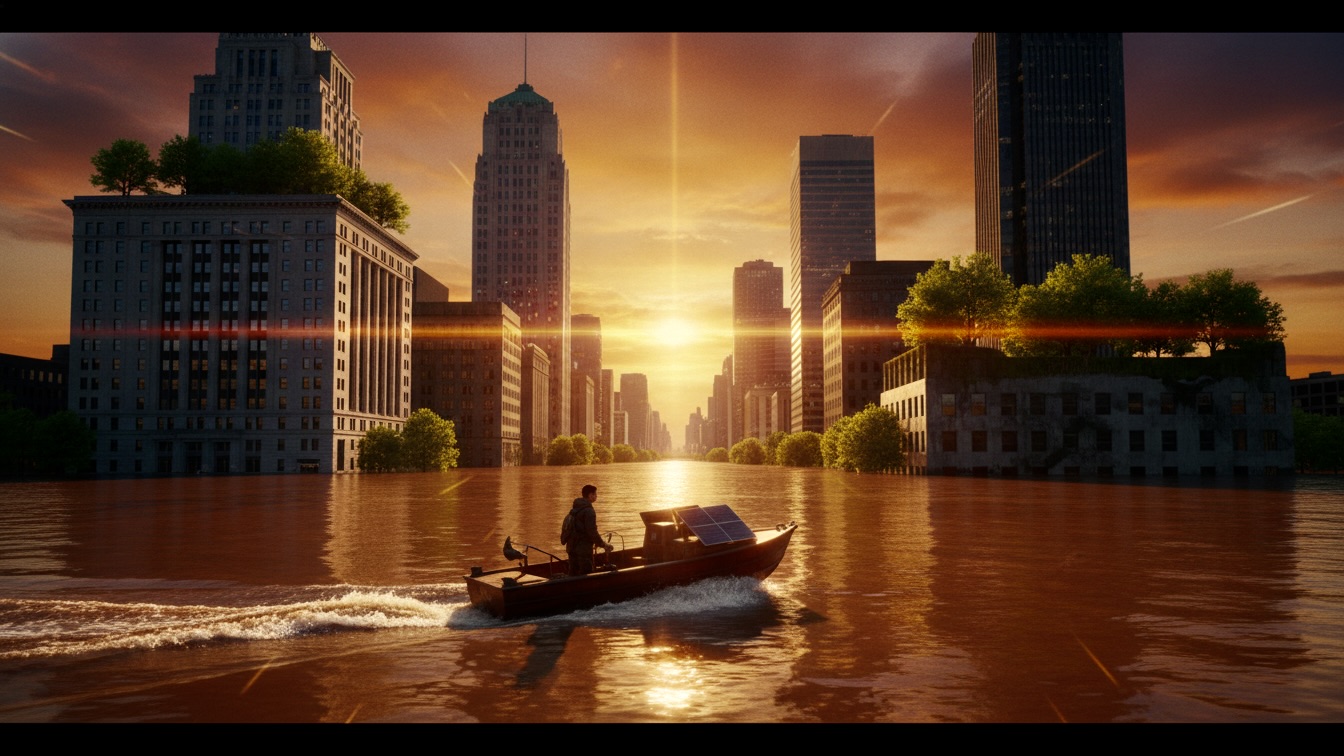
A tech-junkie navigates a flooded Winnipeg to deliver cooling units to seniors abandoned by the emergency power grid.
The heat doesn't just sit on you. It presses. It has mass. In Winnipeg, the spring usually tastes like mud, but the '26 melt turned the city into a stagnant bowl of soup. I looked down at the water. It was a thick, brown slurry, carrying the ghosts of basement suites and flooded parked cars. My skiff hummed. The solar array was doing its best, but the sun was too much. It was a white-hot hammer hitting a bruised landscape. The 'Red Sea' they called it. Main Street was gone. The Richardson Building stood out of the water like a tombstone for a billion dollars that couldn't buy a dry floor.
I checked the tarp. Underneath, the four industrial fans were heavy and cold. Stolen? Maybe. Liberated? Definitely. The emergency grid was a joke. They were keeping the lights on in the Tuxedo highlands while the social housing units in the North End became ovens. I wiped sweat from my eyes with a greasy sleeve. My skin felt like it was coated in sugar and dirt. Every breath was an effort. The air was soup. The city was dying, and I was just a scavenger with a soldering iron.
I saw the blue lights before I heard the engine. A water-police patrol boat was idling near the half-submerged portico of the Concert Hall. Detective Wilson was at the helm. He looked like he hadn't slept since the ice started breaking in March. He saw me. There was no way to turn the skiff around without looking guilty. I kept the throttle steady. The electric motor made a high-pitched whine that felt like a needle in my ear.
"Halt your craft, Caleb," Wilson said. His voice was projected through a bullhorn, making it sound like the voice of a god with a bad cold.
I drifted closer, my hands gripping the tiller. "The water is public, Detective. I have a permit for the skiff."
"The cargo is what interests me," Wilson replied. He stepped onto the gunwale of his boat, looking down at my tarp. "We had a report of a warehouse breach near the rail yards. High-end cooling equipment. Very specific. Very expensive."
"I am moving scrap," I said. My heart was a hammer in my ribs. "The seniors at the tower are roasting. I have fans. Old ones. From the dump."
"Lie to me with more grace, boy," Wilson said. He reached for his boat hook. "Show me the manifest or I impound the vessel. The city is under martial law. I can sink you where you sit."
I didn't answer. I didn't have to. I kicked the throttle to max. The skiff didn't lunge; it surged. The solar capacitors dumped everything they had into the motor. I ducked as the patrol boat's wake hit me, sending a spray of toxic brown water over my deck. I steered hard left, cutting through the shattered glass of a department store front. The skiff skimmed over the tops of clothing racks and jewelry counters. The sound of the hull scraping against submerged metal was a scream. I didn't look back. I knew Wilson couldn't follow me through the narrow aisles of the ruins. I popped out the back loading dock, my heart rate finally slowing as I hit the open water of the back alleys.
I reached the rooftop colony ten minutes later. It was a cluster of tents and makeshift shacks on top of an old parkade. People stood there, watching the water rise. They looked like statues made of dust. A girl I knew as Mags walked to the edge. She held a plastic crate.
"You're late," she said. Her voice was flat. "The sun is killing the kids."
"The law was in the way," I said. I pulled alongside the concrete ledge. "I need the power cells. I can't run the units without a buffer."
She handed down a stack of old laptop batteries, taped together in bundles. "These are the last ones. We drained the medical fridge for this. If you don't bring the water, we don't last the night."
I reached into the hold and tossed up three five-gallon jugs of filtered water. It was heavy, precious, and clear. "Drink slow. The filters are failing."
"Everything is failing, Caleb," she said. "But the water is cold. Thank you."
I pushed off. The sky started to change. The white heat turned a bruised purple. The air pressure dropped so fast my ears popped. A freak hail-storm. It was the heat dome's final insult—ice in a furnace. The first stone hit the deck with the sound of a gunshot. Then another. Within seconds, the sky was falling. Golf-ball-sized ice chunks hammered the water, turning the brown surface into a chaotic white foam. A loud crack echoed through the skiff. I looked back. My solar array was shattered. The glass was a spiderweb of failures. The motor died instantly.
"Not now," I whispered. "Please, not now."
I grabbed the manual oars. They were heavy, clumsy things made of salvaged PVC and plywood. I dug them into the water. The current was strong here, pulling me toward the main channel where the debris was thick. I rowed until my shoulders burned. My palms blistered and tore. The hail was stinging my neck, drawing blood. Every stroke was a battle against the Red Sea. I could see the social housing tower in the distance. It was a gray monolith, stripped of its dignity, surrounded by a moat of trash. I kept rowing because stopping meant drowning in a city I used to call home.
When I finally bumped against the concrete stairs of the tower's entrance, I was spent. My breath came in ragged gasps. A figure stepped out of the shadows of the darkened lobby. He was tall, thin, and moved with a limp I recognized instantly.
"You look like hell, Caleb," the man said.
"Old Man Rivers," I coughed. I leaned on the oars. "You're supposed to be in the interior. Safe. Dry."
"And leave these people to cook?" He stepped into the light. His face was a map of bad choices and better intentions. My old mentor. The man who taught me how to wire a circuit and how to hide from the grid. "I'm the one who sent the signal. I didn't think you'd actually show up."
"I had the fans," I said. "Wilson almost had me."
"Wilson is a dog on a short leash," Rivers said. He helped me haul the cooling units out of the skiff. "Help me with the generator. The backup is flooded, but I've bridged the roof panels to the secondary bus. We just need the fans to kick-start the airflow."
We worked in the dark, our flashlights cutting through the humid gloom of the stairwell. The heat inside the building was worse than the sun. It was a heavy, wet blanket of human misery. I could hear the seniors in their rooms—the soft groans, the labored breathing. It was a choir of the forgotten. Rivers moved with a frantic precision. He was old, but his hands were steady.
"The wiring is brittle," I noted, stripping a copper lead with my teeth. "If we spike the load, the whole floor goes dark."
"Then do not spike the load," Rivers replied. "The theatricality of your doubt is unnecessary. Just connect the damn wires."
I soldered the final connection. My hands were shaking from the row, but the joint held. I flipped the toggle on the DIY cooling unit. There was a moment of silence—a terrifying gap where the world stood still—and then a low hum. The fan blades began to spin. A gust of air, filtered and cooled by the makeshift ice-evaporator, pushed into the hallway. I felt it hit my face. It was the most beautiful thing I had ever felt.
"One down," Rivers said, his voice softening. "Forty-nine to go."
We spent the next four hours rigging the rest. By the time the last unit was humming, the sun had set, leaving the city in a strange, bioluminescent glow of flood-lights and fire. We sat on the landing of the tenth floor, looking out over the water. The tower was humming. The air was moving. Fifty people were breathing easier because a dropout and a ghost decided to play god with some scrap metal.
"You're staying?" I asked.
Rivers looked out at the dark horizon. "The water isn't going down, Caleb. Spring is just the beginning. Someone has to keep the lights on."
I looked at my hands. They were ruined, covered in grease and blood. I felt the cool air from the hallway behind me. It was a small victory. A stubborn spark in a world that wanted to be dark. I leaned my head against the cold concrete wall and closed my eyes. For the first time in weeks, the heat didn't feel like a death sentence.
“I looked at the horizon where the water met the dark sky, and I realized the city wasn't just flooded; it was changing into something we weren't prepared for.”


