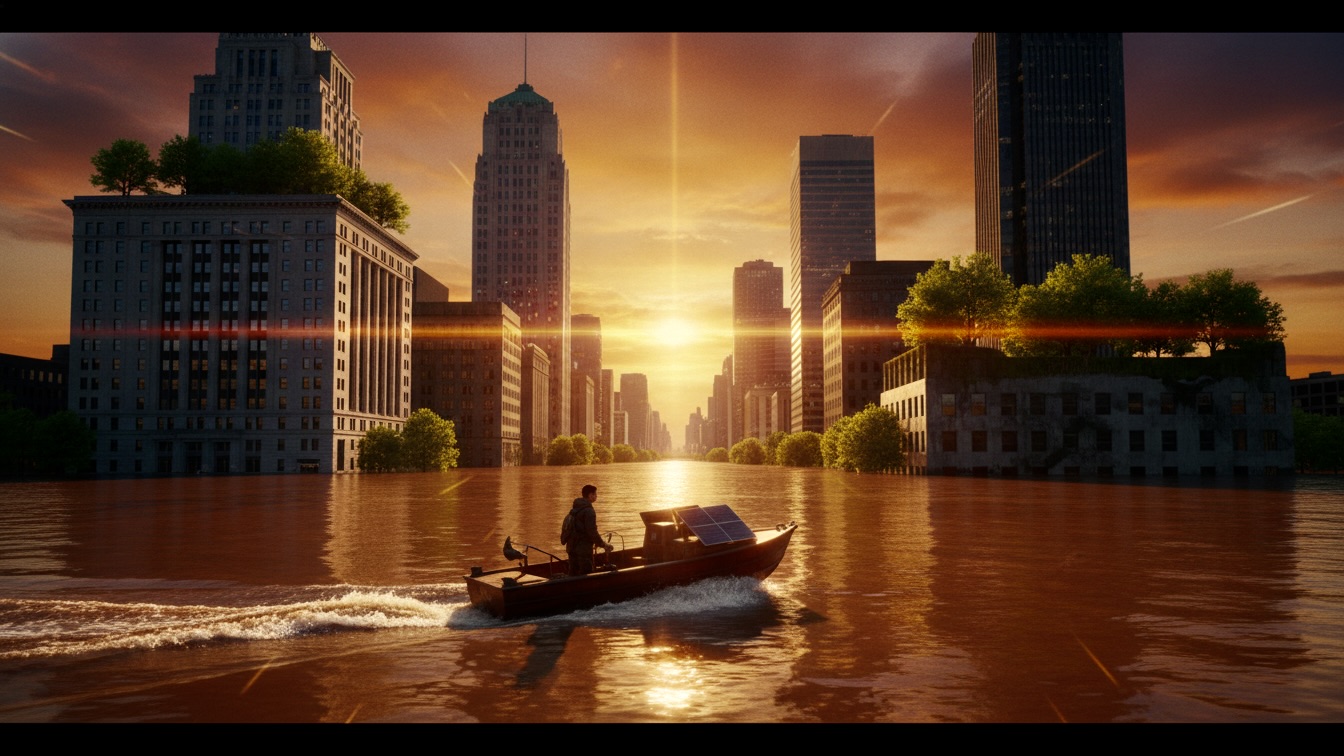
The story follows Caleb, a resourceful scavenger navigating the flooded ruins of Winnipeg in the year 2026. Amidst a catastrophic heatwave and a city submerged by the "Red Sea," he transports stolen industrial fans to a social housing tower in the North End. His journey is fraught with peril, beginning with a tense confrontation with Detective Wilson, a law enforcement officer representing a failing system. Caleb narrowly escapes Wilson by piloting his skiff through a submerged department store, demonstrating his intimate knowledge of the drowned urban landscape.
After a brief stop to trade filtered water for improvised battery packs with a contact named Mags, Caleb faces a sudden and violent hail storm. The ice shatters his solar array, forcing him to row manually through the toxic waters to reach his destination. Upon arrival at the tower, he reunites with his mentor, Old Man Rivers, who has been preparing the building for emergency cooling. Together, they work through the night to rig the cooling units, providing life-saving relief to the elderly residents trapped in the sweltering building. The narrative concludes with a moment of quiet reflection as the two men witness the immediate impact of their labor.
The narrative serves as a harrowing exploration of environmental collapse and the resulting social stratification. The setting of Winnipeg is transformed into a "stagnant bowl of soup," where the heat is a physical weight and the water is a toxic slurry. This climate catastrophe is not a Great Equalizer; instead, it sharpens the divide between the wealthy and the marginalized. The "Tuxedo highlands" retain their electricity and comfort, while the "North End" is left to rot in the heat. This disparity highlights a world where the infrastructure of the state serves to protect property and privilege rather than human life.
Technological ingenuity and the ethics of survival form another core theme. Caleb identifies as a "tech-junkie dropout," yet his skills are the only thing keeping his community alive. The story reframes the act of theft as "liberation," suggesting that in a dying world, the moral weight of a law is secondary to the immediate needs of the suffering. The improvised nature of the technology—using laptop batteries and salvaged PVC—emphasizes a "make-do-and-mend" philosophy that stands in stark contrast to the stagnant, bureaucratic failure of the city’s official emergency grid.
Finally, the story touches upon the theme of collective responsibility and the weight of mentorship. Old Man Rivers represents the previous generation whose "bad choices" may have contributed to the current state of the world, yet he seeks redemption through localized action. Caleb’s relationship with him suggests that knowledge is a tool for resistance. Their "small victory" at the end of the chapter suggests that while the world may be ending, the act of maintaining one's humanity through service to others remains a potent form of defiance against despair.
Caleb is a protagonist defined by a weary but persistent sense of altruism. He views himself with a degree of self-loathing, calling himself a "scavenger with a soldering iron," yet his actions reveal a man deeply committed to his community. He operates in a state of constant physical and psychological pressure, mirrored by the oppressive heat of the environment. His internal monologue is pragmatic and cynical, which serves as a defense mechanism against the overwhelming tragedy surrounding him. He does not see himself as a hero, but his willingness to risk summary execution by Detective Wilson proves otherwise.
Psychologically, Caleb exhibits the traits of a survivor who has adapted to chronic trauma. He is hyper-vigilant and possesses a specialized skill set that gives him a sense of agency in a world where most are powerless. His decision to push through the hail storm, despite his exhaustion and the failure of his motor, demonstrates a dogged determination. He is motivated not by the hope of a better future, but by the refusal to let the present get any worse for those even more vulnerable than himself. His ruined hands at the end of the story symbolize the physical cost of his morality.
Old Man Rivers serves as the narrative’s moral and intellectual anchor. He is a figure of the past, a man whose "bad choices" are etched into his face, yet he possesses a "frantic precision" that suggests he is still fighting for a sense of purpose. As Caleb’s mentor, he represents the transition of knowledge from the old world to the new. He is demanding and unsentimental, as seen when he mocks Caleb’s "theatricality of doubt," but this sternness is a tool used to keep the younger man focused on the task at hand. He understands that in their current reality, sentimentality is a luxury they cannot afford.
The psychologist would see Rivers as a man seeking atonement. By staying in the flood zone rather than fleeing to the dry interior, he is actively choosing to share the fate of the people he serves. His limp and his age suggest a physical decline, but his steady hands during the electrical work indicate a mind that is still sharp and focused. He provides Caleb with a template for how to exist in a collapsing society: by finding a specific, tangible way to be useful. He is the "ghost" who decides to play god, not out of hubris, but out of a desperate necessity to preserve life.
Detective Wilson represents the terminal breath of a dying legal system. He is a man who has "not slept since the ice started breaking," suggesting that he is just as much a victim of the environment as the people he polices. However, he chooses to align himself with the rigid structures of "martial law" rather than the needs of the citizens. His voice, projected through a bullhorn, creates a psychological distance between him and Caleb, turning him into an impersonal agent of a cold and indifferent authority. He views the cooling equipment as property to be recovered rather than a life-saving resource.
Wilson’s character highlights the futility of maintaining old-world hierarchies during a total systemic collapse. He threatens to "sink" Caleb’s boat over a report of a warehouse breach, showing a preference for the "manifest" over human survival. He is described as a "dog on a short leash," implying that he is a tool for those in the Tuxedo highlands who still wish to exert control over the ruins. His presence in the story serves to heighten the stakes, transforming Caleb’s mission from a difficult task into a dangerous act of rebellion against a state that has abandoned its people.
The narrative style is characterized by a gritty, sensory-heavy realism that borders on the "cli-fi" (climate fiction) subgenre. The author uses evocative metaphors to ground the reader in the setting, such as the Richardson Building looking like a "tombstone for a billion dollars." The prose is lean and muscular, reflecting the protagonist’s own no-nonsense approach to survival. Sensory details are used to create a sense of claustrophobia; the air is described as "soup" and the heat "presses" with physical mass. This creates an immersive experience where the environment itself feels like a primary antagonist.
Pacing is expertly handled, shifting from the slow, tense dread of the encounter with Wilson to the frantic action of the escape through the department store. The transition from the "white-hot hammer" of the sun to the "bruised purple" of the hail storm provides a rhythmic shift that keeps the reader off-balance. This reflects the volatility of the new climate, where one extreme is immediately followed by another. The use of sound—the "high-pitched whine" of the motor, the "gunshot" sound of hail, and the "low hum" of the fans—creates an auditory landscape that mirrors the mechanical and natural tensions of the story.
The narrative voice is first-person, which allows for a deep dive into Caleb’s internal state and his specialized technical knowledge. The use of technical jargon like "solar capacitors," "copper lead," and "secondary bus" adds authenticity to his character as a "tech-junkie." This technical groundedness makes the more poetic descriptions of the "Red Sea" and the "choir of the forgotten" feel earned rather than forced. The tone remains consistently somber but is punctuated by moments of "stubborn" hope, culminating in the "beautiful" sensation of the first cool breeze in the tower.


