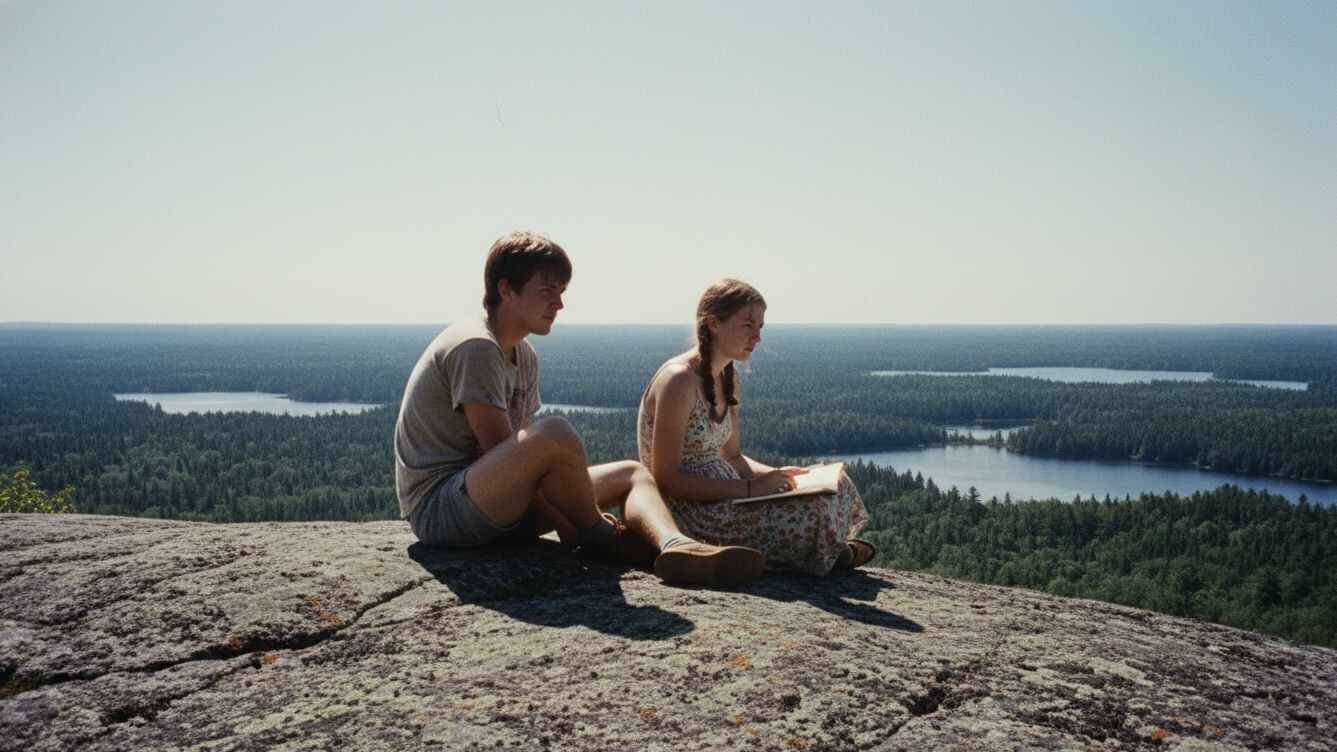
High Noon on the Granite Ridge
Simon and Betty sit atop a sun-baked rock cut overlooking a vast network of lakes in Northwestern Ontario, engaging in a high-stakes conversation about their futures.
“If you stay here much longer, Simon, you’re going to become part of the landscape. I swear I can already see the moss growing over your shoes.”
Betty did not look at him when she said it. She was busy peeling a strip of birch bark from a fallen log, her fingers stained with the dark residue of the forest. She held the white strip up to the sun, inspecting it like a grand curator examining a rare manuscript. It was typical of her to turn a humid Tuesday in July into a scene from a tragic opera. The heat was a physical weight, a wet wool blanket thrown over the world, pressing the smell of heating pine needles and dry lichen into the back of Simon’s throat. He wiped sweat from his upper lip, the grit of the granite dust scratching his skin.
“Honestly, I think I’m already halfway there,” Simon replied. “Give it another month and I’ll have completely melted into the Canadian Shield. Someone will find a puddle of anxiety and acrylic paint where I used to sit. Probably mistake it for an art installation.”
“A tragic end for a painter of your potential,” she said, finally turning her gaze toward him. Her sunglasses reflected the distorted image of the black spruce treeline and Simon’s own hunched, sweating form. “But seriously, we need to talk about the bus ticket. We’re leaving. Or at least, I’m leaving. I’d prefer not to do it alone.”
Simon shifted on the rock. The stone was hot enough to burn through his denim shorts, a radiant heat that felt like it was cooking the marrow in his femurs. They were sitting on the highest point of the ridge, the town of Kenora sprawled out somewhere to the south, hidden behind the rolling green carpet of the boreal forest. Below them, the lake was a sheet of hammered tin, blinding and still. It was too hot for the boats. It was too hot for anything but this—this endless, circular dialogue they had been rehearsing for three years.
“Okay, but buying a bus ticket doesn’t magically make everything different,” Simon said, gesturing broadly with a hand that still bore a smudge of phthalo blue near the thumb. “We go to Toronto, and then what? We’re still the same people. We just have to deal with traffic and rent. And probably a lot more people who think they’re better painters than me.”
“That’s kind of the point, isn’t it?” Betty sighed, dropping the birch bark and picking up her sketchbook, fanning herself with it. “You keep talking like this place is the only thing holding us together. It’s not. We’re twenty-two, Simon. We have the internet, we have buses, and we have perfectly functional legs. We can actually go somewhere.”
“Right. And money? Do we have money?”
“God, you always have to bring that up.”
“Because it’s a fairly important part of moving.”
“We’ll figure it out. People do it all the time. We’ll eat cheap noodles, get terrible jobs, complain about our landlords. It’ll be fine.”
It was a lie, and they both knew it. The urgency in Betty’s voice was real, beneath the layers of affectation. Simon watched an ant navigate the intricate topography of his running shoe. He felt a sudden, sharp pang in his chest—not from the heat, but from the realization that she was actually going to do it. She wasn’t just performing the role of the Restless Youth; she was inhabiting it. The realization made the saliva in his mouth taste metallic, like sucking on a penny.
“You applied,” Simon said. “To the conservatory. You actually sent them your portfolio.”
Betty stopped fanning herself. The silence that followed was heavy, filled only by the distant, rhythmic thrum of a transport truck engine braking on the Trans-Canada Highway miles away. A crow called out, three sharp caws that sounded like mocking laughter.
“Yeah. I did,” she said, her voice dropping, losing a fraction of its usual performance. “The deadline was coming up, and I just thought, what am I waiting for? I couldn’t keep putting it off. I need to be somewhere else for a while, Simon. I need a bit of chaos. Actual people, music, galleries, bad coffee, all of it. Here…” She gestured at the pristine, brutal landscape around them. “I love this place, but sometimes it’s so quiet I can’t even think. I feel like everything I want to do is just getting buried under the same old routine.”
Simon looked out at the horizon. The sky was a pale, washed-out blue, bleached by the intensity of the sun. He loved this place. He loved the way the light hit the water at 8:00 PM, turning the lakes into pools of liquid copper. He loved the rough texture of the bark and the smell of wet asphalt after a thunderstorm. But he knew that loving it wasn’t enough to sustain a life. Not for them. The town was shrinking, the mines were automated, and the gallery downtown had closed last month to become a vape shop.
“So you’re actually going,” Simon said, feeling the words catch in his throat. “And I’m just supposed to stay here?”
“You could come with me,” Betty said, leaning forward. The movement was sharp, urgent. “And don’t pretend you want to stay. You complain about winter from October until May. You hate the gossip. Last week you said you were going to throw yourself into the lake if you had to paint one more picture of a boulder.”
“I said that because the boulder was particularly ugly.”
“Simon, you were having a breakdown over a rock.”
“It was a very difficult rock.”
“It was a rock!”
She stood up, her shadow falling over him, long and distorted against the rock. She paced back and forth, her movements jerky and animated. “We’re twenty-two. We can’t keep waiting for the perfect time to do something. The world’s already a mess. Everything’s getting more expensive, the weather’s getting weirder, and apparently we’re all going to be working until we’re ninety. Fine. Whatever. But we have a chance to do something now. If we stay here, what’s going to happen? We’ll get older, we’ll find jobs we don’t particularly like, and everyone will know us as the people who never left. Is that really what you want?”
Simon looked up at her. She looked fierce, her hair frizzed by the humidity, her eyes wide behind the dark lenses. She looked like a Valkyrie in a thrift-store sundress.
“I’m scared, Betty,” Simon admitted. The admission felt like vomiting. It broke the rules of their game. They were supposed to be witty, cynical, above it all. Admitting fear was pedestrian.
Betty stopped pacing. She crouched down in front of him, invading his personal space. He could smell her—sunscreen, stale sweat, and the peppermint gum she chewed incessantly. “Okay. Scared of what, though? Actually failing? Or finding out you could have done something with your life and never even tried?”
“It’s more like… what if I go there and nobody cares?” Simon whispered. “Here, I’m Simon the Artist. People know me. They know my work. I have a place, I guess. But in Toronto, I’m just another person with a portfolio and a bunch of paintings nobody wants to buy. What if I’m not actually any good? What if I’m only good here because there aren’t that many people doing what I do? What if I’m just a big fish in a really small pond?”
Betty reached out and poked him hard in the chest. “Then you’ll find out. Isn’t that better than spending the next twenty years wondering? Maybe you’re brilliant. Maybe you’re average. Maybe you have to start all over again. So what? You can’t spend your whole life protecting yourself from the possibility that you’re not special. That’s no way to live. And you’re a lot of things, Simon. You’re stubborn, you’re dramatic, and you overthink absolutely everything. But you’re not someone who gives up before he’s even tried.”
He swatted her hand away, but without force. The heat was making him dizzy. Or maybe it was her. The urgency in her voice was contagious. He felt a restless energy twitching in his legs, a desire to run, to jump off the cliff and see if he could fly or just splatter.
“Okay, but have you actually looked at the cost of living there?” Simon argued, retreating to logistics. “It’s like three thousand dollars just to get an apartment. I have four hundred dollars and a stack of watercolours that nobody has bought.”
“Then we’ll get jobs,” Betty said, throwing her arms up. “We’ll work wherever they’ll hire us. Restaurants, shops, whatever. We’ll scrub floors if we have to. I don’t care. You keep talking about wanting to be an artist and having this whole bohemian life, but that means figuring things out as you go. Nobody’s going to hand us a studio and a nice little apartment. We have to start somewhere.”
Simon laughed, a dry, cracking sound. “You make it sound fun because you haven’t actually had to do it yet.”
“Well, I’m about to find out, aren’t I?” She sat back down, crossing her legs. “Look, the bus leaves on Thursday. The morning express. It stops in Thunder Bay, then Sault Ste. Marie, then down. I bought two tickets.”
The air between them suddenly felt very thin. The cicadas seemed to screech louder, a rising crescendo of static noise.
“Two?” Simon repeated. He stared at the grey lichen pattern on the rock, tracing the intricate, map-like shapes with his eyes. It looked like a map of a country that didn’t exist.
“Yeah. Two,” Betty said. “They’re non-refundable, by the way. So I’ve already made a pretty significant financial commitment to this little adventure. If you don’t come, I’ll have to put my bag on the empty seat and pretend I’m mysterious and independent. Which is probably how I end up getting murdered by some creep at a bus station. So I’d really appreciate it if you came.”
Simon looked at the lake again. A motorboat was cutting a V-shape through the water, a tiny white speck disrupting the perfect surface. The wake spread out, reaching for the shorelines, disturbing the reflection of the clouds.
He thought about his room in his parents’ basement. The smell of the damp carpet. The stack of canvases in the corner that he was too afraid to finish. The comfort of it. The suffocating, warm, deadly comfort.
“Thursday,” Simon said.
“Eight in the morning. Don’t be late. Seriously, Simon. If you’re not there, I’m going without you. I’m not going to stand around waiting for you to change your mind. I’ve done enough of that already.”
“You’d really leave me here?”
“I’d have to,” she said softly. “I don’t want to, but I can’t keep waiting for you to decide what you want. We can’t just keep doing this forever. I can’t stay here and watch you spend the next twenty years painting the same sunset because you’re too afraid to see what else is out there. It would hurt me more to watch you give up on yourself than it would to leave.”
The truth of it hung in the hot air. It was a violent thing to say, but necessary. Simon felt tears prick at the corners of his eyes, hot and embarrassing. He blinked them away quickly.
“Okay,” Simon managed to say, his voice thick. “That’s actually a pretty convincing argument.”
“I know,” Betty said. She reached into her bag and pulled out a warm can of soda. She cracked it open, the hiss sounding like a snake. She took a sip and passed it to him. “Here. Drink something. You’re sweating like you’re about to die, and your lips look terrible.”
Simon took the can. The metal was warm, the liquid inside sugary and flat. He drank it anyway. It tasted like childhood. It tasted like the summers that lasted forever, before time started speeding up, before the year 2025 arrived with its drones and its climate anxiety and its crushing weight of expectation.
“If I go,” Simon started, “I’m not scrubbing toilets. I’ll be a barista. There’s a difference.”
Betty smiled. It was a real smile, wide and gum-showing, lacking all her usual irony. “Fine. You can be a barista. Just promise you’ll get me free coffee.”
They sat in silence for a long time. The sun began its slow descent, shifting the light from harsh white to a bruising purple. The shadows of the pine trees lengthened, stretching out like dark fingers reaching for them across the rock.
Simon watched a hawk circle overhead, riding a thermal. It looked so effortless. He wondered if the hawk knew it was flying over a dying town, or if it just saw mice and movement. He wondered if he was the hawk or the mouse.
“Do you actually think we’ll make it?” Simon asked, his voice barely a whisper against the wind that was picking up.
Betty shrugged. “Probably not. But that’s kind of the point, isn’t it? We have to at least give it a shot. Besides, we’re the main characters. Things are supposed to work out for us until at least the end of the second act.”
“And what happens after that?”
“We’ll worry about it when we get there. Maybe we’ll get good reviews.”
She stood up and brushed the dirt off her dress. “Come on. The mosquitoes are starting to come out. I can already feel them circling. I am not donating any more blood to this forest.”
Simon stood up. His legs felt shaky. The horizon looked different now. It didn’t look like a wall anymore. It looked like a ledge.
He followed her down the path, the soles of his shoes gripping the uneven rock. The air was cooling rapidly, the humidity breaking as a dark bank of clouds rolled in from the west. The wind shifted, carrying a new scent—not pine or dust, but something sharper. Sulfur. And the smell of wet charcoal.
Simon looked back once at the ridge. The fire tower stood silhouetted against the darkening sky, a skeletal metal finger pointing accusingly at the heavens. A sudden gust of wind rattled the metal frame, a sound like bones shaking in a bag.
“Hurry up, Simon!” Betty called from the treeline, her voice swallowed by the rising wind.
He turned and ran to catch up with her, his heart hammering a frantic rhythm against his ribs. He had agreed to go. He had agreed to leave the rock and the water. But as they plunged into the dark tunnel of the forest path, the sky turned a bruised, sickly green, and the first heavy drop of rain hit his cheek like a cold, wet bullet. It felt less like a beginning, and more like the first note of a funeral dirge.
The Cliffhanger
It felt less like a beginning, and more like the first note of a funeral dirge.
Read More Unfinished Tales and Short Stories
This project was, at its core, a really fun experiment. We have lots of little English short stories to share, and there is always another one waiting around the corner. You’ll find all kinds of tales here, from funny little adventures and unusual characters to mysteries, imaginary worlds, unexpected twists, and stories that take a few strange turns along the way. Some are quick reads for a quiet afternoon, while others might give you something to think about long after you’ve finished reading.
If you liked this story, take a look through our collection of unfinished tales and short stories. Not every story has to follow a familiar path or have everything figured out from the beginning. Some are works in progress, some leave questions unanswered, and some are simply little experiments in storytelling. You never quite know what you might find.
You can also browse our other collections of short stories to read online. There are new ideas, different voices, interesting characters, and plenty of stories to spend a little time with. Whether you’re looking for something entertaining to read, a bit of inspiration, or just a good story before moving on with your day, have a look around. You might even find an idea that gets you writing a story of your own!