The Nordic Concept - Project Treatment
Project Overview
Format: Feature film, 90–105 minutes
Genre: Tragicomedy / Prestige Drama
Tone References: American Beauty (for its piercing satire of suburban perfection and underlying melancholy), The Ice Storm (for its depiction of a family emotionally frozen by its environment and era), Toni Erdmann (for its exploration of absurdist, heartfelt rebellion against a sterile, corporate-like existence), and Force Majeure (for its masterful use of quiet tension and the slow unraveling of a family dynamic in a controlled, beautiful setting).
Target Audience: The A24 prestige crowd; fans of character-driven, darkly comedic dramas that explore the modern condition with a sharp, aesthetic eye.
Logline: In a minimalist home designed to absorb all life, a father and his children stage a quiet, heartfelt rebellion against their matriarch's oppressive aesthetic by trying to decorate a Christmas tree with genuine, messy memories.
Visual Language & Cinematic Style
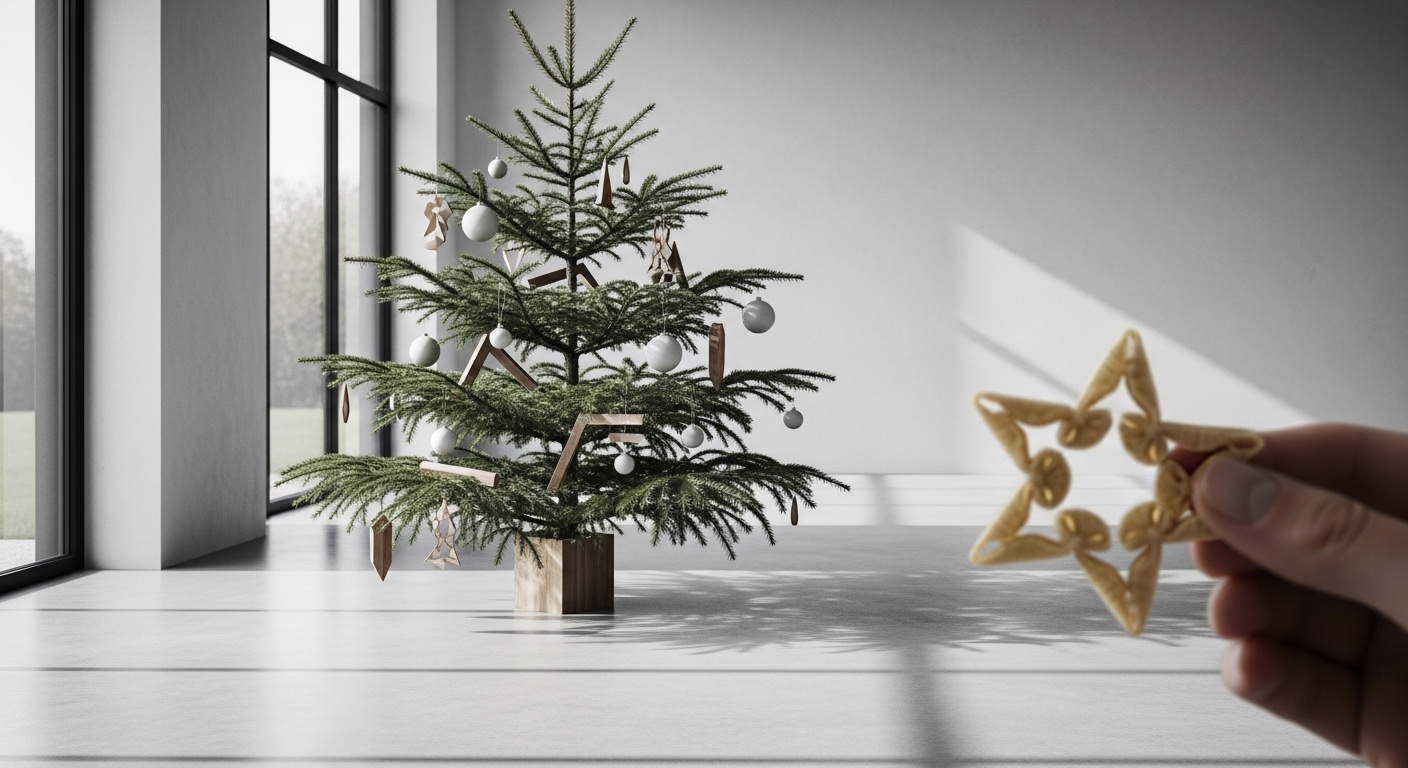
The film's visual identity is a study in contrasts. The primary world of the home is rendered with a static, architectural precision. We will employ wide, locked-off frames that emphasize the rigid geometry of the space—the polished concrete walls, the poured resin floors, the severe angles of the Danish furniture. The color palette is a tightly controlled spectrum of neutrals: oyster, fog, overcast grey, bone. Lighting is cool, diffuse, and often sourced from hidden architectural LEDs, mimicking the blue light of a screen or an Arctic twilight. This creates a sense of a showroom, a space not meant for living but for being observed. In stark contrast, the "Legacy Box" and its contents are shot with a warmer, more intimate camera. Here, we use gentle handheld movements and shallow depth of field, focusing on the textures of memory: the chipped paint on a wooden soldier, the imperfect glitter on a macaroni star, the greasy sheen on an old glass pickle. These objects, when they appear in the sterile main environment, are treated like alien artifacts, pops of saturated, chaotic color that the desaturated world of the house tries, and fails, to reject.
Tone & Mood
The film's emotional rhythm is a symphony of stillness, a slow-burn tragicomedy where the laughs are born from quiet desperation. The tone is meticulously balanced between wry, observational satire and a deep, aching melancholy. The humor is found not in punchlines, but in the absurdity of Julianne's aesthetic jargon clashing with the simple, human desires of her family—a battle between "textural warmth without chromatic distraction" and a child wanting to hang a pickle ornament. The mood is one of quiet suffocation, the feeling of holding one's breath in a perfectly designed room. Yet, beneath the oppressive calm, there are sparks of warmth and rebellion. The scraping sound of a cardboard box, the crinkle of old wrapping paper, or the genuine smile of a child become revolutionary acts, creating a delicate tension that builds from a quiet hum to a resonant, emotional chord.
Themes & Cinematic Expression
The central theme is the tyranny of perfection and the conflict between a curated identity and the authentic, messy self. This is expressed cinematically through the visual war between the house's minimalist design and the kitsch of the "XMAS JUNK." Julianne’s obsession with "visual silence" is a metaphor for her desire to erase the chaotic, unpredictable nature of life and memory. The sound design will amplify this; the house is acoustically treated to be dead, absorbing sound, while the objects from the past—the rattling box, the tearing tape—are jarringly, beautifully loud. We explore the commodification of joy, where concepts like Danish "hygge" are not felt but performed for a photo, a hollow ritual devoid of genuine contentment. Ultimately, the film argues that true sanctuary is not found in a void, but in the cluttered, imperfect spaces where memories are allowed to live, breathe, and shed a little glitter on the floor.
Character Arcs
Julianne
Julianne is the architect of her family's beautiful prison. She operates from a place of deep-seated fear—a fear of chaos, of imperfection, of a past defined by a lack of control that we will come to understand. Her flawless home is her armor. Her personality is rigid, her language a series of design-blog buzzwords that she uses to intellectualize her emotional detachment. Her fatal flaw is her belief that she can curate a perfect life, mistaking aesthetic control for emotional well-being. Her arc begins with her in command, directing the "Arctic Dusk" lighting scheme. The introduction of the "Legacy Box" is an assault on her carefully constructed reality. Through the escalating acts of quiet rebellion from her family, she is forced to confront the profound emptiness her perfection has created. Her journey is not one of dramatic transformation, but of a subtle, painful cracking of her facade. She will not suddenly embrace the mess, but by the end, she will learn to tolerate a single, hidden pickle—a quiet acknowledgment that a home needs a secret heart more than it needs visual silence.
David
David is a man living in the past because his present is so inhospitable. He begins the story as resigned and passively rebellious, using gin and cynical commentary as his only weapons. His personality is warm but suppressed, worn down by years of aesthetic compromise. His flaw is his passivity; he has allowed Julianne's vision to completely erase his and his children's identity from their own home. His arc is a journey from quiet complicity to active, albeit stealthy, emotional preservation. Spurred by his daughter Sophie’s simple, powerful desire for a "real" Christmas, he moves from hiding an ornament in his pocket to being the guardian of his family's collective memory. He fights not for control, but for the right to have a memory that hasn't been "digitized," a joy that hasn't been color-corrected. His victory is small but profound: ensuring the tree has a soul, even if it's one only he knows is there.
Sophie & Ethan
Sophie, at eight, is the story's unwavering moral compass. She is not on an arc of change but is the agent of change for others. She represents pure, uncurated life—a splash of purple in a grey world. She is the keeper of the "headless baby Jesus" and the macaroni star, talismans of genuine feeling. Ethan, her teenage brother, begins as a cynical product of his environment, disconnected and seeking escape in the digital world. His headphones are his shield from the oppressive silence. His arc is one of slow re-engagement. Witnessing his father's and sister's small rebellions, he begins to see the absurdity of his mother's rules. His journey takes him from muttering "It looks like a cage" to perhaps actively participating in the final, quiet act of family connection, choosing the imperfect reality over his scheduled virtual raid.
Detailed Narrative Treatment (Act Structure / Episodes)
Act I
We are introduced to the pristine, minimalist world of the Miller family. JULIANNE is preparing for what she calls "The December Installation," her term for Christmas. The pressure is on, as she is expecting a photographer from an elite design magazine to feature their home. The entire family—a weary DAVID, a disengaged ETHAN, and a vibrant SOPHIE—moves through the house like well-designed furniture. The inciting incident is the arrival of the terrifyingly expensive Norwegian fir. Julianne’s plan for decorating it is a clinical procedure involving a palette of grey, white, and the abstract concept of "void." The tension builds until David, prodded by Sophie's disappointment, retrieves the "Legacy Box" from the basement. This leads directly to the key scene from our source material: the surgical decoration of the tree, the battle between concrete spheres and a glass pickle, the forced "hygge" family photo, and the small, defiant act of Sophie hanging the macaroni star. The act ends with David's secret mission to hang the pickle, establishing the film's central conflict: a quiet war for the soul of the family.
Act II
The rebellion, sparked by the ornaments, begins to grow. The "guests"—the magazine photographer and editor—are due to arrive for a perfectly curated Christmas Eve dinner. David and the children begin small acts of aesthetic sabotage: Sophie uses a brightly colored, hand-drawn placemat; Ethan wears a band t-shirt instead of the prescribed linen; David opens a bottle of cheap, screw-top red wine instead of the sommelier-approved Pinot Noir. Julianne's composure frays as she struggles to maintain the illusion of effortless perfection for her guests. The dinner is a masterclass in passive aggression, with Julianne's design jargon being continually punctured by her family's simple, honest humanity. The midpoint shift occurs when Sophie, asked by the editor what her favorite thing about the house is, gleefully describes the secret, messy "real Christmas" she and her dad have been building in a corner of the basement, complete with tinsel and the headless baby Jesus. Mortified, Julianne finds an excuse to get away. The "All Is Lost" moment follows as she descends into the basement to discover this hidden sanctuary of kitsch. It is everything she has fought against: chaotic, colorful, and joyous. She doesn't yell; instead, she quietly, devastatingly, begins to pack it all away in a black garbage bag, her face a mask of cold fury. The family watches, heartbroken.
Act III
Christmas morning. The house is colder and quieter than ever. The magazine feature is implicitly ruined. David, Ethan, and Sophie are huddled together, defeated. Julianne sits alone in the living room, staring at the perfect tree. It is complete, balanced, and utterly lifeless. Her victory feels hollow. Her gaze lands on the one ugly, defiant object she allowed: the macaroni star. She walks over, intending to finally remove it. As she reaches for it, she sees something else tucked deep inside the branches—the green glass pickle. She pulls it out, and the memory hits her: the petrol station, the laughter with David years ago, a time before their life became an exhibition. It's a profound, emotional crack in her armor. She doesn't put the pickle back on the tree. Instead, she walks to the basement, where her family is sitting in silence. She says nothing, but places the pickle on the table in front of David. She then leaves and returns with a box of store-bought pastries—slightly crushed and imperfect. It's an offering, a truce. The final scene is not a joyful Christmas celebration, but something more real: the four of them, sitting together in the cluttered basement, quietly sharing a pastry, having abandoned the perfect tree upstairs for a moment of genuine, messy connection.
Episode/Scene Beat Sheet (Source Material)
1. The Subject: Julianne evaluates the expensive, "spiritually dead" Christmas tree in her sterile, minimalist living room.
2. The Diagnosis: She declares the tree's symmetry is "off" and needs pruning, much to her husband David's tired dismay.
3. The Theme: Julianne plans the "Arctic Dusk" lighting scheme, a cold, blue-toned concept, contrasting with last year's failed "Industrial Dawn."
4. The Inciting Object: David reveals that Sophie is retrieving the "Legacy Box," a container of old, messy Christmas ornaments, which horrifies Julianne.
5. Aesthetic Conflict: Julianne argues that displaying memories "disrupts the visual flow," while David counters that it's Christmas and their daughter wants to participate.
6. The Artifacts Arrive: Sophie enters, dragging the "XMAS JUNK" box, its scraping sound a "beautiful, jagged noise" in the silent room. She triumphantly announces she has found the "baby Jesus with the missing head."
7. The Procedure Begins: Julianne ignores the old ornaments, unveiling her approved decorations: grey, concrete spheres and other minimalist shapes. She assigns roles for a surgical decorating procedure.
8. The Pickle: Sophie finds the "hideous" and "beautiful" green glass pickle ornament, which Julianne immediately rejects for not being "consistent with the palette." David secretly pockets it.
9. The Surgical Decoration: The family places the approved ornaments under Julianne's precise, critical direction. Ethan complains that a "felted wool teardrop" is just a "ball of fuzz."
10. The Topper: Julianne reveals the tree topper: not a star, but a sharp, brass, geometric "spire" that Ethan observes "looks like a cage." It's heavy and makes the tree's leader branch sag.
11. The Tableau: The decorating is complete. The tree is elegant, tasteful, and "utterly, profoundly depressing."
12. The Ritual: The family changes into matching linen shirts for a forced, "hygge"-inspired family photo, a documentation of their curated contentment.
13. The Plea: After the photo, Julianne orders Sophie to put the "junk" away. Seeing Sophie’s crushing disappointment, David pleads with Julianne to let her hang just one ornament on the back of the tree.
14. The Concession: Julianne reluctantly agrees, stipulating it must be hidden.
15. The Defiant Act: Sophie hangs the garish, yellow macaroni star not on the back, but on the side—a visible flaw in the perfect composition. Julianne whispers that it's "hideous" but does not remove it.
16. The Secret Heart: Later that night, David comes downstairs and secretly hangs the green glass pickle deep within the tree's branches, an invisible core of warmth.
17. The Glimmer of Hope: As he leaves, David catches a reflection of the macaroni star in the window, glowing like "real gold, warm and messy and alive" in a passing car's headlights.
Creative Statement
The Nordic Concept is a story for anyone who has ever felt the immense pressure to project a perfect life, who has scrolled through meticulously curated images and felt their own reality was somehow lacking. It’s a film that asks what we lose when we sacrifice authenticity for aesthetic. This story matters now more than ever, in an age where our homes, our holidays, and even our memories are being rebranded as content for public consumption. By trapping a family inside a literal manifestation of a design blog, we explore the profound, often comedic, and ultimately tragic consequences of prioritizing appearance over feeling. The intended impact is to make the audience laugh at the absurdity of it all, but also to feel the deep, universal ache for genuine connection. This film is a defense of the "XMAS JUNK" in all our lives—the messy, imperfect, glitter-shedding objects and memories that, in the end, are the only things that truly make a house a home.
Audience Relevance
Contemporary audiences are acutely aware of the performance of everyday life. The Nordic Concept taps directly into this zeitgeist, satirizing the "Instagrammable moment" and the tyranny of the minimalist aesthetic. The film's themes are universal and deeply resonant: the struggle between parents and children, the tension between tradition and modernity, and the search for authentic joy in a world that increasingly values a filtered version of it. Viewers will recognize Julianne's obsessive quest for perfection in their own lives, whether in the form of a Pinterest-perfect party or a flawless social media post. By grounding this high-concept satire in a relatable family drama, the film provides a powerful emotional hook. Audiences will root for David's quiet rebellion and Sophie's innocent defiance, finding catharsis in their small victories against an oppressive and ridiculous standard of living. It’s a story that validates the beauty of our own imperfect, cluttered, and wonderful lives.
Share This Treatment


