The Four AM Transit Schedule
Format: Short Film / Anthology Episode | Est. Length: 10-12 minutes
Logline
A former getaway driver, now living a quiet life of penance as a night-shift bus driver, is forced to confront his violent past when a wounded former associate stumbles onto his bus with a bag of money and killers in close pursuit.
Themes
* The Inescapable Past: No matter how much one tries to reinvent themselves, the consequences and connections of a past life will eventually find them.
* Redemption vs. Instinct: The conflict between a conscious desire for a quiet, moral life and the deeply ingrained, amoral instincts required for survival.
* The Illusion of Control: The belief that a structured, mundane routine can protect one from the chaos of the world is fragile and easily shattered.
* The Unseen Observer: The idea that even in moments of perceived solitude and crisis, we are being watched and judged by unknown forces.
Stakes
Shiro risks losing not only his life but also the quiet, anonymous existence he has painstakingly built as a form of penance for his past crimes.
Synopsis
SHIRO, a man seeking refuge from a high-octane criminal past, drives the Number 14 bus loop on the graveyard shift. He finds a quiet, hypnotic peace in the predictable schedule and the solitude of navigating the deserted city streets before dawn. This mundane existence is his self-imposed penance.
His fragile peace is shattered when KENNY O'CONNELL, a wounded and desperate associate from his former life, stumbles onto the bus. Clutching a bleeding side and a heavy duffel bag, Kenny pleads with Shiro to divert from his route and get him to the docks, offering him a cut of the money for a "new life." Shiro, clinging to his new identity, flatly refuses.
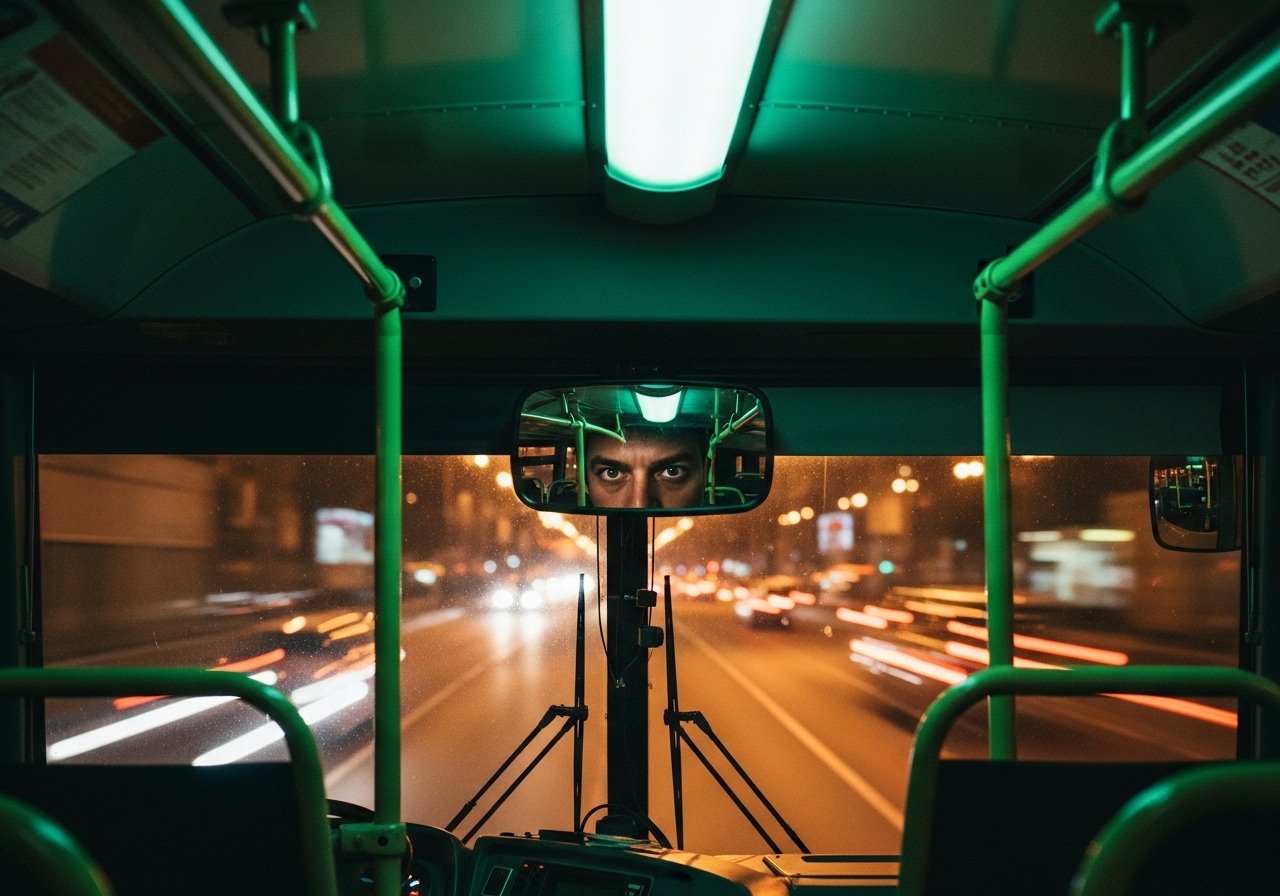
The decision is taken out of his hands when he spots a menacing black car in his rearview mirror—the pursuers Kenny has brought to his door. The cold, familiar calculus of an escape floods his mind, overwriting the transit schedule. As the situation escalates, Shiro notices the only other passenger, a calm and enigmatic woman named NANA, who gives him a subtle, permissive nod.
Forced to act, Shiro’s dormant instincts as a getaway driver roar to life. He violently swerves the unwieldy bus off its route, initiating a desperate chase through narrow side streets. He uses the bus's size to his advantage, culminating in a high-impact maneuver where he wedges the vehicle into a narrow rubbish alley, completely blocking the pursuers.
Shiro drags Kenny out the back door and they escape into a pedestrian tunnel. As they disappear into the darkness, Shiro glances back to see Nana stepping calmly off the bus. Unfazed, she watches them go before turning and walking away into the pre-dawn gloom, leaving her identity and motives a complete mystery.
Character Breakdown
* SHIRO (40s): A former expert getaway driver, now a stoic, weary bus driver. He is disciplined and controlled, seeking redemption through monotony and anonymity. Beneath his calm exterior lies a core of lethal competence and instinct, which he actively suppresses until forced to use it.
* Psychological Arc:
* State at Start: Believes he has found peace and control through a monotonous, solitary existence, actively burying his past self.
* State at End: Forced to accept that his past is inescapable and his core survival instincts are unchanged. His carefully constructed world is shattered, leaving him back in a state of uncertainty and danger, but with his formidable skills reawakened.
* KENNY 'THE WEASEL' O'CONNELL (40s): A desperate, impulsive, and perpetually unlucky low-level criminal. He is the catalyst for the story's action, a living embodiment of the chaotic past Shiro tried to escape. He operates on pure, panicked instinct.
* NANA (50s): The Observer. Poised, intelligent, and unnervingly calm. Her tailored coat and sharp features suggest she is more than just a random passenger. She is an enigma whose silent, analytical presence and subtle nod of approval add a layer of mystery and external judgment to Shiro's crisis.
Scene Beats
1. THE SANCTUARY: The 4 a.m. bus glides through empty, sodium-lit streets. Inside, Shiro is a picture of calm, finding solace in the rhythmic, predictable routine of his job.
2. THE GHOST ARRIVES: The doors hiss open at a deserted stop. Kenny, bleeding and panicked, stumbles on, collapsing into a seat behind Shiro with a heavy duffel bag. The past has boarded the bus.
3. THE REFUSAL: Kenny pleads for an escape to the docks, offering a share of the money. Shiro coldly refuses, stating he just drives his route. He will not deviate.
4. THE CHOICE IS MADE: In the rearview mirror, Shiro spots them: a black saloon, headlights cutting through the dark, moving with purpose. They were waiting. The choice is no longer his.
5. THE PERMISSION: Shiro’s eyes meet Nana’s in the mirror. She looks up from her book, her gaze analytical. She gives a subtle, almost imperceptible nod.
6. THE ROUTE IS CANCELLED: Shiro slams the accelerator and wrenches the wheel. The bus screams off its designated route into a narrow side street. The old instincts take over completely. The chase is on.
7. THE WHALE AND THE SHARK: The nimble car stays on their tail. Shiro uses the bus's bulk as a weapon, side-swiping obstacles and creating chaos.
8. THE DEAD END: Shiro makes a split-second decision, forcing the massive bus into an impossibly narrow rubbish alley. Metal shrieks and sparks fly as the bus wedges itself between two brick buildings, creating an impassable roadblock.
9. THE ESCAPE: Shiro grabs Kenny and kicks open the rear emergency door. They stumble out onto a different street and flee into the darkness of a pedestrian tunnel.
10. THE OBSERVER DEPARTS: Shiro looks back one last time. Nana steps calmly from the wedged bus. She surveys the scene without panic, then turns and walks away in the opposite direction, disappearing into the gloom.
Visual Style & Tone
The visual style is grounded neo-noir, characterized by high-contrast lighting. The warm, isolating glow of sodium streetlights cuts through deep, oppressive shadows. The interior of the bus is bathed in a sickly, greenish fluorescent hum, creating a claustrophobic and tense atmosphere. Camera work will be steady and observational at the start, transitioning to kinetic, jarring, and visceral handheld shots during the chase to place the audience directly in the action.
The tone is tense, atmospheric, and gritty. It begins with a weary melancholy and builds rapidly to explosive, contained action. The dialogue is sparse and functional. Tonally, it combines the contained, single-location suspense of Locke with the sudden, professional violence of Michael Mann's Collateral. The self-contained, high-concept nature aligns with episodes of anthology series like Black Mirror or Love, Death & Robots.
Share This Treatment


