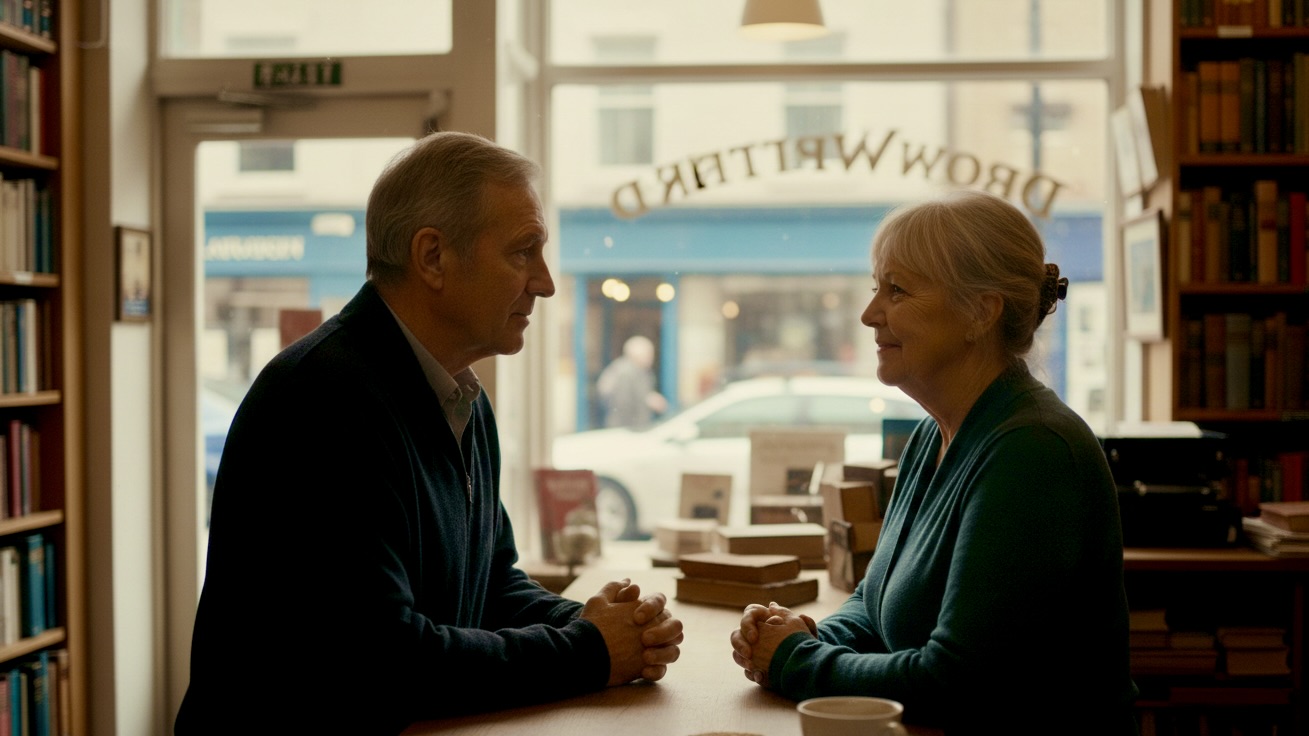
Summer Street Blues
Format: Short Film / Anthology Episode | Est. Length: 10-12 minutes
Logline
In a world fraying with casual hostility, a grieving widower hiding in a quiet bookstore finds an unexpected flicker of human connection, forcing him to choose between cynical resignation and the fragile hope of starting anew.
Themes
* The Erosion of Civility: The story explores a world where common courtesy has been replaced by casual aggression and public confrontations, questioning whether this is a new phenomenon or simply the ugly truth now unmasked.
* Connection Amidst Alienation: In an age of digital megaphones and societal division, the film highlights the profound power of small, quiet, face-to-face interactions to create sanctuary and combat loneliness.
* Grief as a Lens: The protagonist’s recent loss colors his entire perception of the world, making him hyper-aware of decay and conflict. His journey is about learning to see past the cracks his grief illuminates.
* Quiet Defiance: The act of maintaining a bookstore, fixing a leaky faucet, or simply offering a cookie becomes a small but potent act of rebellion against a tide of overwhelming negativity and noise.
Stakes
At stake is Art's chance to overcome the crushing weight of his grief and cynical despair, and find a reason to reconnect with the world before he is lost to it completely.
Synopsis
ART, a quiet widower in his 60s, sits in 'The Written Word,' a struggling independent bookstore that has become his daily refuge since his wife's death. He, the weary owner BETTY, and a cynical regular, CARL, watch as a petty road rage incident unfolds on the sweltering street outside. Their conversation reflects a shared exhaustion with the world's increasing lack of civility and the performative outrage fueled by the internet.
The tension of the outside world is punctuated by a small act of kindness inside: Betty places a plate of shortbread cookies on the counter for Carl, on the house. This simple gesture triggers a sharp, poignant memory for Art of his late wife, Martha, baking the same cookies. It's a quiet reveal of the deep grief that underpins his withdrawn nature and pessimistic worldview.
After the street argument fizzles out, Carl departs with a surprisingly gentle piece of advice for Art and Betty to "take care of each other." Left in the quiet afternoon stillness, the professional barrier between Art and Betty dissolves. He asks her if she ever considers giving up on the bookstore, a question that opens the door to a rare moment of shared vulnerability. She admits she thinks about it every day. Art, in turn, confesses that since Martha's death, all he can see are the "cracks" in the world. Betty’s gentle response—that cracks are easier to see than new foundations—lands with profound weight. The exchange culminates in a shared, genuine smile, a flicker of warmth that cuts through Art's long-held melancholy. The story ends on this quiet, hopeful beat, as Art hesitates, implicitly deciding to stay, suggesting the beginning of a new connection and the first step out of his self-imposed isolation.
Character Breakdown
* ART (60s): A recently widowed man, observant, gentle, and steeped in a quiet melancholy. He was a "builder," but the loss of his wife, Martha, has shattered his foundation, leaving him a passive observer of a world he finds increasingly ugly and fractured. He is kind but shrouded in a deep resignation.
* Psychological Arc: Art begins as a passive observer, using the bookstore as a physical and emotional shield against a world he no longer feels a part of, his grief acting as a filter that only lets in the negative. By the end, through his vulnerable interaction with Betty, he transitions into a potential participant, taking a small but significant step towards re-engagement and allowing a glimmer of hope to penetrate his armor of cynicism.
* BETTY (50s-60s): The pragmatic, tired, but resilient owner of 'The Written Word.' She is the quiet anchor in the story's chaotic world, maintaining a small bastion of civility against overwhelming odds. Her weariness is palpable, but it's matched by a deep-seated stubbornness and a well of empathy she reveals only in quiet moments.
* CARL (70s): A crusty, sharp-tongued regular who functions as the story's unfiltered id. He’s a self-proclaimed cynic who believes the world is going to hell, yet his gruff exterior hides a pragmatic, almost paternal kindness. He complains about the world but still participates in it by fixing what's broken, one leaky faucet at a time.
Scene Beats
1. THE INCIDENT: From the sanctuary of a quiet bookstore, ART watches a petty road rage argument escalate on the hot summer street. He, BETTY, and CARL offer a cynical running commentary on the death of civility.
2. THE COMMENTARY: Carl posits that people haven't gotten worse, they've just "stopped pretending." The conversation touches on the anger and division amplified by the internet.
3. A SMALL KINDNESS: In stark contrast to the ugliness outside, Betty wordlessly gives Carl a free shortbread cookie.
4. THE MEMORY: The cookie triggers a painful, warm memory for Art: his late wife, MARTHA, baking. We understand the true source of his sadness.
5. THE DEPARTURE: The street argument dissipates. Carl leaves, but not before delivering a surprisingly tender piece of advice: "Take care of each other."
6. THE QUESTION: The bookstore is now quiet. Art breaks the silence, asking Betty if she ever thinks about "packing it in."
7. THE CONFESSION: They share a moment of raw honesty. Betty admits she thinks of quitting every day. Art confesses that since his wife died, all he can see are the "cracks" in everything.
8. THE CONNECTION: Betty offers a profound, gentle counterpoint: "Cracks are easier to spot than the new foundations." The words land, shifting something in Art.
9. THE SMILE: For the first time, Art musters a genuine, unforced smile. It feels foreign but good. A silent understanding passes between them.
10. FINAL IMAGE: The afternoon sun streams through the window. Art holds his empty coffee cup, contemplating his next move. He looks at Betty, and in his eyes, we see the flicker of a new beginning. He decides to stay.
Visual Style & Tone
The style is naturalistic and observational, creating a strong contrast between the world inside and outside the bookstore.
* Exterior: The street scenes will be shot with a slightly harsh, over-exposed light, emphasizing the oppressive August heat and the raw, unfiltered nature of the confrontations. The sounds are sharp and jarring: car horns, shouting, sirens.
* Interior: 'The Written Word' is a sanctuary. The lighting is warm, soft, and dusty, filled with shafts of afternoon sun that illuminate floating dust motes. The camera will be more intimate and often static, focusing on small, tactile details: the worn grain of the wooden tables, the condensation on a glass, the faded spines of old books, the fine lines around Betty's eyes.
The overall tone is contemplative, melancholic, and deeply humanist, finding grace in the mundane. It’s a quiet, character-driven piece that seeks emotional truth over dramatic plot. The film's quiet observation of societal decay and the search for meaning aligns with the grounded realism of films like The Station Agent or Paterson, while its underlying commentary on modern alienation and the search for authentic connection shares a thematic thread with a grounded, character-focused episode of Black Mirror.
Share This Treatment


