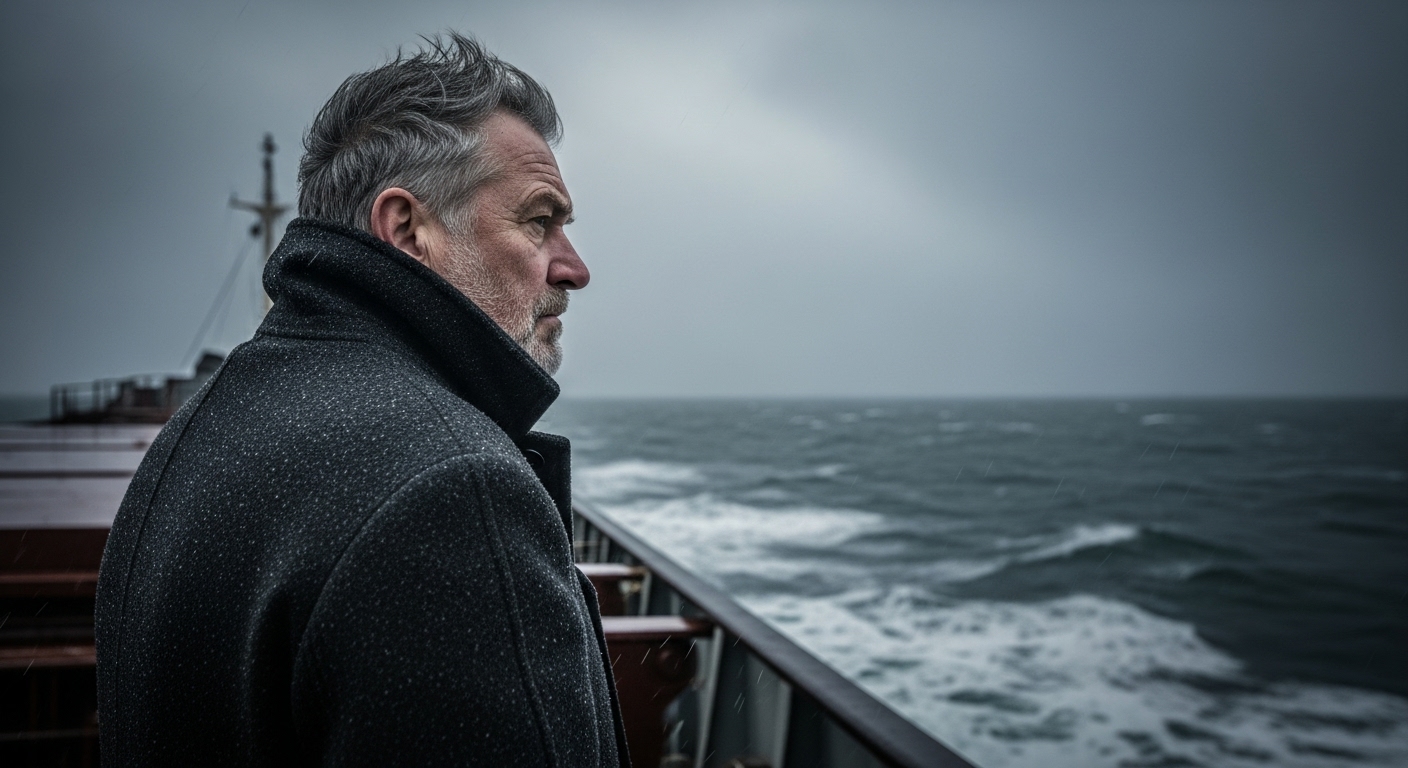
Horizon's Soft Blur
Format: Short Film / Anthology Episode | Est. Length: 10-12 minutes
Logline
An aging sea captain on his final voyage confronts the dissolution of his identity as he prepares to hand over command, discovering that the vast, unknown shore may be more daunting than any storm he's ever faced.
Themes
* The Loss of Identity in Retirement: Explores how a life defined by a singular, all-consuming profession unravels when that role is stripped away, leaving a void of purpose.
* The Inevitable Passage of Time: The story is a meditation on aging, physical decline, and the quiet, unceremonious end of an era for a man who has become one with his environment.
* Mentorship and Legacy: The quiet, weighty transfer of responsibility from an old guard to the next generation, and the hope and burden that legacy entails.
* The Fear of the Unknown: The protagonist's conflict is not with the sea he knows, but with the unfamiliar and seemingly treacherous "currents" of a life on land he has long since abandoned.
Stakes
At stake is Captain Evans's entire sense of self, forged over a lifetime at sea, and his ability to find meaning in a future where he is no longer defined by his work.
Synopsis
On the bruised, cold expanse of the North Sea, Captain Evans stands on the deck of the Seawatcher, the ship that has been his life for forty years. Today is his last day. The constant ache in his bones and the fatigue in his eyes are undeniable signs that his time is over. He is a man inextricably linked to his vessel, feeling its every thrum and shudder as if it were his own heartbeat.
On the bridge, a quiet tension hangs in the air between Evans and his young, capable First Mate, Natan, who is set to take command. Through their sparse, weighted dialogue, Evans’s gruff resignation and Natan’s respectful apprehension become clear. Evans deflects any hint of pity, asserting that the ship will be fine without him, even as he internally grapples with the feeling of becoming a ghost on his own vessel.
A fleeting memory of his first terrifying, exhilarating storm as a boy contrasts sharply with his current weariness. The sea was once a calling, an immense power he bonded with; now, it is simply the backdrop to his departure.
The moment of transition is simple and profound. Evans gives Natan his final charge, an unspoken promise is passed between them with a firm handshake, and Evans walks away from the helm for the last time. Stepping out onto the wing of the ship, he watches the Seawatcher—his life's work and sole purpose—sail away into the darkening horizon. The relief of shed responsibility is immediately replaced by a chilling, disquieting realization: he is not just leaving the sea, but stepping into an equally vast and more terrifying unknown.
Character Breakdown
* CAPTAIN EVANS (60s): A career seaman, weathered by decades of storms and solitude. His hands are calloused, his face a map of his years on the water. He is stoic, proud, and deeply tired, masking his vulnerability with a gruff, humorless exterior. The ship is an extension of his own body; leaving it is a form of amputation.
* Psychological Arc: Evans begins the story in a state of quiet resentment and denial, clinging to the last vestiges of his authority while feeling his identity as "Captain" already slipping away. By the end, he accepts the inevitable and formally passes the mantle, but this acceptance does not bring peace. Instead, it unmoors him, replacing the familiar weight of command with a profound and terrifying sense of purposelessness as he faces a future on land he no longer understands.
NATAN (30s): First Mate of the Seawatcher*. Capable, respectful, and observant. He holds a deep, quiet reverence for Evans but also feels the weight of the command he is about to inherit. He represents the future, the continuation of the cycle, and serves as the catalyst forcing Evans to confront his own departure.
Scene Beats
1. ON DECK - THE LAST WATCH: Evans stands alone on deck, gripping the cold brass railing. The wind, the salt spray, the thrum of the engines—it's all a part of him. We establish his age, his weariness, and his forty-year bond with the sea. The horizon is a soft blur, a metaphor for his uncertain future.
2. THE BRIDGE - UNSpoken TENSION: The bridge is quiet. Natan, his replacement, confirms preparations. The dialogue is sparse but heavy. Natan’s attempt to honor Evans's legacy is met with a gruff deflection. "There's always another hand to grip the wheel." Evans feels like a ghost already.
3. MEMORY - THE FIRST STORM: A brief, visceral flashback. A seventeen-year-old Evans, terrified but exhilarated, on a trawler in a gale. We see the raw power that called him to this life, contrasting sharply with the tired man he is today.
4. THE HANDOVER - PASSING THE MANTLE: Evans’s gaze is fixed on the horizon where sea meets sky. He gives Natan his final piece of advice, a quiet acknowledgment of the younger man's readiness. "You'll keep her true." It is a formal transfer of command and trust.
5. THE FAREWELL - THE FINAL HANDSHAKE: Evans turns from the helm for the last time. He and Natan share a firm, meaningful handshake. "Fair winds, Captain." It is the last time Evans will hear that title applied to him. He offers a final, cryptic warning about the sea's nature before leaving the bridge.
6. ON THE WING - UNMOORED: Evans stands alone on the ship's wing as the Seawatcher continues its journey, leaving him behind. He watches the vessel shrink into the vastness. The cold he feels is not from the wind, but from the sudden, terrifying void of a life without purpose. The land is now the great unknown.
Visual Style & Tone
The film will have a naturalistic and atmospheric aesthetic. The color palette will be desaturated and cool, dominated by the blues and greys of the North Sea and the bruised plum of the twilight sky, reflecting Evans's melancholic internal state.
Cinematography will be intimate and subjective, using handheld or stabilized shots that stay close to Evans, capturing the textures of his worn gloves, the weathered brass, and the lines on his face. Wide, static shots will be used to emphasize the immense, indifferent scale of the ocean, dwarfing the man and his vessel.
Sound design is critical. The constant, visceral sounds of the ship—the low thrum of the engine, the creak of the hull, the lash of the wind—will form a living soundscape that represents Evans's world. This soundscape will slowly fade in the final scene, replaced by an unsettling quiet as he watches his life sail away.
The tone is contemplative, melancholic, and deeply human, focusing on internal struggle over external conflict. It aligns with the quiet character studies of films like Nomadland or the theme of facing finality explored in The Old Man & the Gun.
Share This Treatment


