All Our Tinfoil Gods
Format: Short Film / Anthology Episode | Est. Length: 10-12 minutes
Logline
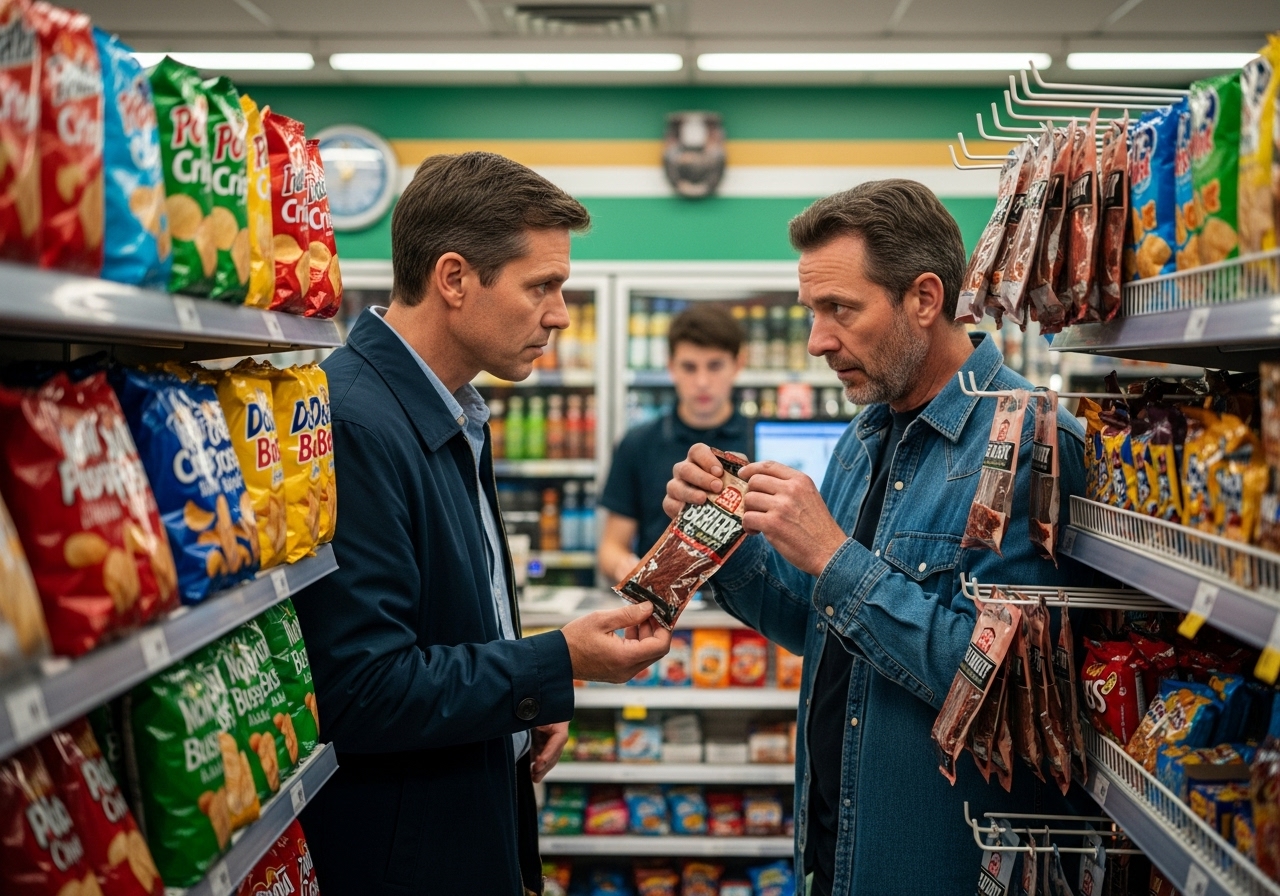
In a desolate late-night convenience store, two rival conspiracy theorists, each believing the other is a government agent, engage in a silent battle of wits and paranoia over the last bag of beef jerky.
Themes
* Perception vs. Reality: The characters’ paranoid worldviews transform a mundane encounter into a high-stakes espionage thriller, highlighting the subjective nature of truth.
* The Echo Chamber of Belief: How deeply held, niche beliefs can isolate individuals and make them see enemies everywhere, even in those who are fundamentally similar.
* The Comedy of Paranoia: The absurdity and humor that arise when the gravitas of a spy film is applied to the most ordinary of situations and conflicts.
* Projection and Pride: The characters project their own fears and narratives onto one another, leading to a stalemate where saving face becomes more important than survival.
Stakes
At stake is the characters' ability to validate their solitary worldviews and maintain a sense of control, where losing a simple bag of jerky represents a catastrophic mission failure at the hands of "the enemy."
Synopsis
In a remote, fluorescent-lit convenience store, DALE watches a man in a security mirror. She identifies him as a government agent from PSYOP, sent to monitor her research into subterranean reptilian financiers. The man, GARY, simultaneously identifies Dale as a known disinformation agent tasked with discrediting his own vital research into Sasquatch migration patterns.
Their paths converge in the snack aisle, where they engage in a tense, coded conversation under the guise of small talk. Their verbal sparring, filled with double-entendres about "geological surveys" and "fossils," is a battle to unmask the other's true purpose.
The conflict crystallizes over the last bag of teriyaki beef jerky—a high-value provision essential to both of their "missions." What begins as a strategic standoff escalates into a gentle but firm tug-of-war over the bag. To them, this is not about a snack; it is about sabotage, resource denial, and psychological dominance.
The spell is broken by the store's oblivious teenage clerk, KEVIN, who asks if they're going to buy the jerky or "just pet it." Shamed by the intrusion of reality, they drop the bag. A cold truce is reached. Driven by pride, both feign magnanimity, insisting the other take the prize while lying about having ample supplies.
Ultimately, Dale breaks the stalemate. She picks up the jerky, pays for it, and gives Gary a parting look that promises their conflict is far from over. Left defeated, Gary asks the clerk if there are any more in the back. There aren't. He is left alone, staring into the desert night, his paranoia now focused on a specific, victorious adversary.
Character Breakdown
* DALE (40s): Intense, hyper-vigilant, and utterly convinced she is on the verge of exposing a vast conspiracy involving reptilian elites controlling global markets. She is practical, resourceful, and sees complex government plots in the most mundane actions.
* GARY (40s): Equally paranoid but with a focus on cryptozoology. He believes he is a genuine researcher tracking Sasquatch through esoteric means and sees Dale as a government plant sent to flood his field with nonsense to discredit him. He attempts a "folksy" demeanor as a clumsy cover.
* KEVIN (Late Teens): The convenience store clerk. Completely absorbed in his phone, he is the anchor to the mundane world. His profound indifference to the high-stakes drama unfolding in his store serves as the story's primary source of comedic irony.
Psychological Arc (Dale & Gary)
* State at Start: Both characters are isolated in their deeply held convictions, confident that they alone perceive the world's true, hidden machinations. Their enemy is a vast, faceless "they"—a shadowy government agency or cabal.
* State at End: Their convictions are not challenged but reinforced and focused. The abstract enemy has been given a face. They leave not with resolution, but with a newly defined, personal adversary, transforming their solitary crusades into an intimate cold war.
Scene Beats
1. THE OBSERVATION: In the starkly lit convenience store, Dale watches Gary's reflection in a security mirror. Her internal thoughts reveal her belief that he is a "Section 4" agent sent to monitor her research into reptilian financiers.
2. THE COUNTER-OBSERVATION: The perspective shifts to Gary. He recognizes Dale from online forums as "LizardTruth62," a disinformation agent on the "Majestic 12" payroll, and fears she is there to sabotage his Sasquatch research.
3. THE ENGAGEMENT: Gary approaches Dale, initiating a conversation laced with paranoid subtext. Their exchange about the weather, "geological surveys," and "fossils" becomes a duel of double meanings.
4. THE OBJECTIVE: The conflict centers on the last bag of teriyaki jerky. Both characters identify it as a critical supply for their respective missions, and their hands hover near it, creating a palpable standoff.
5. THE GAMBIT: The verbal sparring escalates into a physical, yet silent, tug-of-war over the bag of jerky. Their eyes are locked in a battle of wills, each interpreting the struggle as a direct act of sabotage.
6. THE INTERRUPTION: Kevin, the clerk, looks up from his phone and obliviously breaks the tension with a bored comment, shattering their clandestine reality. They drop the jerky as if it's electrified.
7. THE STALEMATE: In a show of false magnanimity born of pride, both Dale and Gary insist the other take the jerky, each lying about having other supplies. Neither will concede by taking it.
8. THE RESOLUTION: Dale breaks the stalemate. She picks up the bag, pays in cash, and gives Gary a look that promises future conflict.
9. THE AFTERMATH: Defeated, Gary asks Kevin if there is any more jerky in the back. The answer is a flat "no." Gary stares out into the night, the sting of his first loss fresh, his new enemy clearly defined.
Visual Style & Tone
The visual style will employ the high-contrast lighting and deliberate framing of a noir thriller, juxtaposed with the mundane, fluorescent-lit reality of a 24/7 convenience store. The camera will use tight close-ups on faces to capture micro-expressions of suspicion, and on objects—the jerky, the security mirror—to imbue them with immense significance. Reflections will be used heavily to emphasize the themes of surveillance and distorted perception.
The tone is a deadpan, paranoid dark comedy. The dialogue and performances are delivered with the absolute gravity of a Cold War spy film, while the context remains absurdly low-stakes. The humor arises not from jokes, but from the unwavering seriousness with which the characters treat their delusional conflict. Aligns with the contained-thriller aspect of Coherence, the paranoid dark comedy of a Coen Brothers film like Burn After Reading, and the thematic exploration of belief systems found in episodes of Black Mirror.
Share This Treatment


