A Concordance of Birds
Format: Short Film / Anthology Episode | Est. Length: 10-12 minutes
Logline
A young, highly disciplined operative, posing as a bored child in a desolate museum, must execute a high-stakes dead drop, but his meticulously rehearsed mission is upended by the arrival of a ruthless counter-agent who sees through his disguise.
Themes
* The Erasure of Childhood: The story explores the chilling transformation of a child into a tool of espionage, where natural instincts and emotions are suppressed in favor of rigid, life-or-death protocols.
* Observation vs. Participation: Larry is trained to be an invisible observer, a "conduit," but the mission forces him into active, dangerous participation, blurring the line between the watcher and the watched.
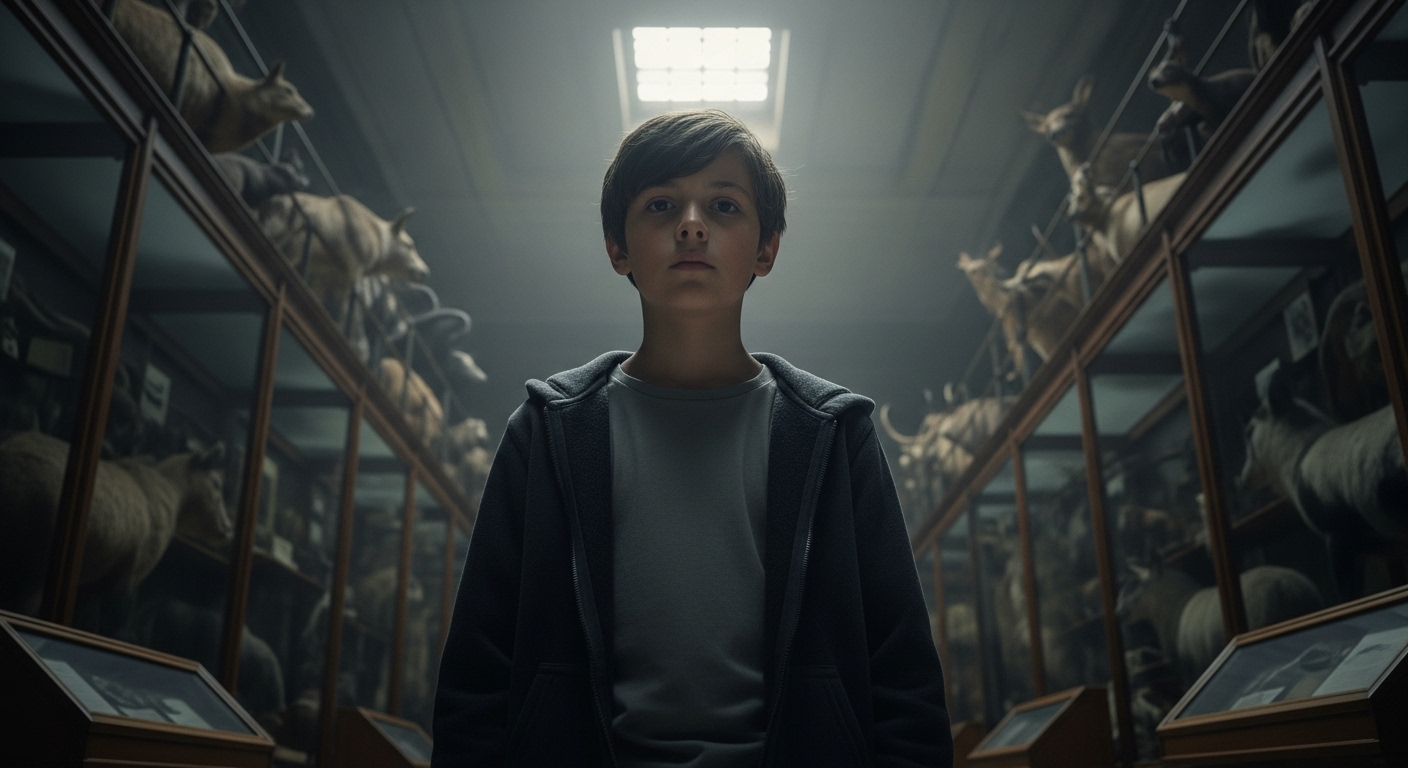
* Manufactured Reality: The museum setting, with its dusty dioramas and taxidermied animals, serves as a metaphor for Larry's own life—a carefully constructed but lifeless reality that is shattered by the intrusion of an unpredictable, lethal threat.
* Protocol vs. Instinct: The narrative builds tension by contrasting Larry's unwavering adherence to his training with the rising tide of pure, instinctual fear when faced with a situation for which there is no script.
Stakes
Failure means not only the loss of a critical intelligence asset but the certain termination of the young operative and the exposure of his clandestine network.
Synopsis
In a cavernous, empty museum on a rainy day, LARRY (Unit Seven), a boy trained to be a stoic operative, receives his final instructions from his handler, MS. GENEVIEVE. His mission: retrieve a micro-cylinder hidden inside a taxidermied robin from a contact known as "The Cartographer." The exchange is governed by strict protocols, with any deviation triggering an abort.
Larry takes his position, perfectly embodying the role of a bored child waiting for his parent. He waits for hours, his patience a trained muscle, observing the lifeless exhibits. The contact, an old man called THE CARTOGRAPHER, finally arrives. They perform the coded exchange flawlessly. Using the man's body as a shield, Larry expertly unlocks the display case, retrieves the asset from the bird, and secures it.
As Larry moves to his exit point, the bell on the museum door rings again—this time with sharp authority. An AUDITOR, a tall, menacing figure in a grey coat, enters. The Auditor's presence radiates threat, a predator entering a quiet space. The Cartographer vanishes. Larry, trapped, reverts to his cover, but the Auditor's confident footsteps move directly toward him. The film ends as the Auditor stands behind the boy, its cold voice shattering Larry's composure: "Lost, little one?"
Character Breakdown
* LARRY (UNIT SEVEN) (Male, 10-12): Small for his age, with a preternatural stillness. Larry is a product of intense conditioning, his childhood replaced with espionage tradecraft. He sees himself as an instrument, an "empty space," and speaks in a flat, programmed voice. He is hyper-observant and disciplined, but beneath the surface lies a child's vulnerability.
* Psychological Arc: Larry begins as a perfect automaton, confident in his training and believing himself to be nothing more than a "conduit" for the mission. By the end, the unscripted, terrifying presence of the Auditor shatters his procedural world, replacing his programmed confidence with genuine, paralyzing fear. He is forced out of his role as an operative and back into the terrifying reality of being a trapped, vulnerable child.
* MS. GENEVIEVE (Female, 50s-60s): Larry's handler. Her voice is dry, her touch is like twigs. She is pragmatic, cold, and utterly focused on the mission's success. She is the architect of Larry's conditioning and views him as an asset, not a child.
* THE CARTOGRAPHER (Male, 60s-70s): The contact. A weary, seasoned field agent whose face is like crumpled paper. He plays his part with tired precision but carries an air of melancholy. He is a ghost at the end of his career.
* THE AUDITOR (Any Gender, 30s-50s): The antagonist. Tall, slender, and impeccably dressed in a grey coat. The Auditor moves with the silent, purposeful confidence of a predator. Their presence is a physical force that changes the atmosphere of the room. Their voice is calm, smooth, and utterly devoid of warmth.
Scene Beats
1. THE PROTOCOL: In voiceover and a brief, sterile flashback, Larry recites the mission parameters to his handler, Ms. Genevieve. Her dry hand on his shoulder emphasizes the stakes. He is a conduit, nothing more.
2. THE WAITING ROOM: Larry sits alone on a bench in the vast, silent museum hall. He perfectly mimics a bored child. He catalogues the smells, sounds, and sights, his mind a disciplined machine. Hours pass. He watches a spider, a brief flicker of connection to something alive.
3. THE COUNTERSIGN: The museum door jingles. An old man, THE CARTOGRAPHER, enters. He wanders the hall, playing the tourist. Larry follows at a distance. They meet at the Ornithology wing. Larry delivers the initiation phrase; the Cartographer gives the correct countersign. The protocol is holding.
4. THE EXCHANGE: The Cartographer shields Larry from view. In a series of tense, precise movements, Larry uses a polymer filament key to open the display case. His small hand darts in, retrieves the micro-cylinder from the taxidermied robin, and secures it. The mission is a success.
5. THE INTRUSION: Larry heads for the staff exit. The door jingles again—a sharp, authoritative sound. A tall figure in a grey coat, THE AUDITOR, enters. The atmosphere immediately chills. The Cartographer is gone.
6. THE PREDATOR: Larry freezes, then forces himself back into his cover. He pretends to study an exhibit. The Auditor's heavy, rhythmic footsteps don't sweep the room; they come directly for him. The sound is terrifyingly close.
7. THE UNRAVELING: The footsteps stop directly behind Larry. The silence is absolute and suffocating. Larry's training battles a rising panic. The Auditor's calm, cold voice cuts through the silence: "Lost, little one?" Close on Larry's face as his carefully constructed composure finally cracks, revealing the terrified child beneath.
Visual Style & Tone
The visual style is cold, controlled, and observational, mirroring Larry's mindset.
* Cinematography: Static, locked-off shots and slow, deliberate camera movements. The composition should emphasize Larry's smallness within the vast, empty spaces of the museum. Extreme close-ups will focus on key details: the filament key, the dust on the dioramas, the glass eyes of the birds, the breaking of the wax seal.
* Color Palette: Desaturated and muted. A world of greys, dusty browns, and weak, filtered light. The only vibrant color is the red breast of the robin in the display case, a splash of artificial life in a dead world.
* Sound Design: Minimalist and atmospheric. The dominant sounds are the low hum of the dehumidifier, the constant drumming of rain, the specific creaks of the floorboards, and the sharp, piercing jingle of the bell. Dialogue is sparse and delivered with precision, making the final, chilling line all the more impactful.
* Tonal Comparisons: The film aligns with the quiet, paranoid tension of Tinker Tailor Soldier Spy, the high-concept dread of a Black Mirror episode, and the theme of weaponized youth found in Hanna. It carries the oppressive, institutional coldness of dystopian works like Fahrenheit 451.
Share This Treatment


