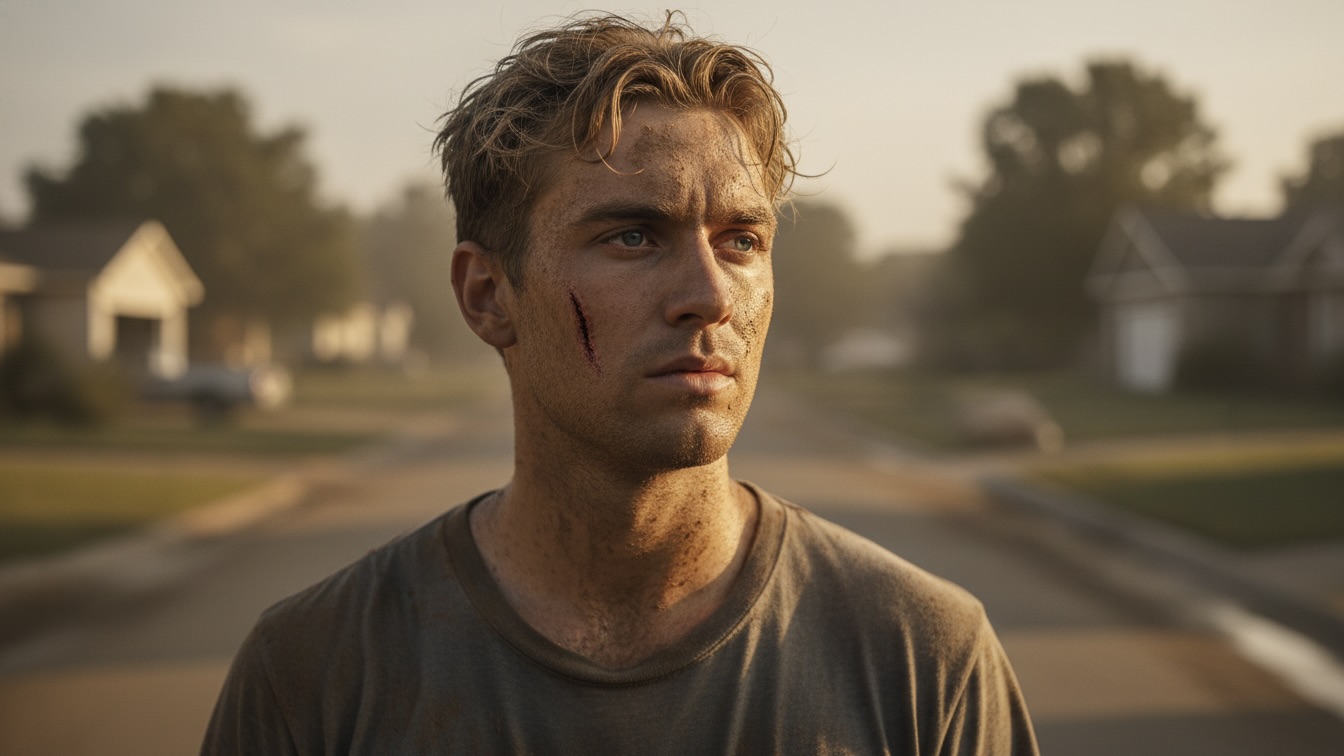
Format: Short Film / Anthology Episode | Est. Length: 10-12 minutes
Imagine this as a haunting entry in an anthology series titled The Great Disconnect, where each episode explores the collapse of societal norms through the lens of digital-native characters facing analog catastrophes. The series is set during a global infrastructure collapse known as "The Lag," following survivors as they navigate a world where the digital "cloud" has evaporated, leaving a generation raised on screens to face the brutal, physical consequences of a dying planet. Each episode focuses on a different localized disaster—floods, fires, or blackouts—linked by the emergence of "The Swarm," a nihilistic youth movement that treats the apocalypse as a gamified reality.
John sits on the edge of a precarious treehouse, filming his childhood home as it slowly disappears beneath a rising tide of brown, toxic sludge. His phone battery hits four percent, the red bar a ticking clock against the backdrop of a world that has gone completely silent.
As a toxic flood swallows their suburban world, two teenagers trapped in a treehouse must defend their sanctuary against a nihilistic cult that views the disaster as a game. When the digital tethers break, they are forced to choose between the morality of the old world and the brutal survivalism of the new one.
The primary theme is the transition from digital abstraction to physical reality, exploring how a generation reliant on "the cloud" processes tangible loss. The story examines the "death of irony" as a defense mechanism; characters like Lisa use cynical, internet-speak humor to mask a paralyzing fear of their own mortality.
Another core theme is the dehumanization inherent in social media culture, manifested by "The Swarm." By reframing life-and-death situations as "lag," "glitches," or "NPC interactions," the antagonists demonstrate how digital detachment can evolve into literal, violent sociopathy when the guardrails of society fail.
For John, the stakes are both survival and the preservation of his humanity; losing the treehouse means drowning, but killing to defend it means losing his connection to "old world" values. Lisa’s stakes are psychological, as she teeters on the edge of a total catatonic break, her sanity tied to the dead screen of her phone. The broader stakes involve the literal "cleansing" of the neighborhood, where those who cannot adapt are discarded like "dead weight" by the marauding Swarm.
The primary external conflict is the rising floodwater and the physical threat of the "Swarm," represented by the masked boy, Leo, who seeks to "uninstall" those he deems unworthy. Internally, John struggles with the paralysis of grief and the transition from observer to actor, while Lisa battles a nihilistic withdrawal that threatens to make her a victim of her own apathy. The environment itself acts as an antagonist, with the toxic water and a wedged car serving as a ticking time bomb for the treehouse’s structural integrity.
In the wake of a catastrophic flood, John and Lisa are stranded in a sturdy oak treehouse as the brown, sewage-filled water consumes their suburban neighborhood. While John obsessively films the destruction on his dying phone, Lisa retreats into a catatonic state, swiping at a dead screen and dismissing the tragedy with hollow, internet-inflected irony. Their fragile safety is threatened when a car becomes wedged against the tree, its weight threatening to uproot their sanctuary and revealing the grim reality of "The Swarm"—a group of local teens who have begun "cleansing" the survivors.
When a masked member of the Swarm climbs into the treehouse, the conflict shifts from environmental survival to a brutal ideological confrontation. The intruder, a former classmate named Leo, treats their life-or-death struggle as a low-latency game, forcing John to abandon his role as a passive observer. In a climactic moment of violence, John uses an old flare gun to defend them, a choice that saves their lives but permanently shatters their remaining innocence. As the water finally begins to recede, it leaves behind a world of silt and corpses, where the survivors are no longer the people they were before the rain started.
John: A pragmatic but sentimental teenager who clings to his phone as a witness to his own life. At the start, he is a passive documentarian, paralyzed by the loss of his physical history; by the end, he has transitioned into a hardened survivor willing to use lethal force, though he is haunted by the ease with which he killed.
Lisa: A girl who uses "dead-eyed irony" as a shield against a world that has become too loud and too real. She begins the story in a state of cynical denial, but the intrusion of physical violence causes a total psychological collapse, leaving her a hollow shell of her former self.
Leo (The Swarmer): A teenage antagonist who has fully embraced the nihilism of the collapse, viewing himself as a "player" in a world of "NPCs." He is charismatic in a terrifyingly bored way, representing the total loss of empathy in a gamified apocalypse.
The Dying Light: John films the water reaching the second story of his house while his phone battery hits a critical low, highlighting the futility of digital documentation. Lisa sits in the corner, rhythmically swiping her dead phone, her dialogue dripping with a hollow irony that fails to mask her trembling hands. The beat ends with the low, heavy hum of the flood vibrating through the floorboards, establishing a sensory-heavy atmosphere of dread.
The Obstacle: A white Toyota Camry slams into the tree, its metallic scream against the wood signaling a shift from passive waiting to active danger. John descends into the toxic, warm water to investigate the blockage, only to discover the body of a neighbor, Mr. Henderson, zip-tied to the car. This discovery transforms the flood from a natural disaster into a crime scene, as John realizes the "cleansing" mentioned by the Swarm is a literal, violent purge.
The Intruder: A flat-bottomed boat passes by carrying masked teens who taunt the "NPCs" in the houses, but one member, Leo, breaks off to climb the treehouse. Leo enters the space with a casual, bored demeanor, offering them "membership" in the Swarm if they "cleanse the server" of their own humanity. The tension peaks as Leo draws a serrated hunting knife, dismissing John’s flare gun as a "basic loot" item and preparing to "uninstall" them.
The Flare: As Leo lunges, John fires the flare gun point-blank, the magnesium flash momentarily turning the night into a blinding, white-hot day. Leo is blasted out of the treehouse and into the water, his burning body sinking beneath the surface like a dying ember. The aftermath is a suffocating silence, filled only with the smell of sulfur and burnt burlap, as Lisa finally breaks, realizing the "game" has permanent consequences.
The Silt: The sun rises over a landscape of grey mud and corpses, revealing the true scale of the devastation as the water recedes. John climbs down into the warm, clinging silt, finding a single clean red sneaker that serves as a haunting reminder of the world that was. He encounters another survivor who tells him the Swarm isn't a group but a state of mind, leaving John to walk into the steaming, ruined horizon alone.
The episode begins with a sense of Melancholic Stasis, characterized by the slow, rhythmic sound of the water and the characters' digital withdrawal. This shifts into Visceral Horror during the underwater discovery and the arrival of Leo, where the mood becomes frantic and claustrophobic. The climax provides a Shocking Catharsis through the flare gun blast, which quickly curdles into a Bleak Nihilism as the sun rises, leaving the audience with a sense of profound loss and the realization that the world cannot be "rebooted."
If expanded, the season would follow John and a catatonic Lisa as they trek toward a rumored "Offline Zone" in the mountains, navigating a landscape divided into "Servers" controlled by different factions of the Swarm. Each episode would introduce a new "glitch"—a different way society has broken down—while John struggles to keep Lisa alive and resist the urge to join the very nihilism he fought against.
The thematic escalation would involve the discovery that the Swarm is being coordinated through a still-functioning, localized mesh-net, turning the apocalypse into a literal live-streamed event for those in the "Offline Zone." The season would culminate in John having to destroy the last remaining server tower, choosing a silent, analog future over a violent, digital one.
The visual style is "Muddy Realism," utilizing a desaturated color palette of browns, greys, and sickly oranges to reflect the toxic environment. The camera work should be intimate and handheld, mimicking the "shaky cam" of a phone recording, with frequent close-ups on textures—wet wood, rusted metal, and the grain of the silt.
The tone is one of "Apathetic Dread," comparable to the bleakness of The Road mixed with the surreal, youth-driven violence of Lord of the Flies in the digital age. Sound design is crucial, utilizing the constant, low-frequency hum of the flood and the sharp, rhythmic "click" of Lisa’s thumb on glass to build a sense of inescapable sensory pressure.
The target audience is adults and older teens (16-35) who are "chronically online" and interested in speculative fiction that critiques modern digital culture. It appeals to fans of Black Mirror, The Last of Us, and Station Eleven, offering a gritty, grounded look at how the "Gen Z" psyche might fracture under the weight of a total infrastructure collapse.
The pacing is "Slow-Burn Tension," with the first half of the episode focusing on the atmospheric dread of the rising water. The midpoint (the car collision) accelerates the tempo, leading to a high-intensity, claustrophobic confrontation in the final act. The 10-12 minute runtime necessitates a lean narrative that prioritizes sensory details and immediate physical threats over extensive world-building.
Practical effects are paramount; the production will require a specialized "treehouse" set built over a shallow, controlled water tank to simulate the rising flood and the impact of the car. The water must be treated with non-toxic dyes and thickening agents to achieve the "wet cardboard" look described in the text, ensuring a visceral, tactile experience for the actors and the audience.
The flare gun sequence requires high-speed photography and careful lighting to capture the blinding magnesium flash without washing out the frame. The "Swarm" masks should be designed with practical, rusted metal studs to catch the light, creating a low-budget but terrifying aesthetic that feels like something a teenager would DIY during a collapse.


