Format: Short Film / Anthology Episode | Est. Length: 10-12 minutes
Imagine a world where the ledger is the only law and every breath is a transaction. This story serves as a haunting entry in an anthology series that explores the intersection of environmental collapse and corporate debt-slavery, offering a visceral look at the psychological cost of survival in a dying world where the lines between memory and reality are blurred by toxic necessity.
Dead Orchard Fruit is a standalone installment of the anthology series The Ledger, which chronicles the lives of "Associates" living in the shadow of the District’s total economic control. The series explores a near-future where environmental disasters have turned the landscape into corporate-owned extraction zones, and social debt is used as a tool for permanent indentured servitude. Each episode focuses on a different sector—from logistics hubs to agricultural valleys—revealing the systemic cruelty of a world where human trauma is harvested alongside dwindling resources.
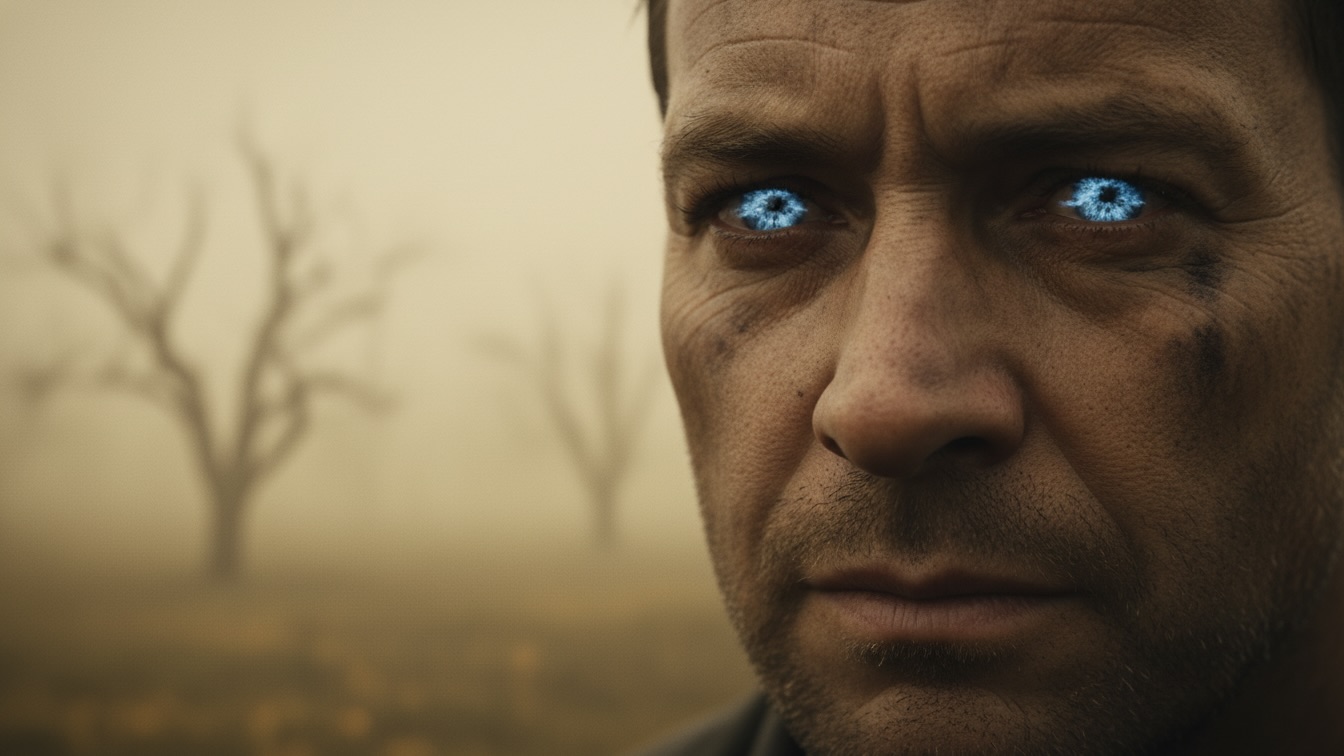
Mike stands in a field of shriveled, ear-like apples under a white-glare sun, his tablet chiming with a notification that his social debt has increased despite the total crop failure. As he touches a feverish, leathery fruit, a yellow mist begins to rise from the ground, signaling the arrival of the "temporal rot."
In a dying orchard where corporate pesticides cause hallucinatory "temporal rot," a debt-ridden laborer must choose between his survival and a final, destructive act of rebellion. As his past sins manifest in the yellow mist, he realizes the only way to clear his ledger is to burn the system down.
The episode explores the theme of corporate exploitation and the weaponization of guilt, illustrating how the "grindset" philosophy is used to mask systemic failure as personal inadequacy. It delves into the psychological toll of debt-slavery, where the protagonist's past mistakes are physically manifested by the very chemicals meant to sustain his labor, turning his environment into a literal graveyard of his own conscience.
Additionally, the story examines the illusion of choice in a closed-loop economy. The "Nature’s Best" spray serves as a metaphor for the toxic narratives individuals consume to justify their own suffering, ultimately suggesting that true agency can only be found by stepping outside the transaction, even at the cost of total destruction.
For Mike, the stakes are both financial and existential; his failure to meet the yield bonus means his social debt will spiral until he is sent to the mines, while his deteriorating mental health threatens to trap him permanently in his own worst memories. For Shauna, the stakes are her remaining sanity and the safety of her sister, whose future is tied to Shauna’s ability to endure the "rot" and keep working. The Company faces the loss of its "optics of production," as any sign of worker rebellion threatens the carefully maintained facade of a functional, profitable ecosystem.
The primary external antagonist is "The Company," an unseen corporate entity that enforces labor through digital debt-tracking, drone surveillance, and the distribution of the hallucinogenic "Nature’s Best" compound. Internally, Mike battles the "temporal rot," a psychological manifestation of his own cowardice and the guilt he feels for betraying his sister, Sarah, to secure a corporate promotion. This internal struggle is exacerbated by the physical environment—the oppressive heat, the lack of water, and the suffocating yellow mist that forces the characters to confront their traumas.
Mike and Shauna labor in a desiccated valley, harvesting useless, leathery fruit while breathing in "Nature’s Best," a chemical that induces "temporal rot"—hallucinations of past traumas. When the Company increases the spraying cycle to combat falling yields, Shauna suffers a breakdown, reliving her father's death during a heatwave, forcing Mike to physically intervene and ground her in their grim reality. They retreat to a sorting shed where a corporate memo rebrands their suffering as "mental health skill issues," a final insult that shatters Mike’s remaining loyalty to the system.
Driven by a hallucinatory encounter with his sister, whom he evicted years ago for a promotion, Mike realizes that his social debt is an inescapable cage. He joins Shauna in a desperate act of sabotage, climbing to the ridge to release the concentrated, flammable chemicals from the storage tanks. As the yellow mist engulfs the valley and the drones circle helplessly, Mike lights a final cigarette and drops it into the pool of liquid, erasing the orchard and their debts in a silent, beautiful flash of blue flame.
Mike (Protagonist): A cynical "High-Value Associate" who has spent years suppressing his guilt through the pursuit of corporate bonuses and credits. At the start, he is a compliant cog in the machine, but the "temporal rot" forces him to confront the betrayal of his sister, Sarah, leading to a psychological collapse. By the end, he transitions from a man chasing a phantom payout to a nihilistic revolutionary who finds peace in the total destruction of his labor.
Shauna (Supporting): A younger worker who is less shielded against the effects of the spray, serving as the emotional catalyst for the story. She is haunted by the memory of her father’s death, a trauma that the "Nature’s Best" fumes force her to relive repeatedly. Her arc moves from a state of paralyzed grief to one of cold, decisive action, as she is the first to propose burning the orchard as a way to break the loop.
Mike surveys the "dead" apples and receives a debt increase notification, establishing the oppressive heat and the dry irrigation lines. He observes the yellow mist hugging the ground and the dry irrigation lines, realizing the "Nature’s Best" canisters are a corporate lie. The heat reaches a hundred and four degrees as Mike struggles with a failing mask filter and the metallic taste of chemical spray.
He finds Shauna experiencing a "temporal rot" episode where she mistakes a gnarled tree for her dying father, forcing Mike to physically intervene and ground her in their grim reality. Shauna screams and fights him, her desperation fueled by the neurochemical reaction to the fumes, while Mike tries to be the anchor in the shifting dust. Eventually, she slumps against him in exhaustion, realizing the tree is just a shriveled husk, and they both acknowledge their shared hatred for the valley.
They retreat to a sorting shed where a corporate memo rebrands their hallucinations as "mental health skill issues," triggering Mike’s realization that the system is a closed loop of misery. The synthetic voice of the memo encourages "deep-breathing modules" while announcing an increase in the spraying cycles that will trap them in the rot permanently. Shauna reveals she is trapped by the debt she owes for her sister’s dorms, while Mike reflects on the sister he abandoned to secure his own position.
Mike experiences his own rot episode, reliving the moment in 2023 when he signed his sister's eviction notice to secure his promotion to the Valley. The sterile District office melts back into the jagged orchard, leaving Mike on the ground, tasting salt and copper as he apologizes to the "wooden ghosts" of the people he has let down. Shauna pulls him up, warning him that the drones are returning and that they must move before the next spraying cycle begins.
Shauna proposes burning the orchard to break the loop, and Mike, finally pushed past his breaking point, smashes his tablet against a rock in a symbolic rejection of his debt. They climb the ridge to the "Nature’s Best" storage tanks, struggling against the rusted valves as the concentrated yellow liquid begins to flood the hillside. The resulting cloud of fumes triggers a mass hallucinatory event among the other workers in the valley, creating a chorus of screams that Mike recognizes as the true "output" of their labor.
As the drones circle and the sirens wail, Mike sits in the dirt with Shauna, sharing a final cigarette while the yellow liquid pools around their boots. He tells Shauna it’s going to be "bright for a second" before dropping the cigarette into the flammable chemical pool. The orchard is erased in a silent, cold blue flame, providing a clean slate and the first real breath of clear air Mike has taken in years.
The episode begins with a sense of suffocating apathy and heat-induced dread, characterized by the "white glare" of the sun and the dry clicking of empty irrigation lines. As the "temporal rot" sets in, the mood shifts into sharp, hallucinatory horror, creating a feeling of claustrophobia and psychological instability. The final act moves from desperation to a cynical, quiet peace, concluding with a cathartic explosion that offers the audience a sense of release from the relentless tension of the corporate grind.
If expanded into a full season, the "Blue Flame" incident in the orchard would serve as the inciting incident for a wider rebellion across the District’s various sectors. The narrative would follow the spread of the "Nature’s Best" sabotage as a form of protest, with Mike and Shauna’s act becoming a legendary symbol for other debt-ridden workers. The overarching story would track the District’s increasingly violent attempts to suppress the "Blue Flame" movement, while exploring the backstories of other characters trapped in different forms of social debt.
The season would also delve deeper into Mike’s past, potentially revealing that his sister, Sarah, has become a leader in an urban resistance group. The thematic escalation would move from individual survival to collective action, questioning whether a system built on debt can ever be reformed or if it must be entirely consumed by the flames of its own making. The finale would bring the various sectors together in a coordinated strike, aiming to "reset the ledger" for the entire population.
The visual style is "Dust-Bowl Cyberpunk," utilizing a desaturated, high-contrast palette to emphasize the blistering heat and the decay of the orchard. The "temporal rot" sequences should be shot with a shifting depth of field and subtle color grading changes—moving from the sickly yellow of the valley to the sterile, cold blues of corporate offices—to create a sense of ontological insecurity. The camera work should be handheld and intimate during the labor scenes, shifting to wide, sweeping shots during the final destruction to emphasize the scale of the rebellion.
The tone is a blend of the grounded, environmental grit of Children of Men and the psychological disorientation of Jacob’s Ladder. It maintains a cynical, noir-like edge through Mike’s internal monologue and the corporate memos, contrasting the horrific reality of the workers' lives with the polished, synthetic language of the Company. The sound design should be dominated by the oppressive hum of drones and the rhythmic popping of the metal shed, creating a constant underlying tension that only breaks during the silent blue explosion.
The target audience consists of mature viewers (ages 18-45) who are drawn to high-concept science fiction, social commentary, and psychological thrillers. It appeals to fans of anthology series like Black Mirror or Electric Dreams, as well as viewers interested in themes of labor rights, environmental collapse, and the psychological impact of late-stage capitalism. The episode is designed for prestige streaming platforms that prioritize atmospheric storytelling and complex, morally ambiguous protagonists.
The episode follows a 12-minute structure, divided into three distinct acts. The first four minutes establish the setting and the "temporal rot" through Shauna’s breakdown, moving at a deliberate, "slow-burn" pace to mimic the oppressive heat. The middle four minutes accelerate the tension as Mike experiences his own hallucination and the corporate memo arrives, ratcheting up the psychological stakes. The final four minutes are a high-tempo climax, focusing on the sabotage of the tanks and the final, cathartic explosion, ensuring the narrative ends on a peak of visual and emotional intensity.
The "temporal rot" hallucinations require seamless transitions between the orchard and memory locations, which can be achieved through clever match-cutting and practical lighting shifts rather than heavy CGI. The "Nature’s Best" mist should be a consistent visual element, created using non-toxic fog machines with a specific yellow tint to maintain the episode’s signature color palette.
The final "blue flame" sequence is the most technically demanding part of the production, requiring a combination of practical fire effects and digital enhancement to achieve the "cold, erasing" look described in the text. Careful attention must be paid to the sound design during this scene, transitioning from the chaotic sirens of the drones to a sudden, profound silence to emphasize the "clean slate" Mike feels at the end. Production should also prioritize location scouting for a truly desiccated, "dead" landscape to minimize the need for digital environment building.


