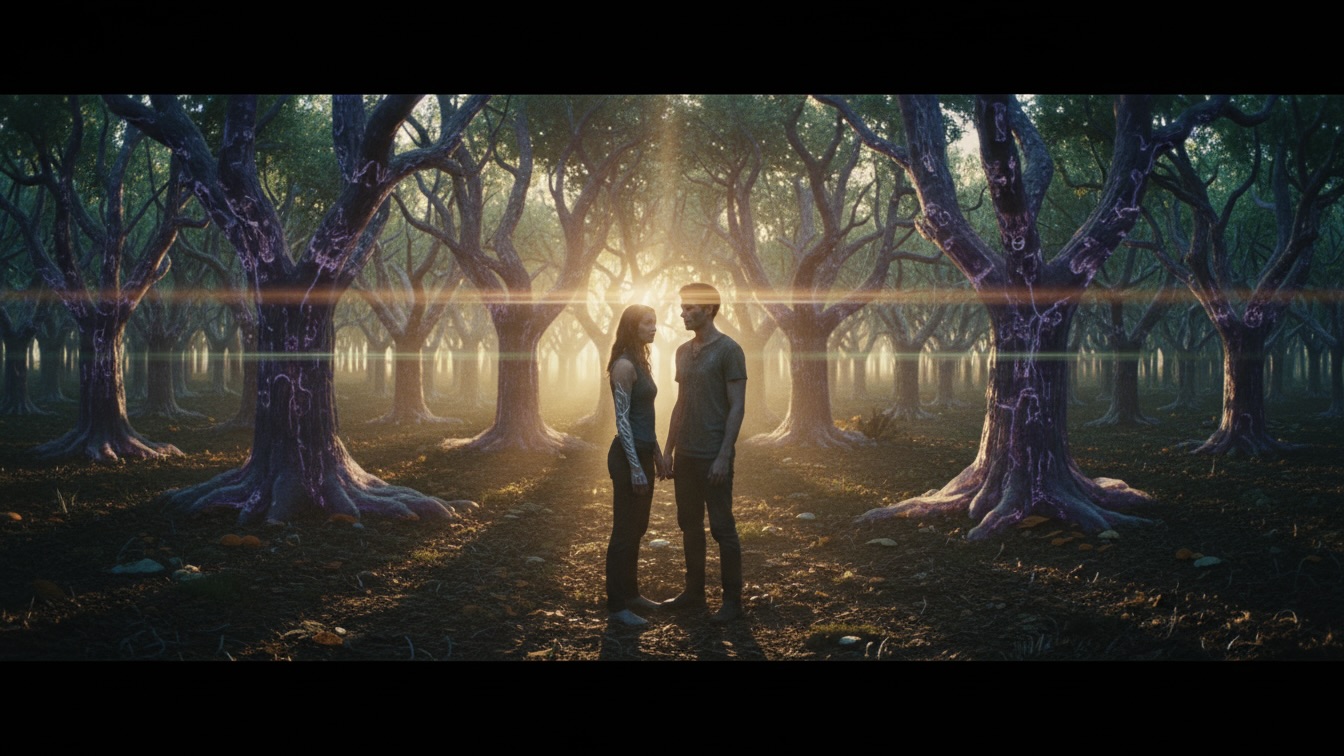
Format: Short Film / Anthology Episode | Est. Length: 10-12 minutes
Imagine this story as a visceral entry in a post-apocalyptic anthology series where the environment has become a sentient, predatory mirror of human trauma. In a world ravaged by "The Blight," isolated settlements survive only through "The Extraction," a ritualistic trade where survivors must surrender their most precious memories to a biological network of pulsing, translucent forests. Each episode follows different "Harvesters" as they navigate these psychological minefields, exploring the high cost of communal survival and the slow erosion of the human soul in a landscape that literally feeds on grief.
This episode introduces the "Shivering Grove," a localized infection that has paralyzed a nearby village’s food supply and infected its youth. The overarching narrative arc of the series focuses on the "Archive," a mythical place where the lost memories are said to be stored, and the growing realization that the Blight is not a natural disaster, but a social infection born from humanity's inability to process collective pain.
In a forest where the trees pulse with purple veins and the ground beats like a heavy heart, a young woman named Edna prepares an obsidian blade to perform a surgical ritual on her own mind. She must choose between her sanity and her village’s survival as her brother succumbs to the seductive, spore-induced hallucinations of their dead mother.
To save their starving village from a sentient biological rot, two estranged siblings must sacrifice their most cherished memories to a predatory forest. The ritual successfully cures the blight but leaves the pair emotionally hollowed and stripped of the shared history that once defined them.
The primary theme explores the "Cost of Survival," specifically the idea that pragmatic leadership often requires the destruction of the leader’s own humanity. Edna’s "Main Character Energy" is interrogated as a defense mechanism; her need to be the hero is revealed as a way to avoid the crushing guilt of the utilitarian choices she made during the famine. The story suggests that survival is not merely a physical state but a psychological tax that eventually leaves the survivor as empty as the world they are trying to save.
Secondary themes include "The Toxicity of Isolation" and "The Erosion of Identity." The Shivering Grove acts as a physical manifestation of the characters' internal rot, reflecting their resentment and secrets back at them. By the end, the episode posits that when we lose our ability to dream and remember warmth, we become indistinguishable from the cold, mechanical world around us.
The immediate stakes involve the survival of Edna and Kory’s village; if the extraction fails, the blight will consume the remaining crops and the children by morning. On a personal level, the characters risk "The Void," a state of permanent emotional numbness caused by giving too much of their core identity to the Grove. For Kory, the stake is his sanity as he teeters on the edge of a permanent, spore-induced psychosis that would leave him a "shell" for the forest to inhabit.
The external conflict is driven by the Shivering Grove, a sentient biological entity that uses spores to induce hallucinations and barbed vines to physically harvest human data. Internally, the conflict stems from the deep-seated resentment between Edna and Kory, fueled by Edna’s cold pragmatism and Kory’s perceived abandonment. The forest acts as a catalyst, forcing these internal tensions to the surface until they manifest as a violent psychic link that neither character can escape.
Edna and Kory enter the Shivering Grove, a humid and pulsing woodland, to perform a desperate ritual known as the Extraction. The village is dying from a biological blight, and only the golden sap produced by the Grove in response to human trauma can cure it. While Edna prepares the obsidian blade, Kory succumbs to the forest’s spores, hallucinating a peaceful reunion with their long-dead mother. Edna is forced to confront her brother’s escapism while battling her own terror as the forest’s heartbeat syncs with her own, demanding a sacrifice of her most painful memories.
As the ritual begins, Edna attempts to feed the Mother Tree her memory of a brutal famine where she decided who lived and who starved. The forest, greedy for more, entangles her in barbed vines, forcing Kory to snap out of his trance and intervene. In a final, desperate act, the siblings join hands and touch the Mother Tree, creating a psychic bridge that exposes their deepest shames and mutual resentments to one another. They successfully harvest the sap and save the village, but the process hollows them out, leaving them as strangers in a world they no longer have the capacity to love.
Edna: A pragmatic and burdened leader in her late teens who has adopted a "hero" persona to cope with the guilt of her past decisions. She begins the episode as a cold, objective strategist who views human life through the lens of survival statistics. By the end of the ritual, her psychological shield is shattered, and she is left as a hollowed-out "NPC," having sacrificed the very memories of safety and warmth that fueled her resilience.
Kory: Edna’s younger brother, an emotional and sensitive soul who has retreated into grief following the death of their parents. At the start, he is a liability, easily manipulated by the forest’s spores and resentful of Edna’s perceived coldness. His arc concludes with a brutal, unshielded understanding of his sister’s burden, yet he is left unable to dream or feel connection, becoming a silent partner in their shared emptiness.
The Weight of the Grove: Edna and Kory navigate the oppressive, humid atmosphere of the Shivering Grove, where the translucent trees pulse with purple veins like bruised skin. Edna taps a frantic rhythm against the soft ground to maintain her grip on reality as the forest’s rhythmic heartbeat vibrates through her boots. She prepares her pack and the obsidian tool, knowing that the environment is a stationary predator waiting for a lapse in their focus.
The Spore Delusion: Kory succumbs to the thick spores in the air, leaning against a throbbing trunk and claiming to hear their dead mother calling from the canopy. Edna tries to pull him away, but her voice feels detached and clinical, revealing the jagged static of her internal panic. Kory mocks her "main character energy," accusing her of being a clout-chaser who only cares about being the village hero while he drifts deeper into the forest's lethal fantasy.
The First Extraction: Edna sits on a muscular root and uses the obsidian blade to draw blood, visualizing her memory of the village famine flowing into the wood. The Grove reacts violently; the heartbeat accelerates and golden sap begins to ooze, but the forest demands a direct feed rather than a curated sacrifice. Barbed vines erupt from the mulch, pinning Edna to the tree as it attempts to bypass the knife and download her entire consciousness.
The Sibling Fracture: Kory snaps out of his trance as Edna screams for help, but instead of immediate rescue, he hesitates, reflecting on his resentment toward her cold leadership. He eventually attacks the vines with the obsidian knife in a frantic, uncoordinated burst of fury, saving Edna but immediately turning his anger on her. They stand in the bruised violet light, arguing over who is the true martyr, while the Mother Tree looms over them, salivating for their combined trauma.
The Psychic Bridge: Realizing the ritual is failing because they are holding back, Edna and Kory join hands and press their palms against the Mother Tree’s thorns. A violent psychic link is established, forcing them to experience each other’s deepest shames, including Edna’s cold utilitarianism and Kory’s secret desire to abandon the village. The Mother Tree groans as it absorbs the core of their identities, finally releasing a torrent of incandescent amber sap that breaks the local blight.
The Hollow Dawn: The siblings emerge from the silent Grove into a flat, grey morning, their hands scarred with silver punctures that will never heal. They look toward their saved village, but the victory feels empty because the forest has taken their ability to feel warmth or imagine a better future. They walk back in silence, two sets of data points moving through a world that calls them heroes while they starve in the void of their own minds.
The episode begins with a sense of "Oppressive Dread," characterized by the humid, claustrophobic atmosphere of the Grove. This shifts into "Psychological Vertigo" during Kory’s hallucination and Edna’s first extraction attempt, creating a feeling of instability. The climax hits a peak of "Brutal Catharsis," where the psychic link strips away all pretenses and defenses. The final mood is one of "Numb Desolation," leaving the audience with a haunting sense of loss that outweighs the physical victory of saving the village.
If expanded, the season would follow Edna and Kory as they travel to other settlements, discovering that the "Extraction" is being weaponized by a central Council to keep the population compliant and emotionless. They would encounter other Harvesters who have been "hollowed" to different degrees, some becoming literal extensions of the forest. The thematic escalation would focus on the search for the "Root Memory"—the original trauma that birthed the Blight—and whether it can be reclaimed or if humanity is destined to become a silent, biological collective.
The character evolution would see Edna attempting to rebuild her identity from scratch, while Kory becomes obsessed with finding a way to "re-upload" the memories taken by the trees. Their relationship would evolve from one of resentment to a shared, silent understanding of the burden of survival. The season finale would involve a return to the Shivering Grove to confront the Mother Tree, not as harvesters, but as rebels seeking to sever the link between human pain and environmental survival.
The visual style is "Biological Gothic," utilizing high-contrast lighting and a palette of bruised purples, sickly ambers, and translucent greys. The cinematography should use macro photography to emphasize the organic, pulsing textures of the forest—veins in bark, spores in the air, and the rhythmic movement of the soil. Tonal influences include the surreal biological horror of Annihilation and the bleak, grounded survivalism of The Road, creating a look that is both beautiful and deeply unsettling.
The tone is "Quietly Nihilistic," avoiding jump scares in favor of a creeping, psychological unease. Sound design is critical, featuring a low-frequency "heartbeat" that persists throughout the episode, occasionally syncing with the characters' breathing. The dialogue should feel sharp and modern, contrasting with the ancient, ritualistic nature of the setting to highlight the characters' desperation to maintain their modern identities in a decaying world.
The target audience is fans of "Elevated Horror" and "Speculative Fiction," specifically those who enjoy character-driven anthologies like Black Mirror or Tales from the Loop. The age group is 18-45, targeting viewers who appreciate thematic depth, psychological complexity, and a focus on the human condition over traditional action. It appeals to an audience that values atmospheric storytelling and is comfortable with ambiguous, emotionally challenging endings.
The pacing is "Deliberately Stagnant" in the first act to establish the oppressive heat and the weight of the environment. The tempo accelerates sharply during the extraction and the psychic link, utilizing rapid-fire editing and sensory overload to mimic the characters' internal chaos. The final three minutes return to a slow, rhythmic pace, allowing the silence of the grey morning to resonate with the audience, ensuring the 10-12 minute runtime feels both dense and expansive.
The Shivering Grove should be constructed using a mix of practical set design and CGI overlays to achieve the "pulsing vein" effect in the trees. The translucent bark can be created using silicone molds with internal LED lighting to simulate the rhythmic glow of the forest’s heartbeat. Practical effects, such as the golden sap and the barbed vines, will provide a tactile reality that enhances the body-horror elements of the ritual.
The "Psychic Bridge" sequence requires a distinct visual language, perhaps using a shift in frame rate or color grading to differentiate the shared memories from the "real" world of the Grove. Minimalist locations are preferred to keep the focus on the two leads, with the village only seen as a distant, hazy silhouette to emphasize the siblings' isolation. Soundscapes should be layered with organic squelches and low-frequency hums to maintain the feeling that the forest is a living, breathing character.


