Format: Short Film / Anthology Episode | Est. Length: 10-12 minutes
Imagine a world where the discarded remnants of human greed and trauma manifest as physical, predatory anomalies in the corners of our cities. This story serves as a standalone entry in a speculative anthology series titled The Residue, which explores the intersection of urban decay and cosmic horror, where every episode uncovers a different "stain" left behind by society’s failures.
The Residue is an anthology series set in a near-future metropolitan landscape where specialized "Clean-Up" units investigate anomalous biological and physical phenomena triggered by high-intensity human emotion or industrial accidents. Each episode follows a different protagonist—often a social outcast or a disgraced official—confronting a localized manifestation of "The Residue," a sentient, parasitic force that adapts to its environment. The series explores a world where the line between psychological trauma and physical infection is blurred, building toward a seasonal revelation about the source of these outbreaks within the city's infrastructure.
Detective Linda Torres steps onto a silent, listing ferry in the sweltering heat of a harbor dawn, only to find the interior swallowed by a pulsing, bioluminescent blue fungus that reacts to the sound of her heartbeat.
A guilt-ridden detective investigating a ghost ship must protect a terrified survivor from a parasitic fungus that feeds on human despair. To escape the vessel before it's incinerated, she must confront the trauma of her past or become part of the ship’s living hull.
The primary theme is the physical manifestation of psychological trauma, represented by the blue fungus that literally "eats" those who give in to their darkest memories. The story explores the concept of resilience not just as a physical trait, but as a mental defense mechanism against a world that profits from misery.
The genre blends "Eco-Horror" with "Hardboiled Noir," utilizing the sterile, cold nature of the parasite to contrast with the sweltering, gritty reality of Linda’s life. It suggests that while grief can be a parasite, hope acts as a biological repellent, turning a survival story into a metaphor for mental health recovery.
For Linda, the stakes are both mortal and spiritual; if she fails to escape the ship, she becomes a permanent, conscious monument to her greatest failure, fused to the metal like the mercenaries before her. For the city, the stakes involve a catastrophic bio-hazard outbreak, as the spores threaten to drift from the harbor into the dense urban population. Shane’s life hangs in the balance as a ticking clock, representing Linda’s last chance at professional and personal redemption.
The primary external antagonist is the "Blue Slag," a sentient parasitic fungus that has mutated the ship's hijackers into mindless, fused guardians. Internally, Linda battles "The Echo," the auditory hallucinations generated by the spores that mimic the voices of her dead teammates to induce the panic the fungus needs to feed. The environment itself acts as a secondary antagonist, with the listing ship, jammed hatches, and toxic fuel fumes creating a claustrophobic death trap.
Linda Torres, a detective relegated to "weird calls" following a botched raid that killed her team, boards the derelict Isle Queen ferry at Pier 44. Inside, she discovers a glowing blue fungus encasing the bodies of mercenaries who recently stole a shipment of gold bullion. She finds a surviving deckhand named Shane barricaded in a cabin; he reveals that the gold was contaminated with a deep-sea parasite that feeds on the host's despair and negative memories.
As they attempt to reach the cargo bay to escape, the fungus uses spores to trigger Linda’s PTSD, forcing her to hear the voices of her fallen comrades. They are hunted by "The Fused"—mercenaries whose bodies and weapons have been integrated into the fungal network. Linda realizes that the parasite starves when confronted with positive memories and hope; she uses this realization to stabilize a dying Shane. They sabotage the ship’s fuel lines, igniting a massive explosion that incinerates the parasite and the gold, narrowly escaping into the harbor as the Isle Queen sinks.
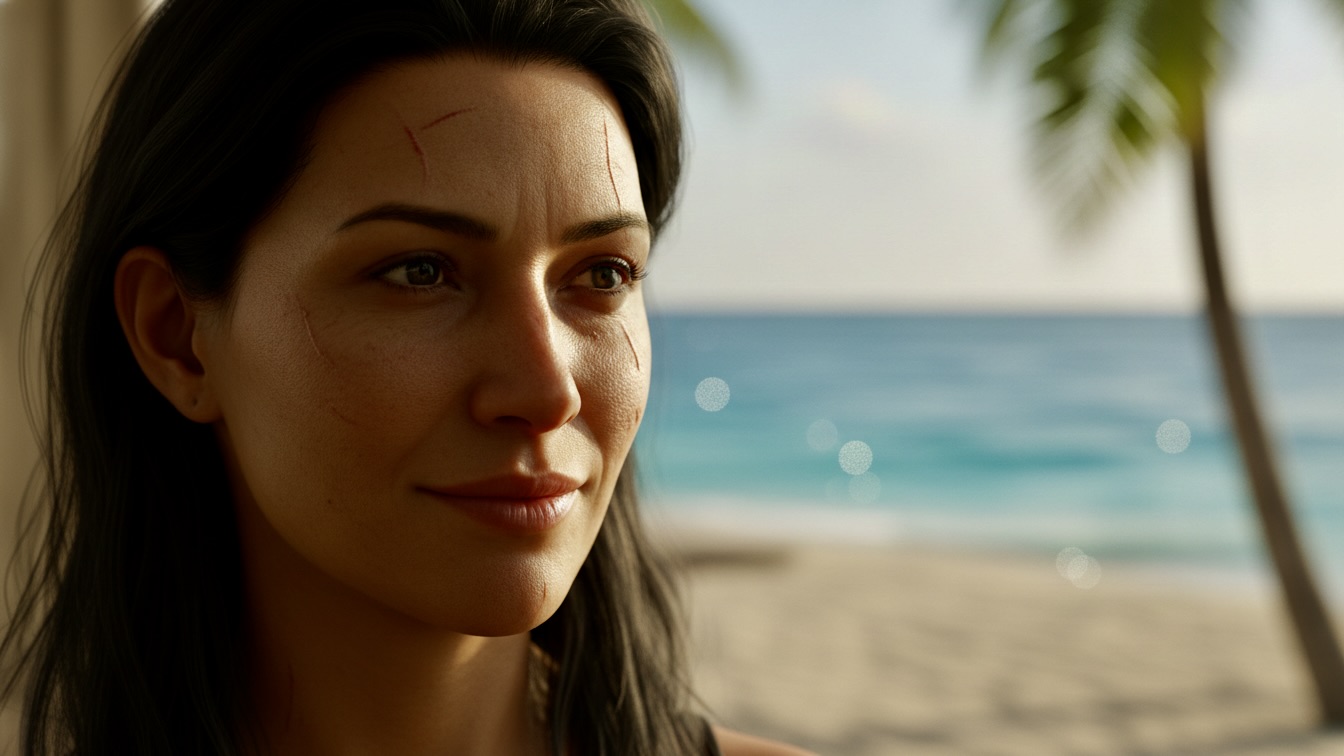
Linda Torres (Protagonist): A veteran detective in her late 30s, Linda starts the episode as a hollowed-out shell of a cop, defined by the "bad call" that cost four lives. Psychologically, she is in a state of "functional freezing," seeking out dangerous, lonely assignments as a form of penance. By the end of the story, she transitions from a victim of her own guilt to a protector, discovering that her capacity for hope is a weapon that can defeat the very darkness she feared.
Shane (Supporting): A 20-year-old deckhand who represents the innocent collateral damage of the city’s greed. He begins the episode in a state of total catatonia and terror, acting as a mirror for Linda’s own internal panic. His survival depends entirely on Linda’s ability to lead, and his eventual recovery provides the emotional proof that Linda is still capable of saving lives.
The Fused (Antagonists): Former high-tier mercenaries who are now biological extensions of the ship’s cargo. They have no individual personality, serving as physical manifestations of the "sunk cost" of greed, their tactical gear and weapons grotesquely melded with glowing blue organic matter.
Linda boards the Isle Queen and moves through the dark, dust-choked corridors, discovering the first body of a mercenary fused to the bulkhead by pulsing blue tendrils. She realizes the ship is not just a crime scene but a living organism when the blue growth begins to pulse in rhythm with her own rising anxiety. The tension peaks as she hears a rhythmic banging from the crew quarters, leading to her tense introduction to a traumatized Shane.
Shane explains the origin of the "Blue Slag" within the gold shipment, and the duo descends into the cargo hold where the air is thick with hallucinogenic spores. The midpoint occurs when the spores trigger Linda’s trauma, causing her to hear the voice of her dead point-man, Trenton, accusing her of his death. She nearly succumbs to the infection until she grounds herself in the physical reality of her weapon and Shane’s presence, forcing the blue light to dim.
The climax erupts when the Fused mercenaries attack, forcing Linda to use emergency flares to ignite the flammable fungus and clear a path to the medical bay. In a desperate moment, she saves Shane from a spreading infection by forcing him to recount a joyful memory, proving the parasite’s weakness. They successfully rupture the fuel tanks and leap into the harbor just as the ship detonates, the cleansing fire destroying the "Residue" and providing Linda with a grim but necessary closure.
The episode begins with a mood of "Stagnant Dread," characterized by the oppressive heat and the silence of the ghost ship. As Linda moves deeper into the vessel, the mood shifts to "Psychological Vertigo" as the supernatural elements and hallucinations begin to blur her reality. The final act moves into "Cathartic Violence," where the slow-burn tension explodes into a high-stakes escape, ending on a note of "Quiet Resilience" as the sun rises over a clean harbor.
In a broader season, the "Tainted Cargo" would be revealed as the first of several shipments of "The Slag" brought into the city by a shadowy conglomerate known as Meridian Holdings. Linda would eventually join a clandestine task force of other "Residue" survivors, moving from a disgraced beat cop to a lead investigator of these metaphysical outbreaks. The season would culminate in a confrontation at the Meridian headquarters, where the source of the parasite is revealed to be a literal "well of sorrow" harvested from the city's most impoverished districts.
The thematic escalation would move from individual trauma to systemic corruption, showing how the city’s elite literally weaponize the despair of the populace. Linda’s evolution would involve her learning to train others to use "Hope-Anchoring" techniques to combat the spread of the infection. The season finale would see the city on the brink of a total "Blue Out," with Linda forced to decide if the city is worth saving or if it needs to be burned clean like the Isle Queen.
The visual style is "Industrial Gothic," utilizing the rusted, cavernous interior of the ferry to create a sense of scale and isolation. The color palette is dominated by the "Harbor Yellow" of the summer smog and the "Neon Cobalt" of the fungus, creating a high-contrast look that feels both grounded and alien. Tonal influences include the claustrophobic dread of Alien and the gritty, sweat-soaked atmosphere of Seven.
Cinematography will favor tight, handheld shots in the corridors to heighten claustrophobia, opening up into wide, sweeping shots in the cargo hold to emphasize the overwhelming nature of the infection. The sound design is crucial, featuring a "Low-Frequency Hum" that increases in volume when the fungus is active, interspersed with distorted, radio-filtered voices. Tonal comparables include the "infected" aesthetics of The Last of Us and the maritime horror of The Terror.
The target audience is adults (18-45) who enjoy elevated horror, psychological thrillers, and "New Weird" cinema. It appeals to fans of anthology series like Black Mirror or Love, Death & Robots, as well as viewers who appreciate character-driven stories about trauma and recovery. The blend of tactical action and supernatural horror makes it suitable for platforms like HBO, Netflix, or AMC+.
The pacing follows a "Tightening Spiral" structure, starting slow and methodical as Linda explores the ship, then accelerating rapidly once the first Fused mercenary is encountered. The 10-12 minute runtime necessitates a lean narrative with minimal exposition; the rules of the fungus are learned through action rather than dialogue. The midpoint "hallucination" sequence serves as a brief, surreal break in the tension before the final, high-octane escape sequence.
The primary production challenge is the "Blue Slag" fungus, which should be a combination of practical silicone prosthetics for the fused bodies and CGI for the pulsing, bioluminescent light effects. The "Fused" mercenaries require specialized stunt performers capable of jerky, non-human movement to emphasize their loss of autonomy. Using a real decommissioned vessel for the location would provide the necessary tactile grit and "rust-and-diesel" atmosphere that a studio set might lack.
The explosion of the Isle Queen can be handled via a high-quality miniature or a composite of practical pyrotechnics and digital matte paintings to manage costs while maintaining scale. Sound design must prioritize the "Auditory Hallucination" effect, using directional audio to make the audience feel as though the voices are inside their own heads. Practical lighting—specifically the orange flares vs. blue fungus—will be essential for creating the episode's signature visual conflict.


