Format: Short Film / Anthology Episode | Est. Length: 10-12 minutes
Imagine this story as a high-octane entry in The Sound, an anthology series exploring the rot hidden within the maritime industries of the Pacific Northwest. Each episode follows a different blue-collar worker—deckhands, crane operators, or lighthouse keepers—who stumbles upon a fragment of a massive, interconnected conspiracy involving corporate espionage and local government corruption. The series utilizes a "ground-level" perspective, where the scale of the threat is felt through the claustrophobia of industrial settings and the vulnerability of ordinary people caught in extraordinary crossfires.
A routine morning ferry crossing is violently interrupted when a "tactical exercise" turns lethal, revealing that the men in balaclavas aren't training—they are hunting. Jordan Reed, a hungover deckhand, watches in horror as a grappling hook bites into the railing and a lead operative levels a live rifle at a crowded passenger lounge.
After a disillusioned deckhand intercepts a data cache during a rogue mercenary raid on a public ferry, he must survive a deadly game of cat-and-mouse within the ship’s industrial guts. His survival depends on outmaneuvering professional killers to expose a conspiracy that reaches the highest levels of his own town.
The episode explores the theme of systemic corruption and the erosion of public trust, framing the ferry as a microcosm of a society where safety is an illusion maintained by those in power. It highlights the "invisible worker," suggesting that those who maintain the machinery of the world are the only ones capable of throwing a wrench into the gears of a conspiracy.
The secondary theme is the transition from apathy to agency. Jordan begins the story as a man defeated by "small, expensive inconveniences," but the life-and-death stakes force him to reclaim his sense of purpose, proving that knowledge of one's environment is a more potent weapon than tactical gear.
For Jordan, the stakes are immediate and mortal: he is an unintended witness to a "ghost op" and must escape professional execution. For the community of Harbor’s Edge, the stakes are existential, as the data in Jordan’s possession holds the power to either dismantle the corrupt infrastructure of the region or be buried forever, leaving the town a "laundromat" for dirty money.
The primary external conflict is the physical pursuit of Jordan by the "Ghost Op" tactical team, a group of mercenaries with the authority to bypass local law enforcement. Internally, Jordan faces the paralyzing weight of his own cynicism, battling the urge to simply hand over the bag and return to his quiet, broken life. These forces collide when Jordan realizes the local police are not his allies, turning the entire town of Harbor’s Edge into an antagonistic landscape.
Disillusioned deckhand Jordan Reed is working the morning shift on The Selkie when a rogue tactical team boards the vessel under the guise of a training exercise. The team ignores standard protocols, violently targeting a nondescript passenger carrying a blue duffel bag filled with encrypted hard drives. When a rogue wave tilts the ship and sends the bag skidding across the deck, Jordan seizes the opportunity to intervene, grabbing the package and diving into the ship’s engine room to evade the armed mercenaries.
Inside the mechanical heart of the ferry, Jordan discovers the courier is a terrified man caught in a massive conspiracy involving the port authorities and local government. Realizing the "drill" is a cover for a state-sanctioned hit, Jordan uses his intimate knowledge of the ship’s layout to outwit the operatives, eventually triggering the fire suppression system to create a chaotic escape. He leaps into the freezing water of the sound just as the ship docks, clutching a ledger that proves the entire town is built on a foundation of laundered money and corporate crime.
Jordan Reed: A twenty-two-year-old deckhand defined by his apathy and a sense of being trapped in a dead-end life. At the start, he is a man who loses his sunglasses and lacks the energy to replace them; by the end, he is a focused survivor who has found a "cold spark of purpose." His arc is one of awakening, moving from a bystander of his own life to the central protagonist of a regional uprising.
Lia: The senior deckhand and Jordan’s cynical superior who masks her anxiety with biting sarcasm and a focus on her social life. She begins as a bureaucratic obstacle, annoyed by Jordan’s "paranoia," but shifts into a state of jagged panic as she realizes the tactical team is unauthorized. She serves as Jordan’s eye in the sky, providing critical information through the radio until the signal is lost.
The Courier (Hoodie Man): A desperate, overworked man who took a delivery job without asking questions, representing the "everyman" crushed by the conspiracy. He is a mirror for Jordan—a reminder of what happens to those who try to stay invisible while carrying the weight of the world. His role is to provide the narrative stakes, revealing the contents of the bag before disappearing into the steam of the engine room.
Lead Operative: A cold, transactional professional who views the mission as a simple exchange of violence for a result. He is the physical manifestation of the conspiracy’s reach, possessing a terrifyingly stable center of gravity and a lack of emotional heat. He serves as the primary physical threat, a machine-like hunter who forces Jordan to use intellect over brawn.
The episode opens with the blinding morning sun and the arrival of three black RIBs, establishing an immediate sense of dread as the "tactical team" boards with aggressive, non-standard efficiency. Jordan watches from the periphery as the lead operative breaks protocol, leveling a rifle at the passenger lounge and creating a "vibration of intent" that signals the start of the hunt. The tension breaks when the operative lunges for the courier, sparking a chaotic chase that ends with Jordan snatching the blue bag during a violent ship swell.
Jordan dives into the engine room, a sweltering maze of pipes where the roar of the diesel engines drowns out the mercenaries' pursuit. He confronts the terrified courier and learns the bag contains data proving the town's entire power structure is corrupt, shifting the conflict from a simple theft to a high-stakes whistleblower mission. As the operative descends into the hold, Jordan uses a secondary escape trunk to bypass the hunters, climbing toward the car deck while strapped to the heavy weight of the hard drives.
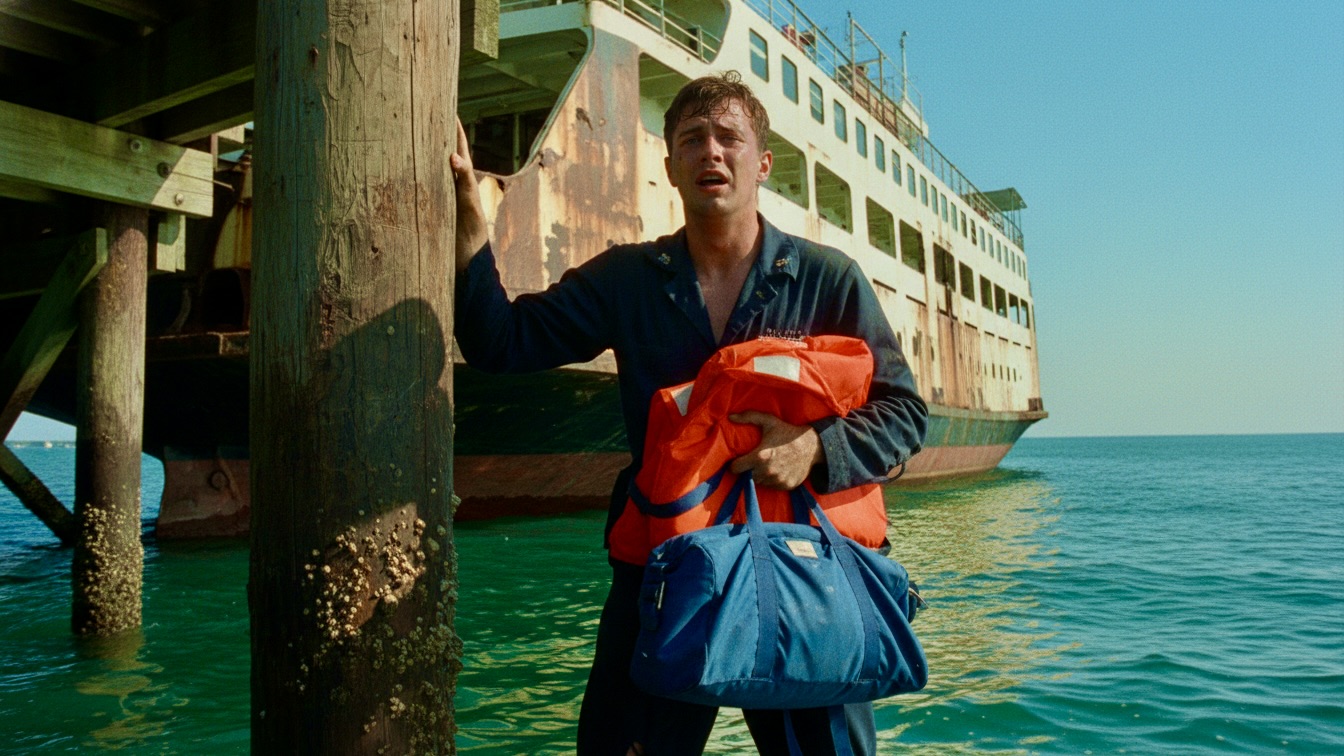
On the car deck, Jordan finds himself cornered between patrolling mercenaries and the approaching dock, which he realizes is a trap set by the corrupt local police. He smashes the fire suppression alarm, drenching the deck in thick chemical foam that blinds the operatives and allows him to reach the manual ramp release. In a final act of defiance, Jordan ties the bag to a life jacket and leaps into the freezing sound, choosing the danger of the water over the certain betrayal waiting on the pier.
The episode begins with a mood of "Industrial Ennui," characterized by heat, salt, and the boredom of a dead-end job. This quickly shifts into "Acute Paranoia" as the tactical team arrives, creating a sharp, jagged tension that spikes during the engine room confrontation. The climax is a blur of "Desperate Adrenaline" and sensory overload—white foam, screaming alarms, and freezing water—ending on a note of "Cold Resolve" as Jordan realizes he can never go back to his old life.
If expanded, the season would follow Jordan as a fugitive in his own town, using the data in the ledger to systematically expose the members of the "laundromat." Each subsequent episode would focus on a different name in the book, revealing how the corruption affects various sectors of Harbor’s Edge, from the fishing industry to the local hospital. Jordan would evolve into an urban legend—a "ghost deckhand" working from the shadows to dismantle the system.
The season-long thematic escalation would move from local corruption to a broader national conspiracy, suggesting that Harbor’s Edge is merely one node in a larger network. The finale would see Jordan returning to The Selkie for a final confrontation, not as a deckhand, but as the catalyst for a full-scale regional investigation. This arc explores the cost of being a hero in a town that doesn't want to be saved.
The visual style is "Gritty Maritime Realism," utilizing a desaturated palette of seafoam greens, oily blacks, and rusted oranges. The cinematography should feel handheld and intimate, capturing the claustrophobia of the ship's interior and the overwhelming scale of the open water. Lighting should play with the "problematic" morning sun, using lens flares to disorient the audience and high-contrast shadows in the engine room to hide the hunters.
Tonal influences include the grounded tension of Captain Phillips and the systemic dread of Sicario. The sound design is crucial, utilizing the constant, bone-shaking thunder of the diesel engines as a rhythmic heartbeat for the episode. The tone is unyielding and humid, making the audience feel the grit of the salt and the slickness of the diesel on Jordan’s skin.
The target audience is adults and young adults (18-45) who gravitate toward grounded, "blue-collar" thrillers and conspiracy dramas. It appeals to viewers who enjoy high-stakes tension in mundane settings, such as fans of The Bear or Outer Range. The story’s focus on class struggle and systemic corruption resonates with a contemporary audience skeptical of institutional authority.
The episode is designed for a relentless 10-12 minute runtime, following a "Real-Time" structure once the mercenaries board the ship. The first three minutes establish the setting and the "small inconveniences" of Jordan’s life, while the remaining time is a continuous, high-tempo sequence of pursuit and escape. There are no subplots; the camera stays locked on Jordan’s perspective to maintain a sense of breathless urgency.
The primary production challenge is the use of a functional or realistic ferry set, requiring a location with an engine room, car deck, and passenger lounge. Practical effects are preferred for the fire suppression foam sequence to ensure the actors’ movements are authentically hindered by the slippery, blinding environment. This sequence requires careful planning for equipment protection and safety due to the simulated "chemical snow."
Water safety and stunt coordination are paramount for the final leap and the subsequent swimming sequence under the boardwalk. The "Ghost Op" tactical gear should be matte-finished and non-reflective to contrast with the bright, oily surfaces of the ship. Using a real ferry during a scheduled crossing or in a controlled dock environment will provide the necessary "vibration" and mechanical noise that defines the episode's atmosphere.


