Format: Short Film / Anthology Episode | Est. Length: 10-12 minutes
Imagine this story as a visceral, sensory-heavy entry in a prestige anthology series that explores the "micro-apocalypses" of modern relationships. The episode serves as a high-tension study of the exact moment a shared future evaporates, using the oppressive humidity of a stagnant summer to mirror the suffocating weight of a hidden ambition.
"Phone Screen Glare" serves as an installment in The Humidity Sessions, an anthology series centered on young adults trapped in the "waiting room" of their lives during a record-breaking summer heatwave. Each episode explores a different couple or friend group facing a terminal fracture in their relationship, set against the backdrop of a decaying suburban landscape. The series uses the oppressive climate as a metaphor for internal stagnation, tracking the inevitable boil-over of long-simmering secrets through a lens of gritty, sweaty realism.
The silence of a stagnant apartment is shattered by the rhythmic, insect-like buzz of a cracked smartphone, revealing a notification for an international job offer that the owner's partner was never supposed to see.
A young woman discovers her boyfriend’s secret plan to abandon their shared future for an internship in Zurich. As they navigate a sweltering drive to a desolate beach, she must confront the reality that their relationship has already reached its expiration date.
The primary theme is the "Transaction of Intimacy," examining how relationships can devolve into a series of silent negotiations and emotional bookkeeping where one person’s growth necessitates the other’s abandonment. It explores the transition from adolescence to adulthood not as a celebratory milestone, but as a violent shedding of skin that leaves both parties exposed and raw.
Secondary themes include "Digital Betrayal" and "Environmental Oppression," where the physical heat and the blue light of a screen become physical manifestations of psychological discomfort. The story functions as a contemporary drama with "mumblecore" sensibilities, focusing on the heavy, unsaid truths that linger in the gaps between spoken dialogue.
For Steve, the stakes are her entire sense of stability and her vision of the next four years; losing Leon means losing the "safe" path she had constructed to survive her hometown. For Leon, the stakes are his identity and the fear of becoming a "default setting" in a town that swallows ambition. Both characters risk the total loss of their shared history to secure a future that neither of them can fully visualize together.
The central conflict is interpersonal, rooted in Leon’s deception and Steve’s refusal to accept a secondary role in his new life. External antagonistic forces include the oppressive July heat and the socioeconomic stagnation of their suburb, which acts as a pressure cooker forcing them apart. Internally, both characters battle the guilt of wanting different things and the fear that they are no longer enough for one another.
In a sweltering, flat-packed apartment, Steve notices a DM on Leon’s cracked phone screen regarding a "next steps" meeting in Zurich—a secret that contradicts their plan to attend state university together. When Leon returns from the kitchen, his uncharacteristic hesitation confirms Steve’s suspicions, prompting a desperate, high-tension drive to the coast in a car with no air conditioning. The physical discomfort of the journey mirrors the rising emotional friction as Steve forces Leon to confront his dishonesty.
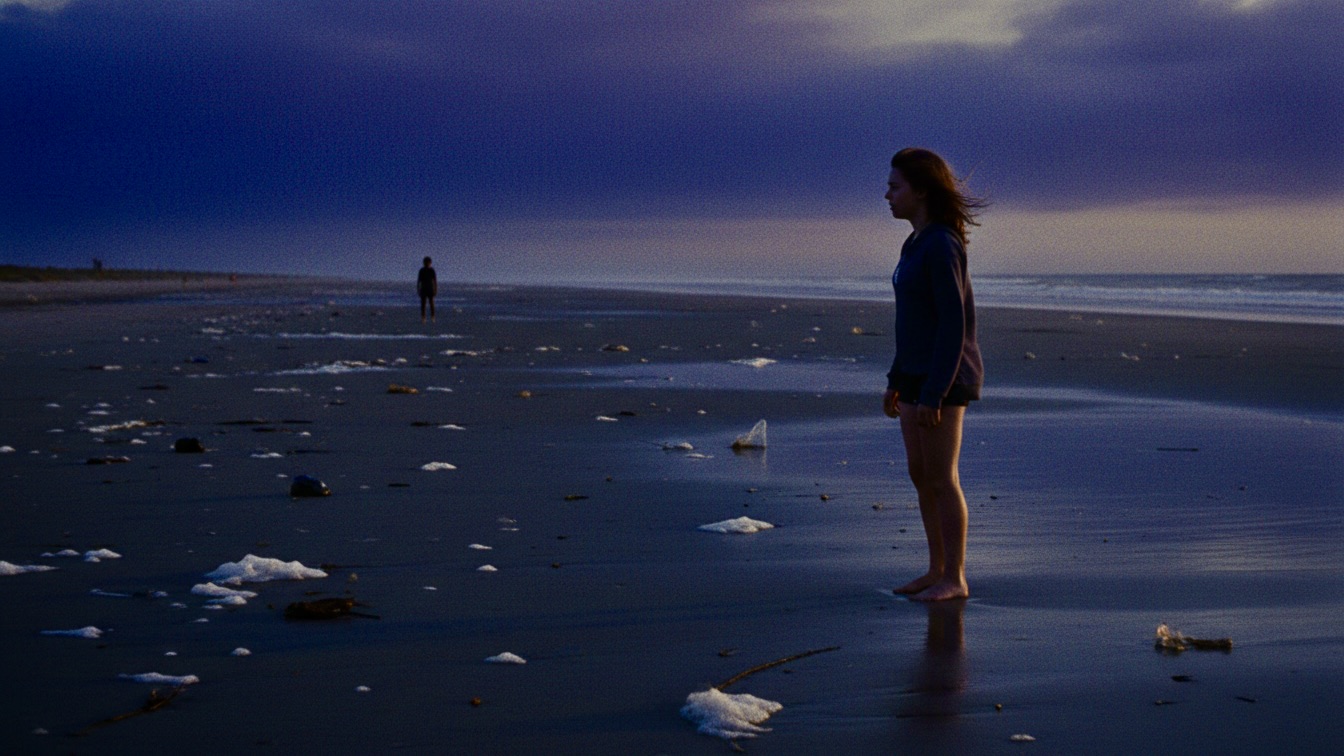
At a desolate, debris-strewn beach, the truth fully unravels: Leon leaves in two weeks, on Steve’s eighteenth birthday. The revelation acts as the final blow, stripping away Leon’s excuses and leaving Steve with the cold realization that he had already mentally exited their life months ago. They return home in a heavy, indigo-hued silence, where Steve officially ends the relationship, choosing the lonely clarity of her "default" life over the lingering lie of their partnership.
Steve (Protagonist): A young woman defined by her pragmatism and a quiet desperation to escape her town through a "mediocre but safe" plan. At the start, she is observant but passive, clinging to the familiar structure of her relationship; by the end, she has undergone a hardening, accepting the "cold peace" of being alone over the "warm lie" of her partnership.
Leon (Antagonist/Partner): A boy wearing a second skin of bravado to hide his terror of being ordinary. He begins the episode as a "heat-seeking missile" for his device, avoiding the reality of his choices; he ends it as a smaller, more transparent figure who has achieved his dream of escape at the cost of his integrity.
Beat 1 (The Catalyst): The episode opens with the jarring vibration of Leon’s phone on a coffee table, its blue light cutting through the dim, stagnant air of the apartment. Steve stares at the "Zurich" notification through a spider-webbed screen, realizing the map of her future has just been redrawn without her consent. Leon enters, his sweaty hairline and hesitant movements betraying his guilt before a single word is even spoken.
Beat 2 (The Pressure Cooker): Leon attempts a "desperate pivot" by suggesting a trip to the beach, leading to a grueling drive in a silver sedan where the broken AC forces them to breathe in the exhaust of the highway. Inside the cabin, the silence is weaponized until Steve breaks it, forcing Leon to admit the internship is real and his departure is imminent. The tension peaks as the car reaches the coast, the physical heat of the interior becoming unbearable just as the emotional truth becomes undeniable.
Beat 3 (The Climax): On a jagged, low-tide shoreline, Steve discovers that Leon’s flight is scheduled for her eighteenth birthday, a detail he had completely disregarded in his excitement to leave. This revelation serves as the "final transaction," where Steve realizes she isn't even a hurdle to him anymore, but a forgotten footnote. The episode concludes with a silent drive back to a darkened suburb, where Steve exits the car and the relationship, finding a hollow sense of peace in the familiar, safe "default setting" of her bedroom.
The episode follows a trajectory from "Stagnant Anxiety" to "Feverish Confrontation," ending in "Cold Resignation." The audience should feel the physical weight of the humidity and the sharp, blue-light intrusion of the phone, creating a sensory experience of being trapped. The final mood is one of somber clarity, where the relief of the sun setting is tempered by the loneliness of the protagonist’s new reality.
In a full season, this episode would serve as the mid-point "breaking point" for the series' exploration of suburban exodus. While other episodes might focus on characters who successfully leave together or those who are left behind without explanation, Steve’s story highlights the "administrative" end of a romance—the paperwork of a breakup.
The season-long arc would track the rising temperature of the summer, with the final episode occurring during a blackout where all characters from previous segments are forced into a singular, dark space. This would allow for a thematic escalation from individual betrayals to a collective realization that their environment is no longer habitable, physically or emotionally.
The visual style is "Sweaty Realism," utilizing shallow depth of field and extreme close-ups on textures: the cracks in the phone screen, beads of sweat, and the shimmering asphalt. The color palette shifts from the sickly, over-saturated yellows and oranges of the afternoon to a bruised, desaturated indigo during the final scene.
The tone is influenced by the "New Realism" of films like Blue Valentine, where the beauty of the setting is undercut by the decay of the circumstances. Tonal comparables include the claustrophobic intimacy of Normal People and the environmental dread of contemporary indie dramas, emphasizing the silence between characters.
The target audience is Gen Z and Millennials (Ages 18-34) who gravitate toward character-driven "slice of life" dramas and anthology series like Black Mirror or The White Lotus. It appeals to viewers who appreciate high-aesthetic, emotionally resonant storytelling that mirrors the complexities of modern digital life and the anxieties of early adulthood.
The pacing is "Deliberately Oppressive," utilizing long takes and slow camera movements to simulate the feeling of moving through thick humidity. The 10-12 minute runtime follows a strict three-act structure: Act I (The Discovery/The Apartment), Act II (The Journey/The Car), and Act III (The Reckoning/The Beach and Return).
Production requires a "Gritty Practicality," emphasizing the use of natural light and practical locations to maintain the sense of realism. Special attention must be paid to the sound design, specifically the contrast between the mechanical hum of the AC/car and the organic, messy roar of the ocean.
The phone screen's "spider-web" crack should be a recurring visual motif, requiring a high-quality prop or VFX overlay that remains consistent across close-ups. The "Zurich" notification must be legible but brief, acting as a visual "brand" that haunts the protagonist throughout the episode.


