Format: Short Film / Anthology Episode | Est. Length: 10-12 minutes
Asphalt Cabbage serves as a pilot or standalone installment for The Concrete Plate, an anthology series exploring the grotesque intersection of extreme culinary subcultures and urban decay. Each episode follows a different "food scout" navigating the ethical minefields of high-end dining in low-income environments, revealing how the aestheticization of poverty by the elite leads to the literal deprivation of the marginalized. The series functions as a dark, satirical mirror to modern "foodie" culture, where the search for authenticity becomes a parasitic act of consumption.
A desperate, broke food critic pays $500—his entire rent—to eat a pile of bitter weeds harvested from a toxic railway yard under a bridge in Winnipeg.
When a failing journalist’s review of an illegal "foraged" supper club goes viral, he inadvertently triggers a gentrification of the city's weeds that starves the local community. To save his career, he must decide whether to expose the chef’s fraudulent "dumpster-to-table" gala or become a permanent architect of the elite lie.
The primary theme is Cultural Parasitism and the Gentrification of Survival. The story examines how the wealthy "discover" and commodify the survival tactics of the poor, turning necessary foraging into a high-status trend that ultimately destroys the resource for those who need it most. It highlights the "locust" nature of internet-driven consumerism, where a community's ecosystem is stripped bare to provide a "visceral" background for a social media post.
The secondary theme is the Death of Authenticity in the face of Narrative. Through the character of Marcel, the narrative explores how the modern economy prizes the "story" of a product over its actual substance or ethical origin. It posits that in a world obsessed with "edgy" aesthetics, a curated lie—like expensive greens covered in alley dirt—is more valuable and safer to consume than the unvarnished, dangerous truth of the streets.
For Danny, the stakes are his professional survival and his moral identity; if he fails to produce a viral story, he loses his livelihood, but if he maintains the lie, he secures a future built on the exploitation of the neighborhood he lives in. For Brenda and the local immigrant community, the stakes are literal food security, as their traditional, non-commercial food sources are obliterated by a trend they cannot afford to participate in.
The external conflict is a class war fought over "worthless" greens, pitting the predatory "foodie" elite against the marginalized residents of the neighborhood. Marcel acts as the primary antagonist, representing the cynical exploitation of urban neglect for profit, while Brenda serves as the moral antagonist who forces Danny to face the consequences of his influence. Internally, Danny is conflicted between his genuine guilt for the "locust swarm" he initiated and his seductive desire for the "VIP" status and relevance that Marcel offers him.
Danny, a struggling food critic in Winnipeg, visits an illegal under-the-bridge supper club run by the enigmatic Chef Marcel, where he pays a month's rent to eat foraged "post-industrial" weeds. His glowing review, which frames the bitter plants as the "decaying soul of urban infrastructure," goes viral and causes a swarm of wealthy influencers to descend on the city's parks. These "locusts" strip the boulevards of every edible weed, inadvertently robbing the local immigrant families—who rely on foraging to supplement their groceries—of a vital food source.
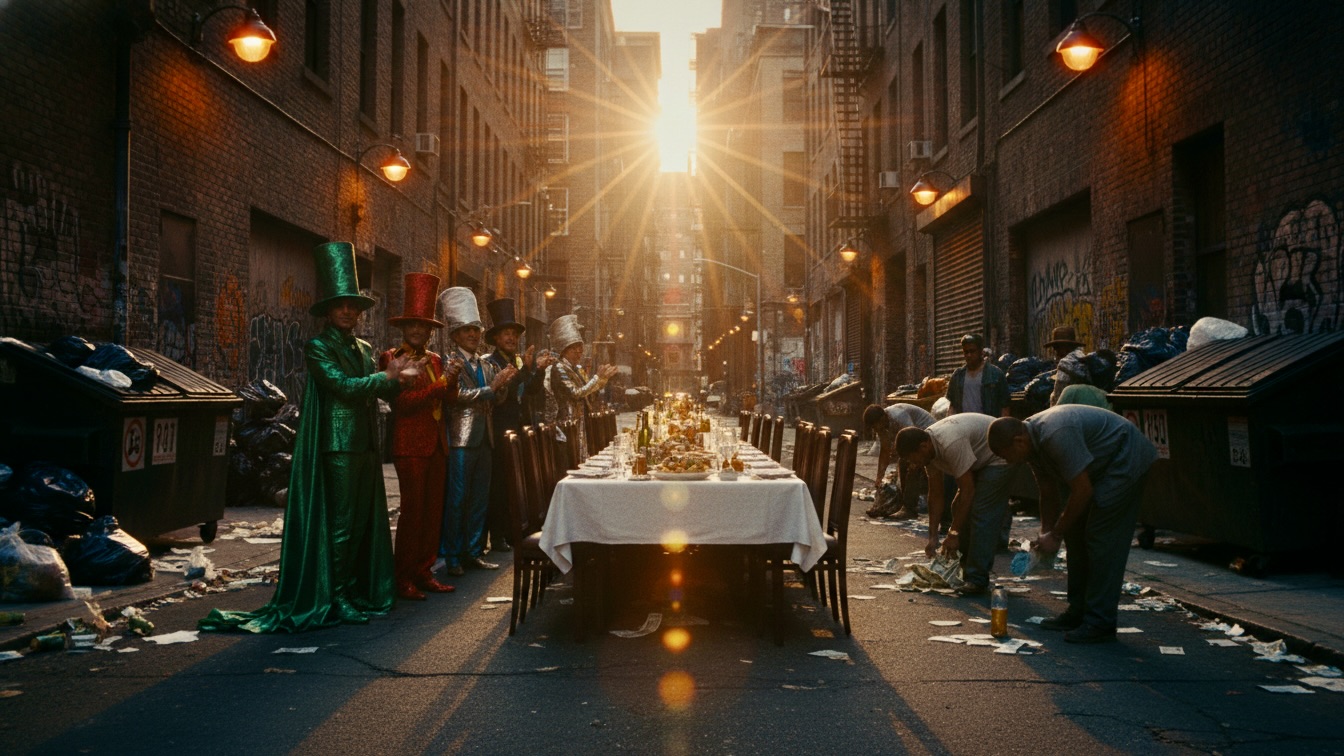
Confronted by Brenda, a community leader, Danny discovers the scale of the damage he has caused and tracks Marcel to a new "Dumpster Gala" to demand an end to the trend. Instead, he finds Marcel faking the experience by rubbing expensive, imported California micro-greens in literal street dirt to keep up with the demand he created. When Brenda and a group of protesters arrive to shut the event down, Danny cynically rebrands their genuine rage as "performance art" to the wealthy patrons. The elite guests respond by throwing cash at the protesters, and Danny is rewarded with a VIP pass and luxury caviar, choosing to swallow the lie rather than return to obscurity.
Danny: A cynical, broke journalist who begins the episode desperate for a career-saving scoop and ends as a high-level gatekeeper of a fraudulent elite. His psychological arc is a descent from a seeker of "urban truth" to a curator of "profitable narrative," trading his integrity for a seat at the table. He represents the complicity of the media in commodifying the struggles of the working class.
Marcel: A cold, calculated chef who views the city as a stage and his customers as marks to be manipulated. He is the ultimate opportunist, shifting from genuine (if pretentious) foraging to outright fraud when the supply chain fails, proving he values the "aesthetic of poverty" over the people living in it. He is entirely devoid of irony, making his cynicism all the more dangerous.
Brenda: The moral anchor of the story, a community leader who represents the tangible consequences of Danny’s words. She begins the episode in righteous anger and ends in a state of defeated pragmatism, forced to accept the "charity" of the people who are destroying her neighborhood's resources. Her arc is a tragic realization that in Danny's world, even her protest is just another form of entertainment for the rich.
Beat 1: The Underpass Encounter. Danny meets Marcel under the Arlington Bridge, paying $500 for a slate of rail yard weeds that taste like "wet pennies" and lawnmower clippings. Despite the bitterness and the heat, Danny recognizes the "audacity" of the dish as his ticket back to journalistic relevance. He writes a feverish review that night, prioritizing the "vitality" of the experience over any potential social impact.
Beat 2: The Locust Swarm. Danny’s article explodes online, and he watches in horror as influencers in designer gear strip the city's boulevards of every edible weed for Instagram content. Brenda confronts him in a coffee shop, revealing that his "trend" has robbed elderly immigrants of their primary source of fresh produce and left the parks as mud pits. The weight of his influence begins to turn from a professional triumph into a heavy, moral burden.
Beat 3: The Alley Fraud. Danny tracks Marcel to a "Dumpster Gala" behind a supermarket, only to find the chef's team rubbing expensive California micro-greens in literal street dirt. Marcel cold-bloodedly explains that the "narrative" of danger is what sells, and that he pivoted to fraud because Danny's readers already depleted the local "supply chain." Marcel dares Danny to take a photo and destroy the illusion, knowing Danny won't trade his new-found relevance for the truth.
Beat 4: The Performance Art Pivot. Brenda and the protesters arrive to shut down the gala, but Danny seizes the microphone and rebrands their genuine rage as an "immersive installation" called The Confrontation. The wealthy patrons, delighted by the "edginess," begin throwing cash at the protesters as if they are street performers. Brenda is forced to pick up the money to feed her community, her eyes meeting Danny’s in a final, silent act of total betrayal.
Beat 5: The Taste of Success. The protesters leave with their crumpled bills, and Marcel rewards Danny with a lifetime VIP pass and a spoonful of genuine, wildly expensive Beluga caviar. Danny looks out at the polluted Red River, recognizing the sludge in the water reflects his own moral state. He raises the spoon, closes his eyes, and swallows the caviar, fully committing to his role as a tastemaker in a world of filth.
The episode begins with a sense of desperate, sweaty grit and intellectual curiosity, drawing the audience into Danny’s struggle for survival. The mood then shifts into a frantic, chaotic energy as the trend goes viral, creating a sense of "social media vertigo." Finally, the atmosphere settles into a cold, clinical cynicism during the "Dumpster Gala," ending on a note of hollow, expensive silence that leaves the audience feeling complicit and uneasy.
Over a full season, Danny would rise through the ranks of the "Concrete Plate" subculture, becoming the primary architect of increasingly dangerous and exploitative dining trends. Each episode would introduce a new "ingredient" sourced from a site of trauma or decay—such as "flood-plain silt" or "abandoned-factory honey"—escalating the tension between the diners and the displaced locals. Danny would move from being a mere observer to a powerful gatekeeper who decides which neighborhoods are "ripe" for culinary discovery.
The season-long arc would track Brenda’s transition from a community organizer to a radicalized saboteur, eventually leading to a violent clash at a "Final Supper" event hosted in a gentrified housing project. Danny’s internal struggle would culminate in a choice to either burn the entire system down or become the very thing he once mocked: a man who knows the price of everything and the value of nothing. The season ends with Danny realizing that he has become the "Asphalt Cabbage"—a product of the cracks, hardened and bitter, but ultimately consumed by the system.
The visual style is "Industrial Neo-Noir," utilizing high-contrast lighting, harsh sodium-vapor yellows, and deep, oily shadows to emphasize the heat and grit of Winnipeg. The camera work should be intimate and handheld during the foraging and protest scenes to create a sense of visceral realism, shifting to static, wide, and symmetrical shots for the "Gala" to highlight its artificiality. The color palette should transition from the dusty browns and greens of the rail yard to the stark blacks and whites of Marcel’s "theater."
The tone is a "Gourmet Satire" in the vein of The Menu or Succession, where the absurdity of the dialogue is played with deadly seriousness. Sound design should emphasize the crunch of gravel, the scrape of silver on slate, and the buzzing of flies to create a sensory experience that feels both luxurious and repulsive. The music should be a jarring mix of industrial drone and elegant, classical strings to mirror the clash between the alleyway setting and the elite clientele.
This is intended for an adult audience (18-45) who enjoys dark social satire, "foodie" culture critiques, and prestige anthology dramas like Black Mirror or The White Lotus. It appeals to viewers interested in urban sociology, the ethics of modern journalism, and the dark side of internet-driven consumerism. The audience is likely one that recognizes the absurdity of high-end trends but feels the uncomfortable tug of their own complicity in them.
The pacing is a "slow burn" that accelerates into a "fever dream." The first five minutes focus on the atmospheric tension of the initial meal and the writing process, establishing the stakes. The middle three minutes are a rapid-fire montage of the viral fallout and Brenda's confrontation, increasing the tempo. The final four minutes are a high-tension, real-time confrontation in the alleyway, slowing down to emphasize the weight of Danny's moral choice.
Practical locations are essential for the "Asphalt Cabbage" aesthetic; the production requires a genuine industrial underpass and a gritty back-alley loading dock to ground the satire in a physical reality. The "food" props must be meticulously crafted to look both like trash and high-end cuisine, requiring a specialized food stylist who can work with "edible decay" to make weeds look like art.
The "locust swarm" montage can be achieved through a mix of found-footage style social media clips and staged B-roll to keep costs down while emphasizing the digital nature of the trend. The final scene requires careful lighting to balance the "apocalyptic chic" of the guests with the stark, unglamorous reality of the protesters, ensuring the visual contrast between the two groups is as sharp as the narrative conflict.


