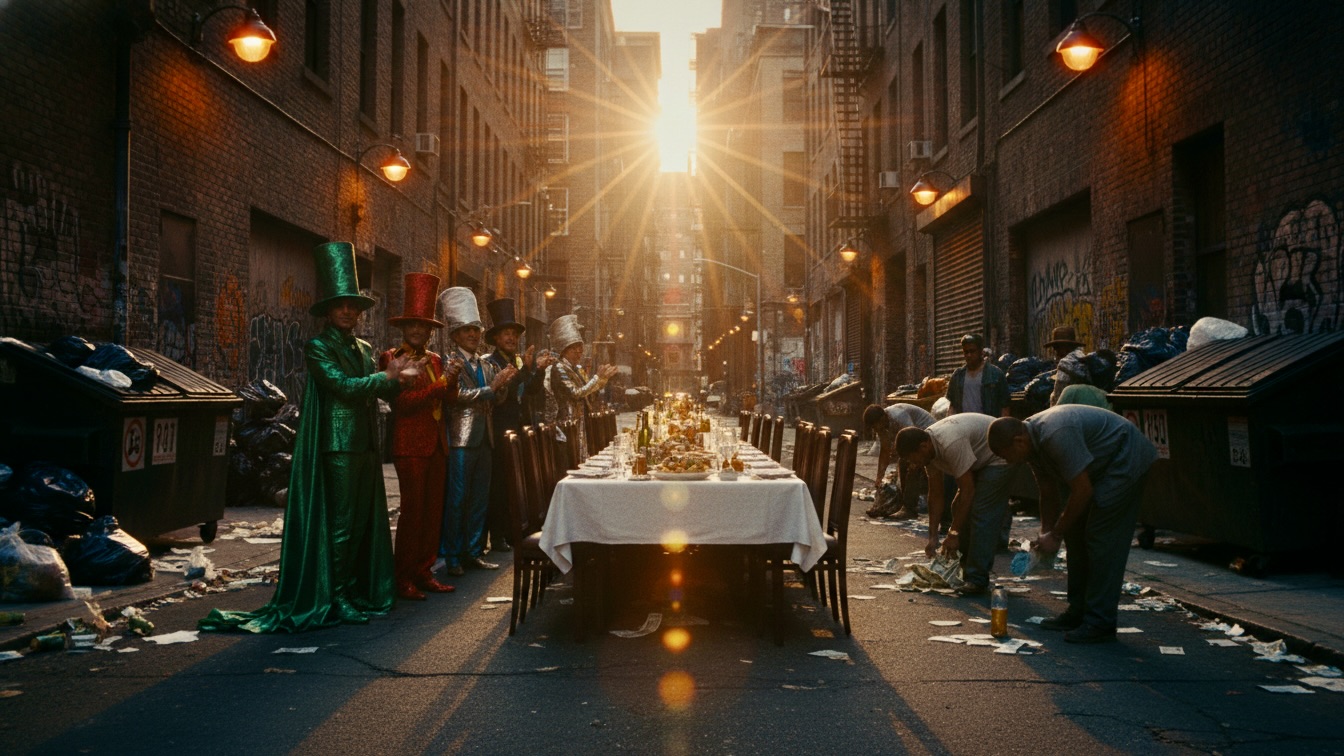
Danny, a struggling food critic in Winnipeg, finds himself on the brink of professional ruin until he discovers an illegal, high-concept supper club run by the enigmatic Chef Marcel. Danny’s review of Marcel’s "post-industrial terroir"—which consists of weeds harvested from urban rail yards—goes viral, transforming a niche culinary experiment into a city-wide obsession. This sudden trend leads to disastrous real-world consequences as wealthy influencers strip the city’s parks of plants that marginalized communities rely on for survival. Brenda, a local community activist, confronts Danny about the harm his writing has caused, prompting him to investigate Marcel’s latest venture, the "Dumpster Gala."
In the shadows of an alley, Danny discovers that Marcel is faking his foraged ingredients by using expensive organic greens covered in street dirt to meet the overwhelming demand. When Brenda and a group of protesters arrive to disrupt the gala, Danny experiences a moment of moral crisis but ultimately chooses his own career over the truth. He manipulates the situation by convincing the wealthy patrons that the protest is actually an immersive piece of performance art. The patrons respond by throwing money at the protesters, effectively commodifying their genuine suffering and silencing their message. The story concludes with Danny accepting a VIP pass and consuming luxury caviar, fully embracing his role as a cynical architect of urban artifice.
The narrative serves as a scathing critique of the gentrification of poverty and the predatory nature of modern "lifestyle" trends. By transforming the survival tactics of the poor—such as foraging for wild greens—into a high-status luxury experience, Marcel and Danny strip these actions of their original meaning and utility. This "poverty porn" allows the wealthy to consume the aesthetic of struggle without ever facing the actual risks of hunger or illness. The story highlights how the "urban chic" movement often operates as a locust swarm, consuming the resources of a neighborhood before moving on to the next trend.
Authenticity is explored as a manufactured commodity rather than a genuine quality. Marcel’s pivot to serving "dirty arugula" demonstrates that in the world of high-end consumerism, the narrative surrounding a product is far more valuable than the product itself. The patrons do not actually want to eat dangerous, heavy-metal-laden weeds from a rail yard; they want the social capital that comes from appearing brave enough to do so. Danny becomes the essential accomplice in this deception, providing the intellectual framework that allows a blatant fraud to be perceived as visionary art.
The corruption of activism and the neutralization of dissent are central to the story’s climax. When Danny rebrands Brenda’s protest as a "Confrontation" installation, he demonstrates how the elite can co-opt resistance to reinforce their own status. By turning a systemic grievance into a theatrical performance, he allows the wealthy to feel benevolent through performative charity rather than forcing them to confront their complicity. The theme suggests that in a hyper-mediated society, even the most visceral truth can be flattened into a "content" experience for those with the power to define the narrative.
Danny is a protagonist defined by a volatile mix of professional desperation and intellectual arrogance. At the start of the story, he is motivated by the fear of being relegated to covering "local zoning board meetings," a fate he views as a form of social death. This insecurity makes him highly susceptible to Marcel’s cynical worldview, as he recognizes that his survival depends on his ability to manufacture "relevance." While he experiences flashes of guilt when confronted by Brenda, his primary psychological defense is a layer of "defensive irony" that allows him to distance himself from the consequences of his work.
As the story progresses, Danny’s internal conflict shifts from a struggle with guilt to a calculated embrace of power. He possesses a keen psychological understanding of his audience, which he uses to manipulate the crowd at the Dumpster Gala. His decision to lie about the protest is not a panicked reaction, but a deliberate choice to preserve the "illusion" that grants him his status as a tastemaker. By the end of the narrative, Danny has fully integrated the role of the elite gatekeeper, choosing the refined taste of caviar over the bitter reality of the streets he once claimed to document.
Marcel functions as the story’s dark visionary, a man who has completely transcended traditional morality in favor of a purely aesthetic and commercial logic. He is characterized by a lack of irony, which Danny initially mistakes for artistic integrity but later realizes is the mark of a master manipulator. Marcel understands that his clientele craves a sense of "danger" that is entirely controlled and sanitized. He views the "ecosystem" not as a biological reality to be respected, but as a supply chain to be exploited until it is depleted.
His psychological profile is that of a high-functioning sociopath who views human interaction as a series of performances. When he is caught faking his ingredients, he does not feel shame; instead, he offers Danny a partnership in the lie. Marcel recognizes Danny as a necessary extension of his own brand, the "lead critic" who builds the stage upon which Marcel can perform. His final gesture of offering Danny caviar is a symbolic invitation into a world where reality is irrelevant and the only thing that matters is the maintenance of the "narrative."
Brenda serves as the moral conscience of the narrative, representing the tangible human cost of Danny and Marcel’s games. She is defined by her exhaustion and her groundedness, standing in sharp contrast to the "apocalyptic chic" of the gala guests. Her psychological state is one of suppressed rage fueled by the observation of systemic injustice. Unlike Danny, she does not view the city as a "terroir" or a "stage," but as a community of people trying to survive. Her confrontation with Danny in the coffee shop reveals her deep understanding of how media narratives can cause physical hunger in her neighborhood.
Her tragedy lies in her eventual forced participation in the very system she despises. When the gala guests begin throwing money at the protesters, Brenda’s initial defiance is met with the crushing reality of her community’s needs. Her decision to pick up the fifty-dollar bill is not an act of greed, but a devastating admission of defeat. She realizes that in Danny’s world, her genuine pain is more profitable as a performance than as a protest. Her silent exit signifies the total erasure of her voice by the very "tastemakers" who claimed to be celebrating the city’s soul.
The author employs a gritty, sensory-heavy prose style that emphasizes the physical discomfort of the urban environment. The "weight" of the heat, the "grit" of the dust, and the "bitter" taste of the weeds create a visceral atmosphere that grounds the story’s more abstract themes. These sensory details serve to highlight the disconnect between the "hostile" reality of the city and the sanitized version consumed by the elite. The pacing is deliberate, beginning with a slow, stagnant build-up that mirrors the Winnipeg heat and escalating into the chaotic, feedback-heavy energy of the Dumpster Gala.
The tone of the story is deeply cynical, utilizing the language of high-end food criticism to mock the pretension of its subjects. Phrases like "decaying soul of urban infrastructure" and "post-industrial terroir" are used to show how Danny uses elevated vocabulary to mask the ugliness of his observations. This linguistic manipulation is a key stylistic choice, reflecting the way the characters use words to rewrite reality. The contrast between the "stark white linen" of Marcel’s table and the "discarded plastic bottle caps" of the embankment visually represents the story’s central conflict between artifice and decay.
The narrative voice remains detached and observational, even as the events reach a point of absurdity. This detachment mirrors Danny’s own psychological distancing from his actions. The use of the "cracked phone" as a recurring motif symbolizes the distorted lens through which Danny views the world—a fractured perspective that he refuses to fix because it provides him with his livelihood. The final image of the caviar on a mother-of-pearl spoon, set against the backdrop of a sludge-filled river, serves as a powerful visual metaphor for the story's conclusion, leaving the reader with a sense of moral nausea.


