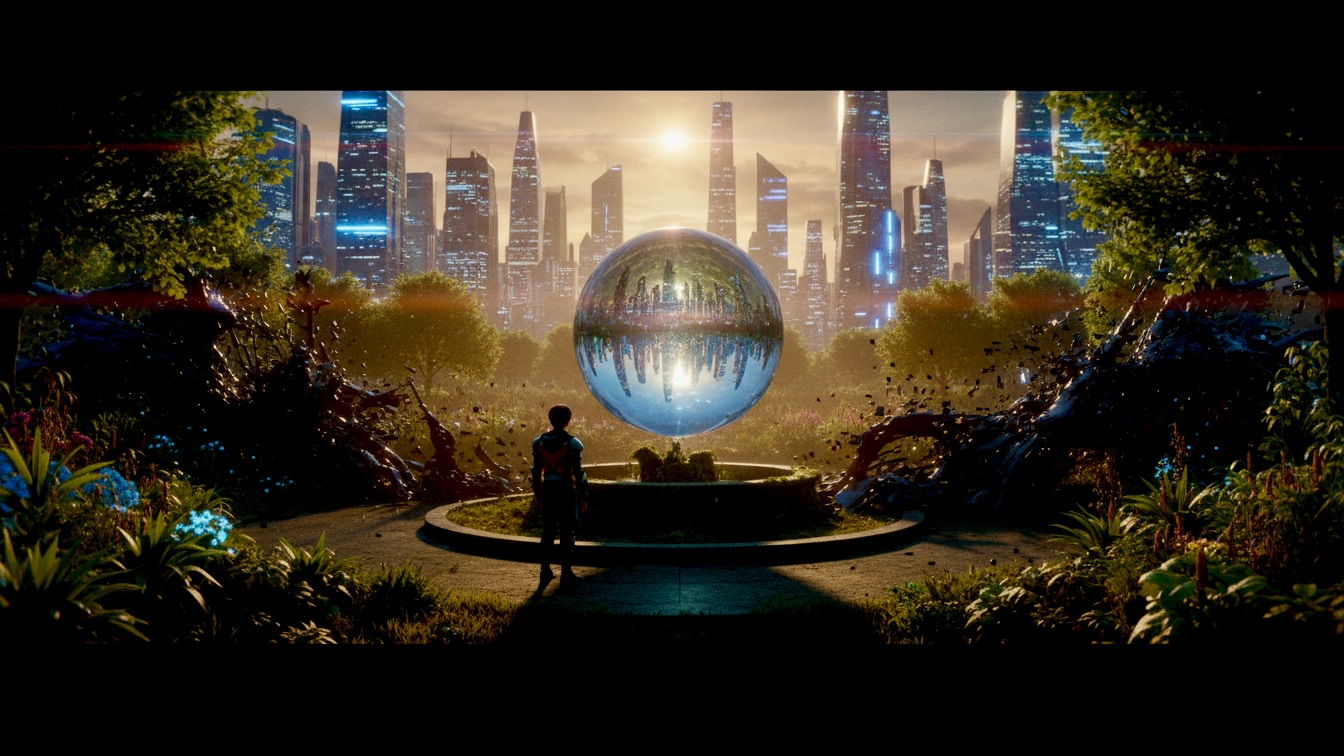
Format: Short Film / Anthology Episode | Est. Length: 10-12 minutes
Imagine a world where the "Harmony Protocol" has digitized human consciousness, smoothing out the jagged edges of history and emotion to ensure societal stability. This episode serves as a pivotal entry in The Un-Synced, an anthology series exploring the "blind spots" of a perfect dystopia where forgotten memories manifest as physical distortions in the environment. The series follows various "glitch-hunters" and "Burners" as they navigate the crumbling seams between the curated digital reality and the raw, painful truths of the analog past.
Leo stands in a community garden where the shadows are rendered at a lower resolution than the rest of the world. He touches a cold tomato leaf, triggering a violent, jagged memory of a girl in a yellow jacket that he is legally required to forget.
In a city where digital "Harmony" erases painful memories, a disconnected man must retrieve a physical data drive from a glitching garden. He faces a lethal recovery team to broadcast a truth that will shatter the city's collective peace and return the burden of memory to the masses.
The primary theme explores the necessity of grief and the danger of curated reality, suggesting that a "perfect" life is a hollow one without the context of past struggle. It delves into the conflict between digital convenience and analog truth, positioning memory as a physical, unyielding force that cannot be fully deleted by software.
The narrative also examines the concept of "somatic memory"—the idea that the body remembers what the mind is forced to forget. By using a physical scar as an encryption key, the story highlights the rebellion of the biological self against a sanitized, technological over-structure.
For Leo, the stakes are his sanity and his identity; failing to broadcast the drive means losing the memory of Maya forever to the "Blue Light" of chemical suppression. On a societal level, the broadcast threatens the stability of the entire district, risking mass psychological trauma and the collapse of the Harmony Protocol in exchange for the return of free will.
The external conflict is a race against time as Leo evades "Specialists" and drones while navigating "Shadow Mass" distortions that un-render the physical world around him. Internally, Leo battles the "Harmony Protocol" within his own mind, struggling to reconcile his tranquilized, "synced" present with the jagged, metallic taste of a past he was never supposed to reclaim.
Leo, a man living "off-grid" from his neural Link, visits an un-synced community garden where he encounters Sam, a "Burner" who monitors memory leaks rising from the soil. Together they discover a floating water droplet—a sensory fragment of the past—containing an image of Maya, Leo’s former partner, who helped him hide a physical drive containing the city’s suppressed history before a mass "update" erased her from his mind.
As a Peacekeeper drone detects the memory leak, Leo retrieves the drive and flees to a subterranean archive of analog paper managed by a survivor named Heather. After unlocking the drive with a physical scar the system had digitally "corrected," Leo reaches a rooftop transmitter and broadcasts the data, shattering the city's simulation and forcing both the citizens and the pursuing Specialists to confront their suppressed traumas.
Leo: A hollowed-out survivor of the "Harmony Protocol" who begins the story in a state of chemically induced apathy and sensory "buffering." By the end of the episode, he has reclaimed his trauma and his physical identity, choosing the agony of truth over the comfort of the digital lie.
Sam: A "Burner" whose attempt to overclock his neural Link left him twitchy and hyper-aware of the world's digital seams. He serves as the prophetic guide to the un-synced zones, moving from a state of paranoid isolation to becoming a sacrificial ally in the final broadcast.
Heather: A stoic archivist living in a subterranean library of analog paper, she represents the physical resistance to digital erasure. Her arc is one of steadfast guardianship, moving from skepticism of Leo’s resolve to a violent, analog defense of the archive against high-tech Specialists.
Beat 1 (The Glitch): Leo enters the Green Patch, noticing the "low-res" shadows and the clicking sound of gravel that signals an un-synced zone. He touches a tomato leaf and experiences a jagged memory of Maya, a girl in a yellow jacket, which causes a physical ache in his jaw. Sam appears from the compost bins, explaining that the "Shadow Mass" is the dampness of buried secrets rising through the roots.
Beat 2 (The Fountain): At the center of the garden, Leo finds a floating sphere of water in a dry fountain that reflects a lush, green past and a younger version of himself. He reaches into the membrane of the sphere, feeling the resistance of the "Shadow Mass" as he retrieves a metallic cylinder hidden in the memory of the basin. A Peacekeeper drone detects the memory leak and alerts a recovery team, forcing Leo and Sam to flee as the garden begins to un-render into gray ash.
Beat 3 (The Archive): Leo and Sam are pulled into a hidden underground archive by Heather, who explains that paper is the only medium the Harmony Protocol cannot edit. Leo uses his physical thumbprint—specifically a childhood scar the Link had digitally "corrected"—to unlock the drive and reveal Maya’s final message. The archive is breached by Specialists using plasma cutters, forcing Heather to stay behind and fight with an iron pipe while Leo and Sam escape to the roof.
Beat 4 (The Broadcast): On the roof of the server farm, Leo connects the drive to an ancient satellite transmitter while a Specialist in carbon-fiber armor demands the "Tier-1" threat. Leo watches Maya’s video message, which urges him to "give them back their ghosts" regardless of the chaos it will cause. He slams the "Send" button, launching a white beam of data that shatters the sky’s simulation and forces the pursuing Specialist to collapse under the weight of their own restored memories.
The episode begins with a cold, sterile sense of detachment and sensory deprivation, mirroring Leo’s "buffering" brain. As the narrative progresses, the mood shifts into high-tension paranoia and then into a visceral, "analog" heat as the characters fight for their memories. The climax provides a cathartic but terrifying release, ending on a note of raw, human vulnerability as the city wakes up to its own collective screams.
If expanded into a full season, the arc would follow the immediate fallout of the "Great Wake-Up," tracking Leo as he searches for the physical Maya while the city collapses into civil war between the "Awakened" and those who crave the return of the Sync. The narrative would explore other un-synced zones, such as "Ghost Malls" and "Static Forests," where the physical world has been permanently corrupted by data overflows.
The thematic escalation would focus on the "Architects" behind the Harmony Protocol attempting to re-sync the population using more aggressive, hardware-based interventions. Leo would evolve from a reluctant messenger into a leader of the Analog Resistance, eventually discovering that the Shadow Mass is not just a glitch, but a sentient manifestation of the city's collective subconscious.
The visual style relies on high-contrast cinematography, where the "synced" city is shot in overexposed, sterile whites and blues with a high frame rate to suggest artificial smoothness. In contrast, the "un-synced" zones and the archive are shot with heavy grain, warm amber lighting, and handheld cameras to emphasize their messy, physical reality.
Tonal influences include the "glitch-art" aesthetic of Spider-Man: Into the Spider-Verse combined with the industrial decay and grounded grit of Children of Men. The "Dead Pixels" and "Shadow Mass" should look like digital artifacts bleeding into a live-action world, creating a sense of visual unease that mirrors the characters' psychological states.
This production targets fans of high-concept sci-fi and psychological thrillers, specifically the 18-35 demographic that enjoys anthology series like Black Mirror or Love, Death & Robots. It appeals to viewers interested in contemporary themes of digital privacy, mental health, and the philosophical implications of memory-altering technology.
The pacing follows a "tightening noose" structure, starting with slow, atmospheric world-building in the garden before accelerating into a frantic, high-stakes chase. The 10-12 minute runtime necessitates a rapid transition from the discovery of the drive to the final broadcast, maintaining a relentless tempo once the Peacekeeper drone appears.
The "Shadow Mass" and "Dead Pixels" effects should be achieved through a mix of practical ink-in-water effects and digital datamoshing to create a truly unsettling visual distortion that feels like the environment is failing to load. This hybrid approach will ground the sci-fi elements in a tangible, physical reality.
The "Specialist" armor should be designed with a matte-black, light-absorbing finish to contrast sharply with the vibrant, white light of the final broadcast beam. Production should prioritize a location with industrial, brutalist architecture for the server farm to enhance the "analog vs. digital" visual conflict during the climax.


