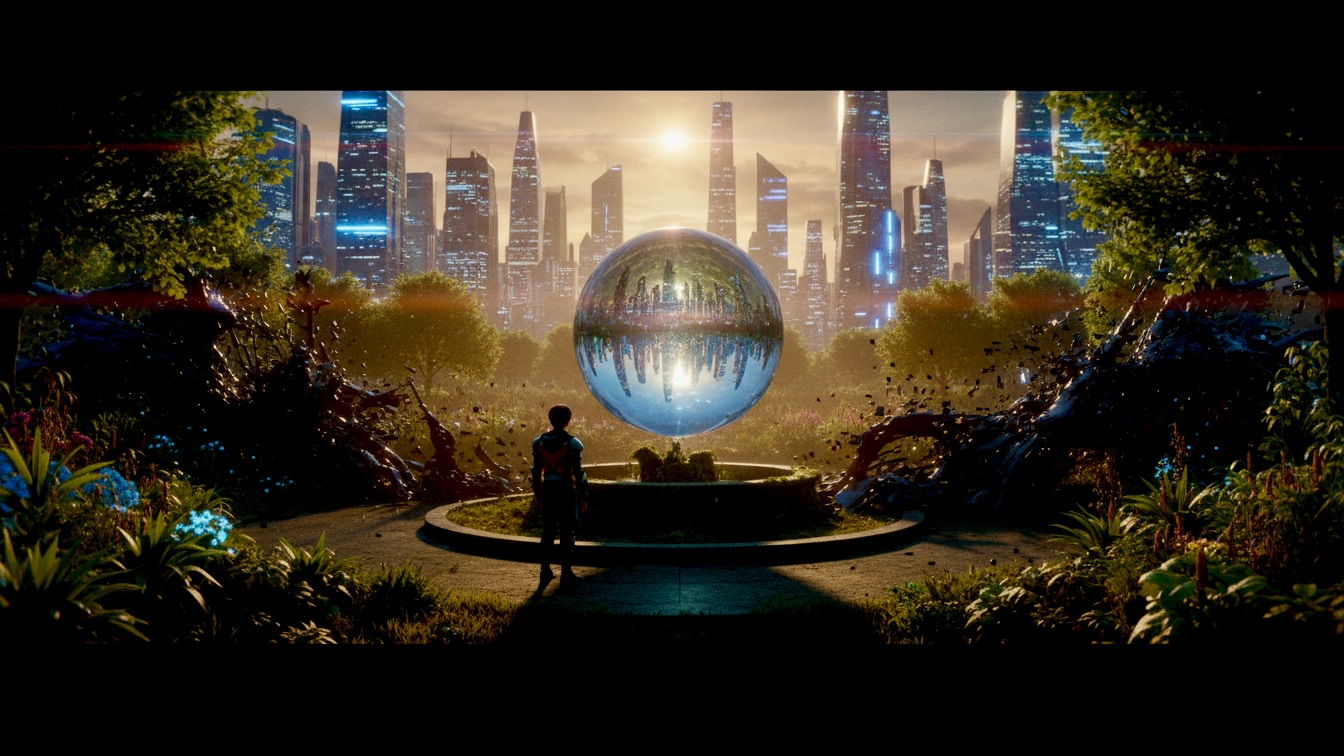
The story follows Leo, a man living in a technologically saturated dystopia where reality is mediated by "the Link" and regulated by the "Harmony Protocol." Leo suffers from a fragmented memory and sensory glitches, leading him to an "un-synced" community garden in search of his lost past. There, he encounters Sam, a technologically scarred individual who guides him toward a hidden truth buried beneath an old oak tree. Through a surreal encounter with a memory fragment of a woman named Maya, Leo retrieves a physical data drive containing suppressed information about the city’s history and a mysterious blackout.
As a security drone detects the "memory leak," Leo and Sam flee to a subterranean archive managed by Heather, a woman who preserves analog history through physical books. Leo uses a physical scar on his thumb—a detail the digital system had erased—to unlock the drive, revealing Maya’s final message. Realizing the drive contains the unfiltered truth of the city's toxicity and the Protocol’s emotional suppression, Leo and Sam race to a rooftop transmitter. Despite a violent confrontation with a robotic Specialist, Leo chooses to broadcast the data, shattering the digital simulation and forcing the population to face a painful, yet authentic, reality.
The central theme of the narrative revolves around the conflict between digital stability and the visceral, often painful, nature of human truth. The "Harmony Protocol" serves as a psychological lobotomy, smoothing over grief and anger to maintain societal order. By framing the system as something that "edits" reality, the story suggests that a life without suffering is a life without identity. Leo’s struggle to remember Maya highlights how personal history is the foundation of the self, and how its removal turns individuals into "zombies" or "dead pixels."
Another prominent theme is the dichotomy between the analog and the digital. The garden, the books in Heather’s archive, and the physical scar on Leo’s thumb represent "un-synced" reality that cannot be remotely updated or deleted. These elements act as anchors to a world that existed before the "Big Sync." The story posits that while digital data is easily manipulated and erased, the "physical world remembers." This suggests that true resistance against authoritarian control lies in the tangible, the messy, and the un-indexed parts of existence.
The narrative also explores the psychological concept of the "return of the repressed," manifested through the "Shadow Mass" and the "leak" in the garden. The system tries to bury the "blackout" and the city's failures, but these suppressed memories eventually seep back into the consciousness of the citizens. The oily, dark distortion at the base of the tree symbolizes the weight of collective trauma that can no longer be contained by the soil. The story argues that truth is an "existential threat" to a manufactured peace because it demands an emotional response that the system cannot control.
Finally, the story examines the ethics of awakening. Leo faces a moral dilemma when he realizes that broadcasting the truth will cause widespread chaos and emotional collapse. He must decide if a "perfect" lie is preferable to a "broken" reality. By choosing to "give them back their ghosts," Leo affirms that human dignity is tied to the ability to feel, even if those feelings are agonizing. The ending suggests that the destruction of the simulation is not a victory in the traditional sense, but a necessary step toward becoming human again.
Leo functions as the narrative’s psychological anchor, embodying the struggle of an individual attempting to reclaim his ego from a collective hive-mind. At the beginning of the story, he is in a state of constant dissociation, described as his brain "buffering." This state of mental suspension reflects his role as a "Citizen" who has been chemically and digitally suppressed. His journey is one of reintegration, moving from a fragmented collection of "dead pixels" toward a cohesive, albeit pained, identity.
His motivation is driven by a deep-seated "itch" for the truth, which is a manifestation of his subconscious resisting the Harmony Protocol. The revelation of his physical scar is the turning point for his character, as it proves that his biological reality is more authentic than his digital profile. When he finally presses the broadcast button, he completes his transformation from a passive observer to an active revolutionary. He accepts the "weight" of the world, choosing the burden of memory over the lightness of the simulation.
Sam serves as a cautionary figure, representing the "Burners" who have been physically and mentally destroyed by the system’s technological overreach. He exists in the margins of society, both literally and figuratively, living in the "gaps between buildings." Psychologically, Sam is a man whose cognitive filters have been stripped away, leaving him vulnerable to the "static" of the world. He acts as a shamanic guide for Leo, possessing a frantic, raw insight that the "synced" citizens lack.
His jittery movements and "gravel in a blender" voice reflect the permanent trauma inflicted by his overclocked Link. Despite his broken state, he retains a fierce loyalty to the idea of a "real world" and a memory of the resistance. Sam’s desperation to "wake them up" is fueled by his own inability to return to a state of peace. He is the physical evidence of the system’s cruelty, a man who would rather live in the "screaming" reality than the silent lie of the Harmony towers.
Although she appears primarily through memory fragments and a recorded message, Maya is the catalyst for the entire plot. She represents the intellectual and emotional heart of the resistance, serving as the "ego ideal" that Leo strives to reconnect with. Her presence is associated with warmth, dirt, and laughter—elements that are starkly absent from the sterile, digital city. She is the one who recognized that the Link was a "partition" designed to separate the present from the past.
Maya’s role is that of a martyr who planned for a future she knew she might not see. Her decision to hide the drive in the garden and use Leo’s unique physical trait as a key shows a profound understanding of both the system’s weaknesses and Leo’s character. She does not offer Leo a happy ending; instead, she offers him the "weight" of the truth. Her final message is a psychological call to arms, urging him to embrace a reality that is "supposed to be real" rather than perfect.
Heather is the guardian of objective history, a character who finds power in the permanence of the analog world. She is defined by her skepticism and her sharp, scanning eyes, which contrast with the "performative cheerfulness" of the Link-users. By maintaining an archive of physical books, she preserves the "non-productive" emotions that the system seeks to erase. She understands that paper is a medium of resistance because it "doesn't update" and "doesn't sync."
Her willingness to engage in an "analog fight" with an iron pipe demonstrates her rejection of the system's sophisticated control methods. She provides the necessary infrastructure for Leo’s awakening, bridging the gap between his personal memories and the collective history of the city. Heather represents the resilience of the human intellect when it is grounded in physical reality. She is the anchor that allows Leo and Sam to transition from the "glitchy" garden to the definitive action on the rooftop.
The pacing of the story mirrors Leo’s psychological state, beginning with a slow, atmospheric dread and accelerating into a high-stakes thriller. The initial scenes in the garden are heavy with sensory detail, emphasizing the "dirty gym sock" air and the "clicking" gravel to ground the reader in Leo’s distorted perception. This slow build-up creates a sense of unease, reflecting the "buffering" of Leo's mind. Once the security drone appears, the narrative shifts into a rapid, urgent tempo that reflects the life-or-death nature of the resistance.
The tone of the piece is quintessential tech-noir, blending a cynical view of technological progress with a desperate search for human connection. The author uses digital metaphors—such as "dead pixels," "memory overflow," and "un-synced zones"—to describe both the environment and the characters' internal states. This creates a cohesive world where the line between the biological and the technological has been blurred. The contrast between the "sterile white halls" of the Center and the "oily shadow" of the garden highlights the conflict between artificial order and organic chaos.
Sensory details are used effectively to distinguish between the "real" and the "simulated." The coldness of the tomato leaf in the heat and the "metallic and sour" taste of Maya's name provide a visceral counterpoint to the "blue light" of the meds. The description of the sky "shattering" to reveal the stars is a powerful visual metaphor for the collapse of the simulation. This stylistic choice ensures that the reader experiences the world-breaking broadcast as a physical relief, echoing the characters' transition from a state of digital suppression to one of raw, sensory reality.


