Evan finds three rare flowers uprooted in the garden, signaling a crime far deeper than simple botanical theft.
The heat was already a physical weight by seven in the morning. It wasn’t just the sun; it was the humidity rolling off Pelican Lake, thick enough to coat my lungs with every breath. I knelt in the dirt at the edge of the community garden, my old knees popping like dry kindling. I’ve spent thirty years in the bush as a ranger, and you learn to read the ground like a ledger. Today, the ledger was messy. Someone had been here. Someone who didn't know what they were doing, or didn't care.
I looked down at the Nodding Trilliums. They’re shy things, Trillium cernuum. Usually, they hide their white petals under a canopy of broad green leaves, looking at the ground as if they’re embarrassed to be noticed. But these three weren't nodding anymore. They were flipped over. Their roots, fine and pale like frayed thread, were exposed to the harsh morning glare. They were dying. You don't just 'accidentally' flip a trillium. They’re deep-set. They take years to establish.
My jaw tightened, a familiar ache starting at the base of my skull. I reached out and touched the soil. It was too loose. Too dark. This wasn't the natural compaction of the forest floor. This was a rush job. Someone had dug a hole and tried to slap the landscape back together like a bad DIY project. My breath came shallow, the air tasting of damp mulch and the metallic tang of the garden fence. I could feel the pulse in my temple, a steady, rhythmic thumping that matched the distant drone of a lawnmower.
"It’s just a plant, Evan. Don't go full John Wick over a weed."
I didn't turn around. I knew that voice. It was Gina. She’d moved up here from Toronto six months ago, claiming she needed to 'disconnect' and 'find her center.' Mostly, she just looked at her phone and tried to make organic kale grow in soil that was eighty percent Precambrian shield. She was standing behind me now, the gravel crunching under her expensive hiking boots—the kind that had never actually seen a trail until she bought them.
"It’s not a weed," I said, my voice sounding like it had been dragged over a whetstone. "It’s a protected species. And it didn't just fall over. Someone dug here."
I stood up slowly, brushing the grit from my palms. Gina was dressed in a matching athletic set that probably cost more than my first truck. She was holding a reusable water bottle like a shield. Her eyes were darting around, never quite landing on the uprooted flowers. She was tapping her foot, a fast, frantic beat against the stones. She looked like she’d slept about three minutes in the last forty-eight hours.
"People dig in gardens, Evan. That’s kind of the whole point of the aesthetic," she said, her voice hitting a high, nervous pitch. She tried to laugh, but it died in her throat. "Maybe a squirrel got bored? Or like, a very aggressive groundhog?"
"Squirrels don't use trowels, Gina. And they don't pack the dirt back down with the heel of a boot." I pointed to a faint indentation in the mud near the trillium. "Size seven? Eight? Slim profile. Not a work boot. Not a squirrel."
Gina’s face went very still. The irony she usually wore as a defense mechanism seemed to evaporate, leaving her looking small and incredibly tired. The summer sun was relentless now, turning the garden into an oven. I watched a bead of sweat crawl down her temple. She didn't wipe it away. She was staring at the hole I’d started to uncover with my fingers.
"I was just trying to help the drainage," she whispered. It was a lie. A bad one.
"The drainage is fine," I said. "This soil is high in organic matter. Acidic. Perfect for trilliums. But look at this." I grabbed a handful of the dirt and held it out to her. "It’s gritty. There’s lime in this. Someone dumped something here that changed the pH. The flowers aren't just dying because they're upside down. They’re being poisoned by whatever is underneath them."
I saw her throat move as she swallowed. She looked like she was about to bolt. I’ve seen deer do the same thing right before they jump in front of a grill. I stepped closer, not to be threatening, but to keep her focused. The air between us felt static, charged with the kind of tension that happens before a transformer blows. My own stress was a physical knot in my stomach, a dull heat that wouldn't quit. I needed to know why she was trashing my garden.
"Gina, what did you bury?" I asked.
She didn't answer. Instead, she looked toward the road where a black SUV was idling. It was Kenneth, the developer who’d been trying to buy this plot for a 'wellness retreat' for months. He wasn't supposed to be here this early. The plot was thickening, and not in the way the compost did. I looked back at the dying flowers. They were a marker. A tombstone for something that wasn't supposed to be found.
I didn't wait for her to give me a permission slip. I knelt back down, the heat from the ground radiating through my trousers. I used my hand trowel, the one with the worn wooden handle that fit my palm perfectly, and started to scrape away the top layer of mulch. Gina made a small, stifled sound, like a wounded animal, but she stayed put.
"Evan, stop," she said, her voice trembling. "You’re literally being so extra right now. It’s just dirt."
"It’s never just dirt," I muttered.
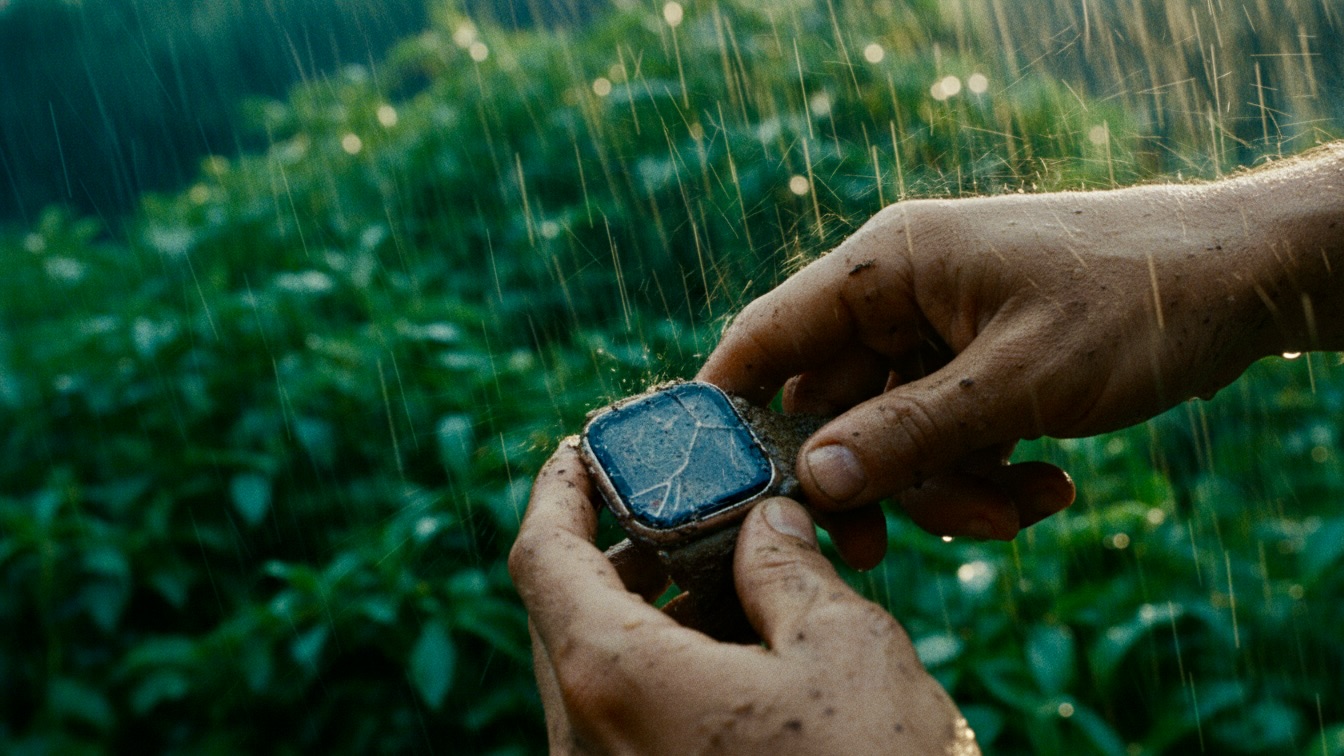
I dug deeper. The soil was packed tight, far tighter than it should have been if it were just for planting. About six inches down, the metal of my trowel hit something hard. It didn't sound like a rock. It was a sharp, plastic clack. I slowed down, using my fingers to brush away the remaining earth.
I saw a flash of silver first. Then a black silicone strap. I reached in and pulled it out. It was a high-end smartwatch, the kind that costs as much as a used sedan. The screen was cracked, a spiderweb of fractures across the face, but the casing was ruggedized. It was covered in dried mud, but as I wiped it on my thigh, I saw something else. A dark, brownish stain crusted into the crevices of the charging port. Blood.
I looked up at Gina. She had her hands over her mouth, her eyes wide. She looked like she was seeing a ghost.
"Is this yours?" I asked, my voice flat.
"No," she whispered. "No, it’s... it belongs to someone else."
"Someone who’s missing a lot of skin?" I pointed to the blood. "This isn't a gardening accident, Gina. Why was this under the trilliums?"
She sat down hard on the wooden edge of the raised bed, her head in her hands. The 'urbanite' facade was gone. She looked like exactly what she was: a kid who had gotten in way over her head and was drowning in the shallow end.
"I'm so delulu," she sobbed, using that word I’d heard the kids use on their TikToks. "I thought if I just moved here, if I just vanished into the Shield, they’d stop. I thought I could just hide the tracker and it would be over."
"The tracker?" I frowned, looking at the watch. It wasn't just a fitness tracker. I saw a small, customized engraving on the back: Property of Apex Recoveries.
"It’s a debt collection agency," Gina said, her voice muffled by her palms. "But they don't just call you anymore. They use 'environmental assets.' They told me they put sensors in my stuff. They said if I missed another payment, they’d find me through the local grid. I found the watch in my bag. I didn't even know I had it. I thought it was a gift from my ex. It’s been pinging my location every ten minutes for three months."
I turned the watch over in my hands. "And the blood?"
"I tried to smash it," she said, looking up, her face streaked with tears and dirt. "I tried to break the casing with a rock, and it slipped. I cut my hand open. I got scared, Evan. I thought if I buried it deep enough, the signal would die. I saw you looking at those flowers yesterday, talking about how rare they were and how no one should touch them. I thought... I thought no one would ever dig there. It was supposed to be safe."
I felt a pang of sympathy, but it was quickly buried by the sheer stupidity of the plan. "You buried a lithium-ion battery and a GPS transmitter under a protected species. You didn't just hide it, Gina. You created a beacon. These things have leak-detection protocols. If the casing is breached—which it is—it sends a high-frequency distress signal to the recovery team. You didn't hide from them. You invited them to breakfast."
As if on cue, the black SUV at the gate began to move. It didn't drive away. It pulled right up to the garden entrance, the tires crunching over the 'No Parking' sign I’d put up last spring. The door opened, and Kenneth stepped out. He wasn't wearing his usual developer's suit. He was in a tactical vest and heavy boots. He didn't look like he was here to talk about zoning laws.
"Evan," Kenneth called out, his voice booming across the quiet morning. "We have a bit of a situation. The ground here is unstable. Safety concerns. I’m going to have to ask you and the girl to clear out. Now."
I gripped the watch tighter. My heart was hammering against my ribs, a dull, insistent ache. "The ground is fine, Kenneth. But the flowers aren't. And neither is this watch I just found."
Kenneth stopped ten feet away. He wasn't smiling anymore. The summer sun caught the edge of something metallic on his belt. It wasn't a tape measure.
"Give me the watch, Evan," he said. His voice was quiet now, which was much worse than the shouting. "You're a ranger. You know how to stay in your lane. Don't make this a thing."
I looked at Gina. She was shaking so hard the wooden boards were rattling. I looked at the trilliums. They were dying for a secret that had nothing to do with nature and everything to do with greed. My jaw was so tight I thought my teeth might crack. The snap point was here. I wasn't going to let him have it.
Kenneth took a step forward, his boots heavy on the mulch. He had that look—the one men get when they think they own the air you’re breathing. I’ve seen it a thousand times in the Ministry offices, guys who think a title and a bank account give them the right to pave over anything that doesn't turn a profit.
"This is a community garden, Kenneth," I said, standing my ground. I felt the sweat slicking my palms, making the grip on the trowel feel uncertain. "You don't have jurisdiction here. And you definitely don't have the right to be leaning on residents."
"I have a contract with Apex, Evan," Kenneth said, his eyes fixed on the cracked watch in my hand. "They’re clients of mine. They lost some high-value hardware, and it led them right to my doorstep. Or rather, to the land I’m about to buy. You think this garden is some sacred grove? It’s a liability. And that girl? She’s a thief."
Gina stood up, her voice cracking. "I'm not a thief! I just... I couldn't pay the interest. They kept moving the goalposts. It’s giving predatory vibes, Kenneth. You’re literally working for a company that stalks people."
Kenneth laughed, a short, dry sound. "It’s called asset recovery, kid. Get used to the real world. Now, Evan, the watch. It has encrypted keys on it. Financial data that belongs to the company. It’s not yours, and it’s definitely not hers. Hand it over, and we can all go get an iced coffee and forget this happened."
"The data isn't the only thing on here, is it?" I asked. I pointed to the blood again. "Gina said she cut herself, but this isn't just a smear. There’s a lot of copper in this dirt. I’ve been testing the pH. It’s not just lime. There’s a high concentration of metallic salts. This watch wasn't the only thing buried here, was it?"
Kenneth’s expression shifted. It was subtle—a slight narrowing of the eyes, a tightening of the mouth—but I caught it. I spent years tracking poachers. You learn to spot the moment they realize they’ve been seen.
"You're overthinking it, old man," Kenneth said. "It’s a garden. There’s fertilizer. There’s runoff. Don't turn a broken watch into a conspiracy. You’re retired. Go fish. Go take a nap."
"I'm a forest ranger, Kenneth. We don't really retire. We just stop getting paid to care," I said. I felt a surge of adrenaline, that sharp, cold clarity that comes when the stakes finally clarify. "I know what environmental sensors look like. They’re used to monitor soil health in industrial zones. But they can also be used to hide things. Like leachate. Or waste. You’ve been using this 'community garden' as a dumping ground for the runoff from your construction site across the lake, haven't you? And you used the watch—and Gina’s debt—as a convenient way to keep eyes on the site without anyone suspecting."
Gina looked between us, her face pale. "Wait, what? The sensors... they weren't just for me?"
"You were the perfect cover, Gina," I said, not taking my eyes off Kenneth. "A girl from the city, 'finding herself,' moving into a plot of land that just happened to be adjacent to a major development. They 'found' a debt they could leverage, gave you some 'monitored' tech, and used the signal to mask the readings from the illegal dumping they were doing under these beds. The trilliums died because the soil is toxic. The watch wasn't just a tracker for you. It was a benchmark for the sensors buried deeper down."
Kenneth’s hand went to his belt. He didn't pull anything yet, but the threat was there, clear as the summer sun. "You have no proof of that, Evan. You have a handful of dirt and a broken watch. My lawyers will have you for breakfast before you can even file a report."
"I don't need a report," I said. I reached into my pocket and pulled out my phone. "I already called the Ministry of Environment. And the Federal Botany Survey. See, these trilliums? They’re a specific subspecies, Trillium cernuum var. macranthum. They’re endangered in this part of the province. That makes this a protected habitat. The moment I saw them uprooted, I triggered an emergency survey. They’re on their way. And they don't just check for flowers, Kenneth. They check the soil. They check the water table. They check everything."
Kenneth’s face went a strange shade of grey. The drone of the lawnmower in the distance suddenly stopped, leaving the garden in a heavy, expectant silence. The first few drops of rain began to fall—large, warm splashes that kicked up the scent of dry dust and ozone.
"You're bluffing," Kenneth hissed.
"Try me," I said. I felt the tension in my jaw ease slightly. I wasn't just a tired old man anymore. I was a barrier.
The sky opened up then. A classic Ontario summer downpour, sudden and violent. The rain hammered down, turning the garden into a blurred landscape of green and grey.
"Get in the shed, Gina!" I yelled over the roar of the water.
She didn't need to be told twice. She bolted for the small cedar structure at the back of the garden. I followed her, keeping the watch clutched in my hand, my boots sliding in the rapidly forming mud. Kenneth was right behind us, his face twisted in a snarl as the rain drenched his tactical gear. This wasn't about a debt anymore. This was about survival.
The shed smelled of dry cedar and old potting soil. Outside, the rain was a solid wall, drumming against the tin roof with a deafening rhythm. I leaned against the door, my chest heaving, my breath coming in ragged gasps. Gina was huddled in the corner, surrounded by rusted rakes and bags of bone meal. She was shaking, her wet hair plastered to her face.
"Is he going to kill us?" she asked, her voice a tiny thread in the storm. "Evan, this is so not how I thought my summer would go. This is literally a horror movie."
"He’s not going to kill anyone," I said, though I wasn't entirely sure. "He’s a businessman. Killing people is bad for the bottom line. He just wants that watch. It’s the link between his company and the illegal dumping. If he gets it, he can claim it was all your fault. A 'disgruntled debtor' trying to frame him."
I looked at the watch. The screen flickered to life for a second, a bright, ghostly blue in the dim shed. A string of coordinates scrolled across the display, followed by a series of red warning icons.
"The sensors are failing," I whispered. "The rain... it’s washing the chemicals deeper into the soil. The sensors are hitting their limit. That’s why he’s so desperate. The evidence is about to become undeniable."
A heavy blow struck the door. The wood groaned, the latch rattling in its housing. Kenneth was outside, and he wasn't going away.
"Open the door, Evan!" he shouted. "Don't make this harder than it has to be! You're an old man! You don't want to get hurt over some dirt!"
"I'm old, Kenneth, but I'm not deaf!" I yelled back. I looked around the shed, searching for anything I could use. My eyes landed on a heavy iron pry bar leaning against the workbench. I grabbed it, the cold metal feeling solid and honest in my hand.
"Gina," I said, turning to her. "I need you to take my phone. I’ve already started a live stream to the Ministry’s server. It’s recording everything. If anything happens, it’s already in the cloud. You understand?"
She nodded, her eyes wide. She took the phone with trembling fingers. "I got it. I'm recording. It’s giving 'final girl' energy, Evan. I can do this."
I smiled at her. It was a weird time for it, but she was showing more spine than I’d given her credit for.
I turned back to the door and kicked it open.
The rain hit me like a physical blow. Kenneth was standing there, his gun drawn now, but he looked hesitant. He knew the stakes had changed. The garden was a swamp, the carefully tended beds overflowing with muddy water. And in the middle of it all, the three Nodding Trilliums were being washed away, their roots finally losing their grip on the poisoned earth.
"It’s over, Kenneth," I said, stepping out into the storm. I held the pry bar at my side, my feet planted firm in the muck. "I can see the sirens from here."
It was a lie, but it worked. He glanced toward the road, his focus breaking for just a split second. In that moment, the sound of real sirens—the deep, rhythmic wail of federal vehicles—cut through the noise of the rain. Two white SUVs with government plates swung into the garden lot, their blue and red lights reflecting off the sheets of water.
Kenneth swore, a long, ugly string of words. He lowered the gun, his shoulders slumping. He wasn't a soldier; he was a bully who’d run out of room to push.
The agents moved fast. They weren't just botanical surveyors; they were environmental enforcement. They had Kenneth in zip-ties before the rain even started to let up.
One of them, a woman with sharp eyes and a no-nonsense jacket, walked over to me. She looked at the watch in my hand, then at the dying flowers in the mud.
"Mr. Thomas?" she asked. "I'm Agent Miller. We got your data burst. You were right. The soil analysis from the sensors we tapped into remotely shows massive levels of industrial solvents. This whole site is a crime scene."
I handed her the watch. "Make sure you check the encryption keys. There’s a debt collection agency involved. They were using a resident to monitor the site."
Miller nodded. "We’ll handle it. You did good, Evan. Most people would have just ignored a few dead flowers."
I looked back at the garden. The rain was stopping now, the sun beginning to peek through the clouds, turning the wet leaves into shards of emerald light. Gina came out of the shed, looking small and bedraggled, but her head was up. She walked over to the spot where the trilliums had been.
"Can we save them?" she asked, looking at the broken plants.
"Maybe," I said. "We’ll have to move them to clean soil. It’ll take time. They’re resilient, but they don't like being lied to."
Gina looked at me, a small, genuine smile touching her lips. "Me neither, Evan. Me neither."
As the agents began to cordoned off the area, I felt the tension finally leave my body. My jaw was sore, and my knees ached, but the air felt cleaner. The garden was no longer a secret burial ground. It was a protected site.
Gina looked at her hands, still stained with mud and the memory of the watch. "I guess I have to go deal with my digital footprint now, don't I?"
"It’s better than being buried under it," I said.
She laughed, a real laugh this time. "True. It’s giving 'new beginnings' vibes. I think I’ll stick around, Evan. If you’ll have me. I think I actually want to learn how to grow something that doesn't die."
I looked at the horizon, where the summer sun was reclaiming the sky. "Well," I said, picking up my trowel. "The first thing you need to know is that you have to respect the roots."
She nodded, and for the first time since she’d arrived in Pelican Lake, she looked like she was exactly where she was supposed to be.
“As the agents led Kenneth away, Gina noticed a second, smaller light blinking from beneath the roots of an undisturbed oak tree.”


