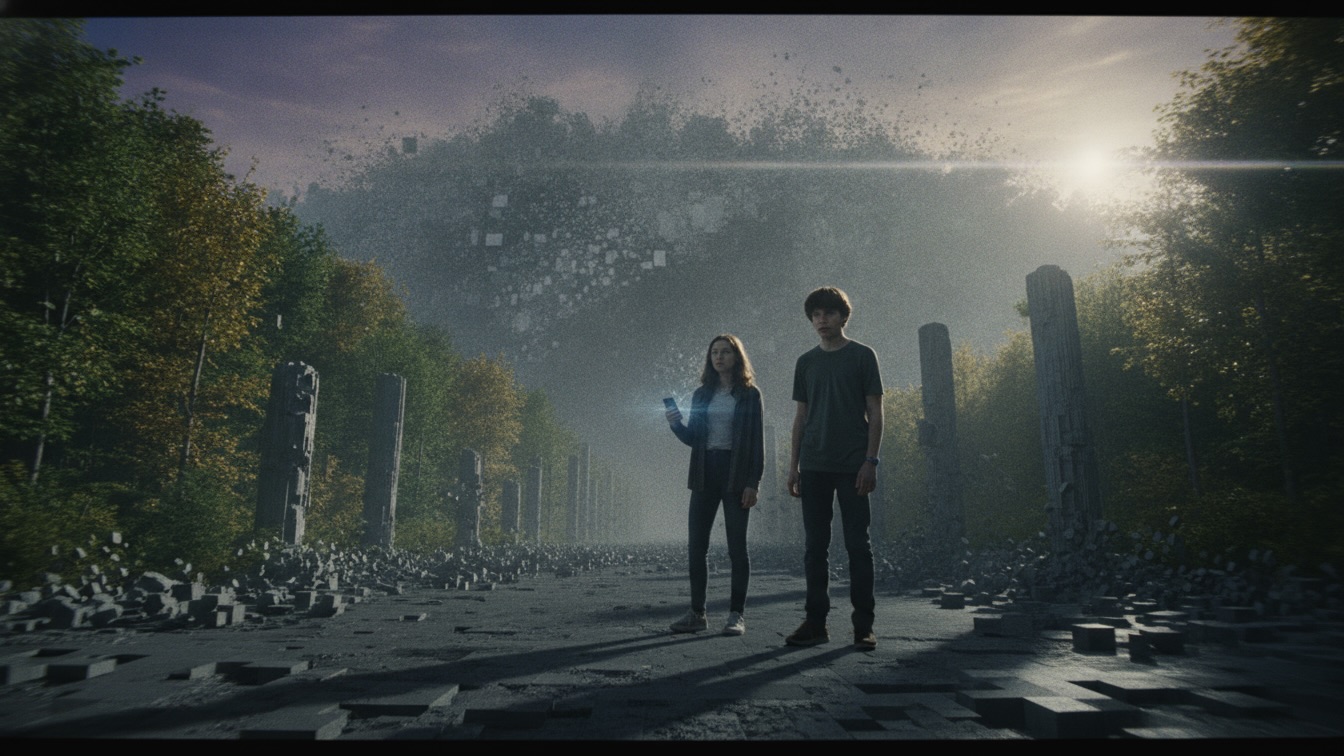
George turns seventeen in a forest where the fog behaves like a corrupted video file, hiding something very hungry.
Seventeen felt like a forced software update. George stared at his lock screen, the digits clicking over to 6:02 PM. The battery icon was a sliver of red, a dying lung. He wasn't sure what he was supposed to feel, but it definitely wasn't this. He felt like a placeholder. A temporary file in a directory that was about to be wiped. The forest didn't help. It was the peak of summer, and the trees were doing that aggressive, over-saturated green thing that made everything look fake. The air was a damp sponge. It didn't sit on you; it occupied you. He kicked a clump of dry dirt, watching it explode into a miniature mushroom cloud. It was his birthday, and he was walking through a graveyard of sticks with a girl who spent most of her time trying to curate a life she wasn't actually living.
"You're doing the brooding protagonist thing again," Millie said. She didn't look at him. She was busy trying to find a signal, her phone held high like a sacred relic. "It’s your birthday, George. You’re legally obligated to exhibit at least three percent more joy. It’s in the Terms and Conditions. I checked."
"Joy is a premium feature," George muttered. He adjusted the strap of his backpack. The nylon dug into his shoulder, a sharp, localized friction. "I’m on the free tier. I get ads and general existential dread. That’s the deal."
Millie finally dropped her arm, her face reflecting the blue glow of a 'No Service' notification. "Zero bars. We are officially off the grid. If a bear eats us now, it’s not even going to trend. How depressing is that?"
"The bear would probably get more engagement than I do," George said. He stopped and looked up. The sky was losing its grip on the sun. The light was turning that bruised, expensive purple of a late July evening. But something else was happening. At the edge of the clearing, where the hemlocks stood like jagged teeth, a grey blur was leaking out of the ground. It wasn't the soft, romantic fog of a period drama. It was thick and granular. It looked like the static on an old TV, the kind George had only seen in YouTube retrospectives about the nineties.
"Is that... smoke?" Millie asked. She didn't sound scared, just annoyed. Like the fog was a late delivery she was going to leave a one-star review for.
"No," George said. He watched the grey stuff swallow a bush. It didn't flow; it jerked. It moved in frames. "It’s just the atmosphere being extra. It’s humid, Millie. Science or whatever."
"It’s weird," she said. She stepped closer to him. Her shoulder brushed his, a sudden spark of human heat in the middle of the cooling woods. "It looks like it’s rendered in low-res. Look at the edges of that branch. It’s all pixelated."
George squinted. She was right. The fog wasn't a gas. It was a texture pack that hadn't loaded correctly. It felt sharp. The air didn't just get colder; it got thinner, more mechanical. He felt a sudden, violent twitch in his left calf. A cramp, or a warning. He didn't like the way the trees were disappearing. They weren't being hidden; they were being deleted.
"Maybe we should head back," George said. He tried to sound casual, like he was just bored, not starting to feel the first prickles of genuine panic. "My mom’s probably already lit the candles on whatever gluten-free tragedy she baked."
"Wait," Millie said, her voice dropping an octave. She pointed into the encroaching grey. "Did you see that?"
George followed her finger. The fog was ten feet away now. Inside the blur, a shape moved. It wasn't a deer. It was too tall, too angled. It moved with a stuttering, stop-motion gait. It looked like a person made of broken glass, reflecting nothing. It moved silently, which was the wrongest part. The forest was usually a cacophony of cicadas and rustling leaves, but the fog had muted everything. It was a digital silence. A complete lack of data.
"Millie, walk away," George said. He didn't look at her. He kept his eyes on the shape. It stopped. It seemed to be looking at them, though it had no face he could discern. It was just a suggestion of a predator, a sketch of a threat.
"Is that a person?" Millie whispered. She reached for her phone again, her thumb hovering over the camera app. Habit was a powerful drug. "If this is a prank, I’m going to be so mad. Is this your brother? If it’s your brother, I’m literally going to block him."
"My brother is at home playing Valorant," George said. His heart was hammering against his ribs, a frantic bird in a cage. "That’s not a person."
The shape in the fog tilted its head. The movement was too fast, a frame-skip. Then, it hissed. It wasn't a biological hiss. It sounded like a corrupted audio file, a burst of white noise that made George’s teeth ache. The fog surged forward, a wave of grey grit. George grabbed Millie’s hand. Her palm was sweaty, a terrifyingly real sensation in a world that was rapidly becoming an illusion.
"Run," George said.
They didn't wait for a second prompt. They turned and bolted back the way they came, but the path was gone. Where the dirt trail should have been, there was only more of that stuttering grey static. The forest was being overwritten, and they were the only two files left in a corrupted drive.
Their boots hammered against the forest floor, but the sound was wrong. Instead of the satisfying thud of rubber on earth, it sounded like someone tapping on a hollow plastic shell. George didn't stop to analyze the acoustics. He just kept running, his fingers locked around Millie’s wrist. He could feel her pulse jumping under her skin, a rapid, syncopated rhythm. It was the only thing that felt honest. Everything else—the trees, the sky, the air—felt like a simulation that was running out of RAM.
"George!" Millie gasped. She stumbled over a root that looked more like a jagged piece of dark geometry than wood. "Where are we going? Everything looks the same!"
He slowed down, gasping for air. The fog was everywhere now. It wasn't just a wall; it was the atmosphere itself. It clung to his clothes, leaving no moisture, just a fine, dry grit that felt like powdered glass. He looked around. The towering oaks were gone. In their place were tall, grey pillars that lacked bark or leaves. They were just vertical lines, placeholders for a forest that no longer existed.
"I don't know," George admitted. The skepticism that usually defined him was being replaced by a cold, clinical terror. "The trail is gone. The GPS is dead. We’re in a dead zone, Millie. A literal one."
Millie leaned against one of the grey pillars. She pulled her hand away instantly. "It’s vibrating. George, the tree is vibrating."
He touched it. She was right. A low-frequency hum thrummed through the material. It wasn't the vibration of a machine, but the steady, rhythmic pulse of a server farm. He looked up, but there was no sky. Just a flat, grey ceiling that seemed to be descending. The summer heat was still there, but it was artificial now, like the heat coming off the back of a laptop. It was oppressive and stale.
"We need to find a boundary," George said, trying to force his brain into a logical loop. "If this is a... whatever this is... it has to have an edge. We just need to keep moving in one direction."
"Which direction?" Millie asked. She looked like she was about to cry, but her face was set in a mask of defiant irony. "North? South? Toward the nearest Starbucks? I don't have a compass app that works in silent-hill-mode."
"We use the sun," George said. He looked for the bruised purple light from before, but it was gone. The light was coming from everywhere and nowhere. There were no shadows. It was a flat-lit world. "Okay, we don't use the sun."
They started walking again, slower this time. The silence was the worst part. There were no birds, no insects, no wind. Just the sound of their own breathing and the distant, electronic hiss of the fog. Every few steps, the world would glitch. A bush would flicker out of existence and be replaced by a pile of grey cubes. A rock would float two inches off the ground before snapping back into place.
"Do you think we’re dead?" Millie asked. She wasn't joking anymore. "Is this the afterlife? Because if it is, the developers really phoned it in. It’s so glitchy."
"We're not dead," George said, though he didn't have any evidence to support the claim. "If we were dead, I wouldn't have this stupid cramp in my leg. Death is supposed to be an upgrade, right? No more physical bugs."
"Maybe we’re being uploaded," Millie suggested. She was looking at her hands. The edges of her fingers were starting to blur, the skin losing its definition against the grey air. "Look at my nails, George. They’re losing resolution."
He grabbed her hands. They felt solid, but she was right. Her skin was becoming a series of smooth, untextured surfaces. The fine lines of her knuckles were smoothing out. He looked at his own hands. His tan was fading into a generic peach color. The scar on his thumb from a kitchen accident three years ago was gone. He was being optimized. Simplified.
"Don't look at it," George said, his voice shaking. "Just keep moving. We’re going to find the exit."
They walked for what felt like hours. Time was another casualty of the fog. It didn't feel like a linear progression; it felt like a loop. They passed the same jagged root three times, but each time it was slightly different, more abstract. The forest was becoming a parody of itself.
Suddenly, the hiss grew louder. It wasn't just in the air anymore; it was in their heads. It was a rhythmic, scraping sound, like a hard drive struggling to read a scratched disc. The shape from before appeared again, fifty yards ahead. This time, it wasn't alone. Three more of the glass-like figures stood in a semi-circle, their movements synchronized and jarring.
"They’re blocking the path," Millie whispered. She reached into her pocket and pulled out a small, metal key-ring. It was a pointless weapon, but she gripped it until her knuckles—what was left of them—turned white.
"They’re not blocking it," George said, noticing the way the fog swirled around the figures. "They’re creating it. They’re the ones deleting the world."
One of the figures stepped forward. Its body was a mosaic of shifting grey shards. It didn't have eyes, but George felt a profound sense of being scanned. He felt his memories, his birthday, his skepticism, all being indexed and filed away. It was a transaction. Their lives for the data of the forest.
"What do they want?" Millie asked.
"Everything," George said. "They want the raw material. We’re just high-density data. We’re the only things in this forest that aren't corrupted yet."
The figures began to move, their glass bodies clinking together with a sound like a thousand breaking windows. They weren't running; they were teleporting in short, rapid bursts, closing the distance between frames. George looked around for a way out, his mind racing through every survival movie he’d ever seen, but none of them covered what to do when reality itself was being uninstalled.
The first figure reached them in a blur of motion that bypassed the laws of physics. It didn't strike; it just existed in the space Millie had occupied a second before. She screamed and dove to the left, her body moving with a frantic, unpolished grace. George swung his backpack at the creature, the heavy weight of his textbooks—a useless carryover from his 'real' life—connecting with something that felt like cold, vibrating smoke.
His bag passed right through the figure. The creature didn't flinch. It just turned, its head tilting at that nauseating, broken angle. The hiss intensified, a screeching roar of digital feedback that made George’s vision swim with red and green artifacts. He felt a sharp pain in his chest, not from a physical wound, but from the sheer pressure of the sound.
"Run to the rocks!" George yelled over the noise. He pointed toward a massive outcropping that still looked somewhat solid. It was a granite cliffside that served as the forest’s spine. If anything was still anchored to the real world, it was the stone.
They scrambled over the increasingly abstract terrain. The ground was no longer dirt; it was a grey, frictionless plane. Every step was a gamble. Millie slipped, her knees hitting the surface with a sickening crack, but she didn't stop. She crawled, then stood, her face a mask of pure, unadulterated survival. The irony was gone. The banter was dead. There was only the roar of the static and the desperate need to remain a three-dimensional being.
They reached the base of the rocks. The granite was cold—blessedly, naturally cold. It didn't hum. It didn't vibrate. George pressed his back against the stone, feeling the grit of the real world against his spine. It was a small mercy. The summer sun was a memory now, replaced by the flickering grey light of the fog.
"They’re coming," Millie panted. She was clutching her side, her breathing ragged. Her skin was almost entirely smooth now, like a mannequin’s. "George, I can't feel my toes. I think they’re... they’re merging."
He looked down. Her feet were becoming part of the grey floor. The boundaries between her body and the environment were dissolving. The fog wasn't just around them; it was in them. It was a virus, rewriting their biology into something simpler, something more efficient for the system to handle.
"Listen to me," George said, grabbing her shoulders. He needed her to stay focused, to stay human. "Think about something real. Something specific. Don't let the fog simplify you. Remember the smell of the rain on the pavement? No, wait, I can't smell. Remember the sound of your brother’s car? The way the bass rattled the windows?"
"The blue one?" she whispered, her eyes fluttering. "The one with the dent in the bumper?"
"Yes!" George shouted. "The dent. The specific, ugly, non-optimized dent. Think about that. Think about the grease on the fries from that place on 5th. Think about the way the salt felt on your tongue."
Millie nodded, her face twitching as she fought to hold onto the details. The grey smoothing of her skin slowed. The flicker at the edges of her vision stabilized. For a moment, they were a pocket of reality in a sea of corruption.
But the figures were still there. They stood at the edge of the granite’s influence, unable to step onto the solid stone, but waiting. They were patient. They were part of a process that had all the time in the world. The fog swirled around them, thicker now, a churning vortex of grey static that was slowly eroding the base of the cliff.
"They’re waiting for the rocks to go," George realized. He looked at the granite. Even here, the edges were starting to blur. The stone was being processed. It was a slower file, but it was still being deleted.
"We can't stay here," Millie said. Her voice was thin, like a low-bitrate recording. "If we stay, we just disappear slower."
"We have to fight back," George said. He looked at his backpack, lying ten feet away in the grey void. "The books. The paper. It’s dense information. It’s too much for them to process all at once."
"You want to throw your history textbook at a digital ghost?" Millie asked, a ghost of a smile touching her pixelated lips. "That is the most George thing I’ve ever heard."
"It’s not just a book," George said, his mind racing. "It’s a physical record. It’s messy. It’s got handwriting in the margins. It’s got coffee stains. It’s high-entropy. They want simple data. They want patterns. We give them chaos."
He lunged for the bag. The movement was a risk. The moment he stepped off the granite, the floor tried to claim him. His ankles sank into the grey plane like it was quicksand. The figures hissed, their glass bodies vibrating in anticipation. One of them lunged, its arm extending in a jagged, flickering spike.
George grabbed the bag and swung it with everything he had. He didn't aim for the creature; he aimed for the air around it. He zipped the bag open as he swung, and a flurry of papers, notebooks, and his heavy hardcover textbook spilled out. The effect was immediate. The fog reacted to the physical objects like they were poison. Where the paper touched the grey static, the fog began to churn and boil. The figures recoiled, their glass bodies fracturing further as they tried to process the sudden influx of complex, messy information.
"It’s working!" Millie cheered, though her voice was barely more than a whisper. "Throw the rest!"
George grabbed his math notebook and began tearing out pages, throwing them into the fog. Each page was a shield. The handwritten formulas, the scribbled doodles of spaceships, the ink blots—it was all too much for the system. The fog around them began to tear, revealing glimpses of the real forest behind it. For a split second, George saw a green leaf, a real, summer-green leaf, and it was the most beautiful thing he had ever seen.
But the system was adapting. The figures stopped recoiling. They began to absorb the paper, their bodies turning a dull, matte white as they integrated the new data. The tear in the fog began to close. The grey static surged back, twice as thick as before, and the hiss became a deafening roar of pure, unadulterated noise.
The roar wasn't just a sound anymore. It was a physical force, a wall of vibration that knocked George back onto the granite. He felt the stone beneath him shudder. The cliff was giving way. The granite was being converted into the same grey cubes as the rest of the world. He looked for Millie, but she was gone. No, not gone—she was blending into the stone. Her legs were already a smooth, grey slope, merging with the base of the cliff.
"Millie!" he screamed, but his voice was lost in the feedback. He reached for her, his hands trembling. His own fingers were becoming transparent, the bone visible beneath the thinning skin like a low-opacity layer in Photoshop.
This was it. Seventeen years of being a skeptical bystander, and this was the payoff. A birthday present from a universe that had finally decided to stop pretending it was real. He felt a wave of weariness wash over him. It would be so easy to just stop fighting. To let the fog take the rest of his data. To become a smooth, unburdened thing, free of cramps and birthday expectations and the constant, buzzing anxiety of being a person in 2026.
Then he saw it. In the middle of the swirling static, a small, bright light. It wasn't a digital light. It was a spark. A firefly. A tiny, biological glitch in the system. It was flying toward them, its yellow glow a defiant puncture in the grey void. It landed on Millie’s hand—or where her hand used to be—and for a second, the resolution snapped back. Her skin returned to its normal, freckled texture. The firefly flickered once, twice, and then vanished, but the impact remained.
Nature wasn't dying. It was fighting back. The forest wasn't being deleted; it was being compressed, and the compression was failing.
George stood up. His legs were heavy, but they were his. He looked at the figures, the glass predators that were closing in for the final harvest. They weren't gods. They were just cleaners. Janitors of a reality that had become too cluttered with human noise.
"You want chaos?" George shouted, his voice cracking. "I am seventeen years of unorganized data!"
He didn't have any more paper. He didn't have his books. He had himself. He reached into his pocket and pulled out his phone. The battery was at one percent. The screen was a spiderweb of cracks, a physical record of every time he’d dropped it, every moment of frustration and carelessness. It was the most human thing he owned.
He didn't try to call for help. He didn't try to take a photo. He held the phone up like a grenade. "Happy birthday to me."
He smashed the phone against the granite cliff. The screen shattered completely, shards of glass and plastic flying into the fog. The lithium battery, compromised and exposed, began to hiss. Not a digital hiss, but a chemical one. A plume of white smoke erupted, and then, a spark.
Fire. The one thing the system couldn't simulate correctly. The one thing that was pure entropy.
The battery ignited, a small, fierce orange flame blooming in the center of the grey void. The effect was cataclysmic. The fog didn't just churn; it screamed. The orange light was a hole in the simulation, a burning pixel that the system couldn't overwrite. The figures shrieked, their glass bodies melting and warping as the heat—the real, chaotic heat of a chemical fire—hit them.
George grabbed Millie, pulling her toward the flame. "Stay in the light!" he yelled. "Stay in the fire!"
They huddled around the tiny, burning wreckage of his phone. The orange glow was a sanctuary. Around them, the world was a nightmare of melting geometry and screaming static, but within the three-foot radius of the fire, things were real. He could see the sweat on Millie’s forehead. He could see the dirt under his own fingernails. He could feel the searing heat on his face, and it was the most glorious sensation he had ever known.
"Is it working?" Millie sobbed, her voice returning to its normal, human pitch.
"It has to," George said. He watched the fire consume the plastic casing of the phone. It wouldn't last long. A lithium fire was intense but brief. "When the light goes out, we run. Not away. We run through the middle of them. They can't touch us while the system is rebooting."
"How do you know it’s rebooting?" she asked.
He pointed at the sky. The flat, grey ceiling was flickering. Lines of code, or something like it, were scrolling across the horizon. The system was trying to compensate for the fire, trying to patch the hole, but it was lagging. The frame rate of the entire world was dropping.
"Now!" George yelled.
The fire flickered out, leaving only a glowing, charred husk. But the hole was still there, a lingering afterimage of heat and chaos. George and Millie bolted, sprinting through the center of the warped glass figures. The creatures were frozen, their bodies stuck in a loop of shattered frames. They passed through the line and kept running, their feet finally finding the soft, damp resistance of real forest soil.
The air changed. The static hiss vanished, replaced by the sudden, overwhelming sound of a thousand cicadas. The heat was no longer artificial; it was the heavy, humid embrace of a summer night. They didn't stop until they reached the edge of the woods, where the streetlights of the suburb began. The orange glow of the sodium lamps was the most comforting sight George had ever seen.
They collapsed onto the pavement, gasping for air. George looked at his hands. They were solid. Freckled. Dirty. Real.
"George," Millie whispered, looking back at the woods. The forest looked perfectly normal now. A dark, quiet collection of trees under a summer moon. There was no fog. No glass figures. No grey void. "Did that... did that just happen?"
George reached into his pocket and felt the empty space where his phone should have been. He looked at his burnt, blackened palm. The pain was sharp and persistent, a physical receipt for the transaction they’d just survived.
"Yeah," he said, his voice finally regaining its cynical edge. "But don't bother posting about it. No one’s going to believe the review."
They sat there for a long time, two seventeen-year-olds on the edge of a world that was a lot thinner than they had ever realized. The summer night was loud and alive around them, a beautiful, messy, unoptimized reality that was, for the moment, still running.
George stood up, his bones aching, his birthday finally coming to an end. He looked at the forest one last time, wondering when the next update was scheduled, and if they would be ready for it.
Just as they turned to walk toward the safety of the houses, the streetlights flickered in a sequence that wasn't random, and for a split second, the pavement beneath their feet felt as hollow as a plastic shell.
“Just as they turned to walk toward the safety of the houses, the streetlights flickered in a sequence that wasn't random, and for a split second, the pavement beneath their feet felt as hollow as a plastic shell.”


