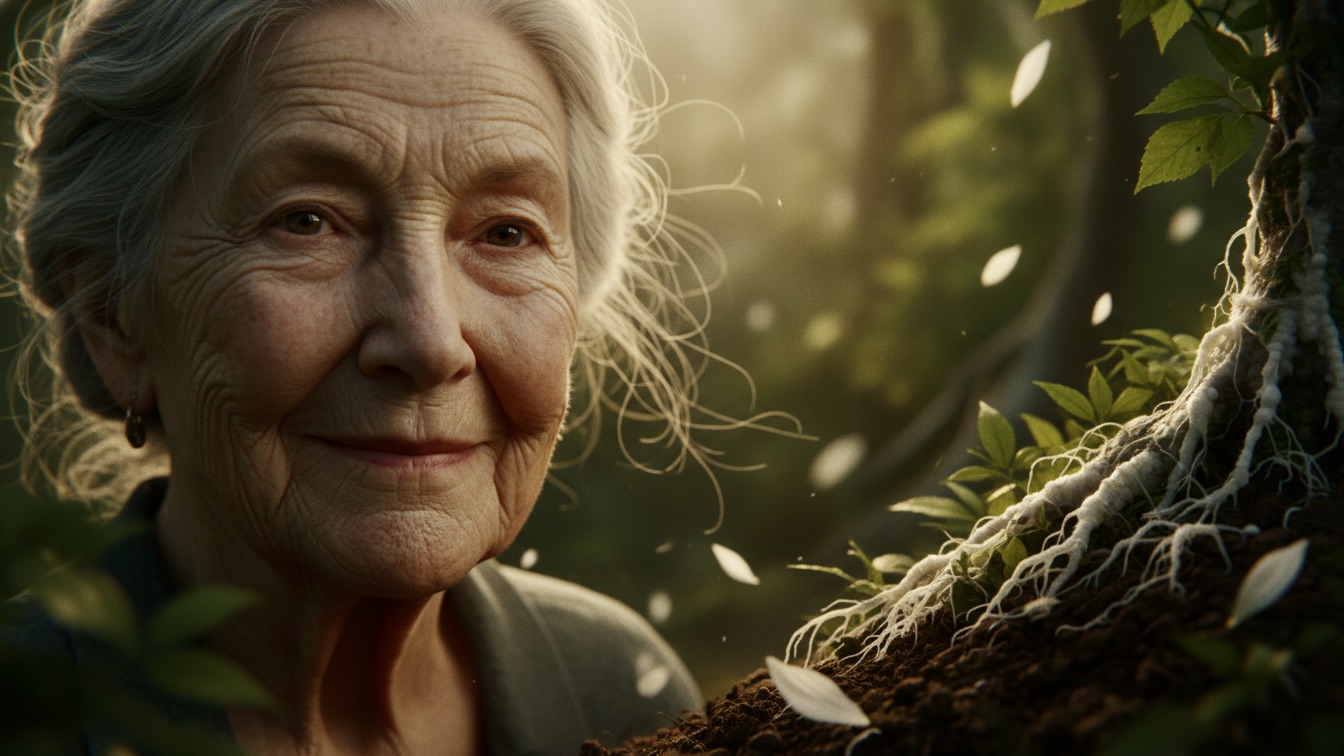
The story unfolds in the Deep Wilds, where a mute woman named Edna discovers that the Great Oak is weeping a black, unnatural sap. This environmental decay signifies the collapse of the Mycelium Link, a sentient network that sustains the world's ecosystem. Her solitary vigil is interrupted by Kyle, a cynical mercenary operating a steam-powered harvester. He intends to clear-cut the forest to bolster the defenses of Oakhaven, a city-state currently under siege and defined by its isolationist ideology.
A sudden and profound structural failure, described as the Earthquake of Apathy, destroys Kyle's machine and leaves the pair stranded. As they trek deeper into the dying woods, they encounter a Wither-Beast, a physical manifestation of collective grief and loneliness that feeds on the life force of the forest. Edna leads Kyle to the Mother Root, the heart of the fungal network, insisting that they must reconnect with the earth through shared memory and vulnerability.
In a climactic moment of psychological breakthrough, Kyle abandons his defensive cynicism and joins Edna in a psychic link with the Mother Root. Their combined emotional resonance—Edna’s love and Kyle’s acknowledged trauma—restarts the ecosystem, transforming the Wither-Beast into flower petals and restoring the forest's health. The narrative concludes with the duo returning to Oakhaven, not as conquerors or scavengers, but as harbingers of a new, interconnected era between humanity and the natural world.
The central theme of the narrative revolves around the tension between radical isolationism and the necessity of interconnectivity. Oakhaven represents the psychological "fortress mentality," where survival is predicated on hard borders, individual strength, and the exploitation of natural resources. In contrast, the Mycelium Link serves as a biological and spiritual metaphor for the invisible threads that bind living beings together. The story suggests that when these connections are severed by apathy or trauma, the world itself begins to physically collapse.
Another prominent theme is the manifestation of emotional states into physical reality. The "Earthquake of Apathy" and the "Wither-Beast" are not merely supernatural occurrences; they are the externalized consequences of human neglect and collective sorrow. The Wither-Beast, born from the loneliness of dying villages, highlights the author’s argument that grief, when unaddressed and unshared, becomes a predatory force. This psychological realism suggests that the environment is a mirror reflecting the internal health of the human soul.
Finally, the story explores the concept of vulnerability as a prerequisite for salvation. Kyle’s reliance on his iron axe and steam-powered crawler proves useless against the spiritual rot of the forest. It is only when he drops his guard and shares a genuine, fragile memory that the world is healed. This underscores the idea that true power does not come from the "walls" we build to protect ourselves, but from the courage required to be seen and to connect with the "other," whether that be a fellow human or the earth itself.
Edna functions as the narrative’s empathic anchor, representing a primal connection to the earth that modern society has discarded. Her muteness is not a disability but a stylistic choice that emphasizes her reliance on non-verbal, intuitive communication. She perceives the world through vibrations and resonances, making her the only character capable of diagnosing the spiritual starvation of the Mycelium Link. Psychologically, she embodies the "Caregiver" archetype, driven by an innate need to protect the ecosystem even at her own peril.
Her strength is deceptive, characterized by a quiet persistence rather than overt force. When she drags Kyle toward the black sap, she is attempting to force a sensory confrontation with a reality he has spent his life ignoring. She possesses an advanced emotional intelligence that allows her to look past Kyle’s aggressive exterior to the wounded man beneath. By offering him her hand at the end of the journey, she signals that the "Song of Weaving" is not a solo performance but a collaborative effort required for the survival of their species.
Kyle serves as the psychological foil to Edna, embodying the trauma-induced cynicism of a society that has forgotten how to trust. His reliance on his heavy iron axe and leather armor suggests a man who views the world as a series of threats to be managed or resources to be exploited. His dialogue reveals a deeply ingrained defense mechanism; he uses sarcasm and "common sense" to shield himself from the terrifying implications of the forest’s sentience. To him, nature is merely "stuff we can burn," a worldview born from the scarcity and fear he experienced in Oakhaven.
His internal conflict reaches its peak at the Mother Root, where he is forced to confront his "ideology of self-preservation." His resistance to the psychic link is a manifestation of his fear of ego-dissolution; he believes that letting people in is "how you get hurt." However, his journey is one of deconstruction. By the end of the chapter, he has transitioned from a man who builds walls to a man who advocates for their opening. His transformation signifies the potential for even the most hardened individuals to find redemption through vulnerability.
The narrative employs a rich, sensory prose style that emphasizes the physical weight of the environment. The opening descriptions of the "white-hot coin" of the sun and the "black motor oil" sap create a visceral sense of dread and stagnation. The author uses contrast effectively, shifting from the mechanical, hissing sounds of the crawler to the "soul-crushing sobs" of the Wither-Beast. These auditory details help to establish a tone that is simultaneously industrial and hauntingly gothic.
Pacing in the story follows a traditional arc of escalating tension, beginning with a localized environmental mystery and expanding into a high-stakes survival horror. The transition from the glade to the "A Hole in the Map" section marks a shift in the narrative's reality, as the laws of the civilized world are replaced by the logic of the Deep Wilds. This shift is mirrored in the prose, which becomes more fluid and metaphorical as the characters approach the Mother Root, reflecting the breakdown of the rigid boundaries Kyle once relied upon.
The narrative voice is third-person limited, primarily oscillating between the perspectives of Edna and Kyle to highlight their differing worldviews. This allows the reader to experience the forest as both a "chaotic mess" of resources and a "map of vibrations." The use of the "Earthquake of Apathy" as a plot device is a notable stylistic choice, as it blends the line between literal geology and metaphorical psychology. This blend of the mundane and the metaphysical ensures that the story functions as both a fantasy adventure and a psychological allegory.


