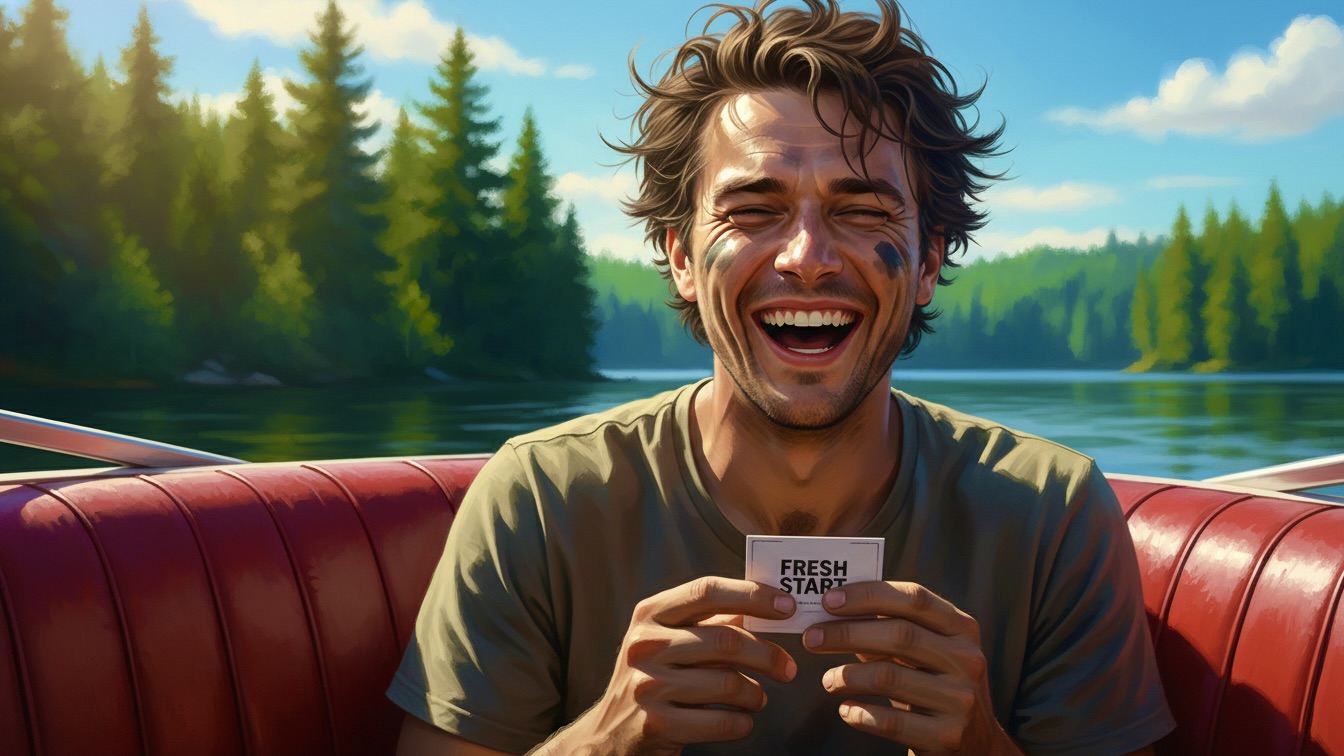
Evan is a man pushed to his breaking point by a predatory rent increase in Winnipeg. In an act of desperate rebellion, he abandons his job and steals a vintage speedboat from a marina in Kenora, Ontario. His plan to live as a hermit on a remote island is immediately derailed when he discovers a twelve-year-old stowaway named Harper and a bomb wired to the boat’s dashboard. He soon learns that the vessel is powered by a "Karma Engine" that punishes cynical thoughts and apathy with explosive consequences.
The situation escalates as a talking loon informs Evan that he must engage with the local community to survive. A town hall meeting broadcast over the radio reveals that a local dam is on the verge of a catastrophic failure. Despite his initial desire to flee, Evan realizes he cannot escape the "rubber water" of the lake, which physically prevents him from leaving the scene. He chooses to pilot the boat toward the dam to save the town and Harper’s family.
At the dam, Evan and Harper work together to manually override the release valves. Evan endures physical pain and intense heat to pull the heavy levers, successfully diverting the water and preventing the flood. The bomb deactivates, and the boat rewards Evan with a voter registration card. The story ends with a mysterious new voice emerging from the radio, suggesting that Evan’s journey into civic responsibility has only just begun.
The central theme of the story is the transition from nihilistic apathy to active civic engagement. Evan begins the narrative as a man who feels the "universe owes" him, a perspective born from economic hardship and social isolation. His theft of the boat is a literal and metaphorical attempt to "opt out" of a system he finds rigged and oppressive. However, the boat’s "Karma Engine" serves as a physical manifestation of the social contract, proving that one’s actions and attitudes have unavoidable ripples in the lives of others.
Another prominent theme is the interconnectedness of the individual and the community. Evan initially dismisses the town hall meeting as "boring zoning issues," failing to see how a concrete fracture in a dam relates to his own survival. The narrative uses magical realism, such as the talking loon and the bouncy water, to break down the protagonist's defensive barriers. These elements force him to recognize that he is "part of the ecosystem," a status that carries both burden and dignity.
The story also explores the cost of modern labor and the psychological toll of the housing crisis. Evan’s frustration is rooted in the absurdity of a basement apartment that floods while the rent skyrockets. His "manual override" of the dam is a cathartic reversal of his previous helplessness. By physically saving the town, he moves from being a victim of a broken system to a guardian of a functional one. The voter registration card at the end symbolizes his official reintegration into society.
Evan is a protagonist defined by his profound sense of burnout and resentment. He is introduced as a man who has reached his limit, evidenced by his grease-smeared knuckles and his impulsive flight from his service job. His decision to steal the boat is not an act of greed, but a desperate attempt to reclaim agency in a life where he feels squeezed by economic forces. He views himself as a solitary actor, justified in his cynicism because of the unfairness he has endured.
As a psychological subject, Evan exhibits a "flight" response to trauma, attempting to regress into a primitive state as a "swamp monster." This regression is challenged by the boat's mechanics, which require him to evolve from an isolated individual into a responsible citizen. His struggle with the steering wheel and the levers represents his internal resistance to caring about a world that has treated him poorly. When he finally screams that he is "engaging," it marks a pivotal psychological breakthrough where he accepts the weight of his own influence.
By the end of the chapter, Evan has moved from a state of reactive anger to one of proactive sacrifice. The physical injuries he sustains—the blisters and the bruised shoulder—serve as the "price of admission" back into the human community. His laughter at the voter registration card suggests a release of the tension between his perceived powerlessness and his actual capability. He is no longer just a barista fleeing a rent hike; he is a man who has found a reason to participate in the world again.
Harper serves as the story’s moral anchor and the catalyst for Evan’s transformation. Although he is only twelve, he possesses a sense of belonging and concern for the community that Evan has lost. He is not merely a passenger; he provides the specific local knowledge and technical assistance necessary to avert the disaster. His vulnerability, particularly his fear for his mother and his house, provides the emotional stakes that force Evan to abandon his nihilism.
Harper also represents the future generation that is most at risk from the apathy of adults. His presence in the boat prevents Evan from treating the situation as a purely abstract or mechanical problem. By helping Harper, Evan is forced to confront the tangible human cost of the "catastrophic failure" he initially wanted to ignore. Harper’s competence at the computer console highlights the theme of cooperation, showing that the "manual override" requires both youthful hope and adult strength.
The Loon acts as a surrealist mentor and a manifestation of the "Super-ego" within the narrative. He provides the necessary exposition regarding the boat’s "Karma Engine," but he does so with a judgmental, cigar-smoking-man persona that challenges Evan’s ego. The bird represents the natural world’s stake in human behavior, reminding the protagonist that his actions have consequences beyond his own immediate needs. He is the voice of a higher, albeit eccentric, moral order that Evan cannot argue with or escape.
The author employs a vivid blend of sensory realism and absurdist magical realism to create a unique narrative atmosphere. The opening descriptions of the heat feeling like "standing inside a mouth" and the smell of "dead fish and premium unleaded" ground the story in a gritty, uncomfortable reality. This tactile detail makes the sudden shift into the fantastic—such as the "rubber water" and the talking bird—feel more impactful. The contrast between the mundane town hall broadcast and the life-or-death stakes of the bomb creates a sense of heightened irony.
Pacing is a crucial element of the chapter’s style, as it mirrors the accelerating speed of the speedboat and the ticking of the bomb. The narrative begins with a slow, heavy tension in the marina and rapidly transitions into a high-stakes action sequence. The use of the digital timer creates a rhythmic urgency that drives the plot forward. Short, punchy dialogue between Evan and Harper emphasizes the frantic nature of their situation, while the Loon’s calm, cryptic interjections provide a counter-rhythm.
The use of the radio as a plot device is a clever stylistic choice that bridges the gap between the internal world of the boat and the external world of the town. It allows the author to deliver necessary exposition without slowing down the action. The transition from "bored" bureaucratic tones to "frantic" emergency screams reflects Evan’s own internal shift from boredom to intense focus. Finally, the irony of the voter registration card serves as a thematic punctuation mark, grounding the wild adventure in a simple, civic reality.


