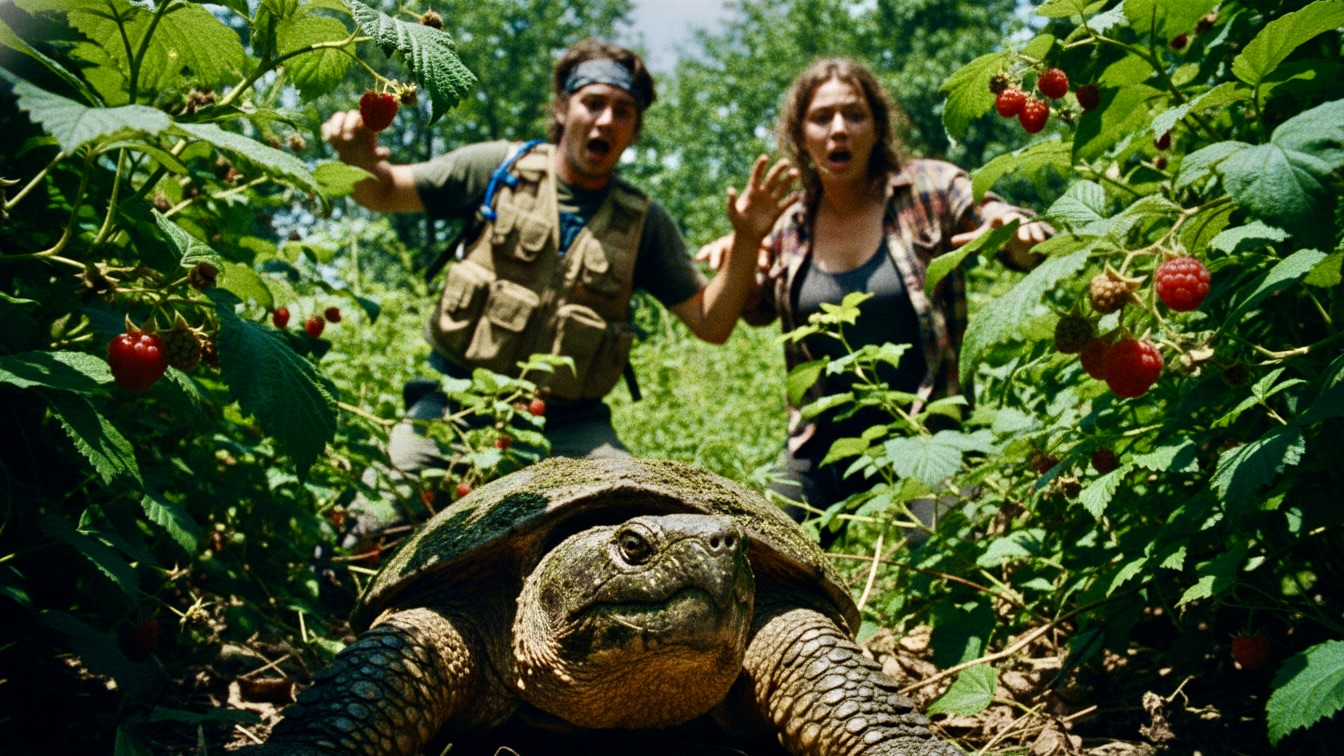
The story begins with Benji, a determined jam-maker, trespassing on old railway property near Vermilion Lake during a sweltering July afternoon. He is on a quest for rare, wild raspberries to secure a victory at the upcoming Jam Fest, hoping to redeem himself after a second-place finish the previous year. His solitary mission is interrupted when he discovers his rival, Heather, using a high-tech drone to map and harvest the same secret patch. The two engage in a heated debate over the merits of traditional craft versus modern optimization, highlighting their clashing philosophies on "the struggle" of the harvest.
Their competition is abruptly halted by the appearance of "The Tank," a legendary and massive snapping turtle guarding the most succulent berries. The situation escalates from a petty rivalry to a survival scenario as the turtle aggressively defends its territory. After a failed attempt to photograph the creature leads to a near-miss attack on Heather, the duo decides to cooperate. They devise a plan using Heather's drone as a distraction while Benji gathers the fruit, eventually leading to a chaotic struggle involving a garden hose and a rusted fishing net.
The arrival of Game Warden Miller adds a legal layer of tension to the encounter. Miller initially attempts to cite the pair for poaching and harassment of a protected species, but he quickly finds himself the target of the turtle’s prehistoric rage. After Benji and Heather save the Warden from a painful encounter, a truce is brokered. They trade their high-resolution drone footage of the turtle’s nesting grounds for their freedom. The story concludes at the Jam Fest, where their joint entry, "Tank’s Revenge," wins the blue ribbon, cementing a new partnership focused on sustainable resource management and future adventures.
A primary theme of the narrative is the tension between traditionalism and technological advancement. Benji represents the "rugged woodsman" archetype, believing that the value of a product is derived from the physical hardship and "soul" invested in its creation. He views Heather’s drone and data-driven approach as a hollow shortcut that strips the craft of its meaning. However, the story suggests that neither approach is entirely sufficient on its own. Benji’s manual labor is limited by his physical reach, while Heather’s technology fails when confronted with the raw, unpredictable aggression of the natural world.
The narrative also explores the theme of Man versus Nature, specifically the idea that nature is indifferent to human ambition. The snapping turtle, "The Tank," serves as a personification of the wild’s defensive and territorial instincts. He does not care about blue ribbons, Jam Fests, or property lines; he simply exists as a prehistoric force that demands respect. Both characters must learn that nature cannot be fully "optimized" or "mastered." Instead, they must find a way to coexist with it, shifting their perspective from exploitation to a more balanced form of interaction.
Finally, the story highlights the necessity of cooperation over competition. Benji and Heather begin as bitter rivals, each seeking individual glory and validation. The introduction of a common threat forces them to combine their disparate skill sets—Benji’s physical grit and Heather’s technical ingenuity. This synthesis of old and new leads to their ultimate success, suggesting that true progress occurs when tradition and innovation work in tandem. Their victory at the Jam Fest is not just about the quality of the berries, but the "authenticity" of the story they forged together through mutual reliance.
Benji is a character driven by a deep-seated need for validation and a romanticized view of manual labor. His obsession with the Jam Fest stems from a bruised ego, as he feels his "authentic" methods were undervalued in previous years. He views the world through a lens of struggle, believing that the more painful a process is, the more virtuous the result. This psychological framing makes him stubborn and resistant to change, as seen in his initial disdain for Heather’s equipment.
Despite his rigid adherence to tradition, Benji demonstrates significant psychological growth when faced with a crisis. He shows a capacity for quick thinking and self-sacrifice, such as when he uses his bucket to save Heather’s drone or when he tackles the turtle with a garden hose. His evolution from a solitary, bitter competitor to a collaborative partner shows that his passion for the craft is ultimately stronger than his pride. He finds a new sense of purpose not just in winning, but in the "absurdity" of the shared experience.
Heather serves as the psychological foil to Benji, embodying the modern drive for efficiency and data-driven success. She views the world as a series of problems to be solved through optimization and technology. Her reliance on her drone and UV maps suggests a desire to distance herself from the messiness and danger of the physical world. She wants the reward of the harvest without the "thorns," reflecting a contemporary anxiety about loss of control and physical vulnerability.
However, Heather’s encounter with The Tank shatters her illusion of technological superiority. When her drone fails and she is nearly bitten, she experiences a visceral shock that forces her to re-engage with reality on a more primal level. She is not merely a "techie"; she is also a fierce competitor who is willing to adapt when her primary tools fail. By the end of the story, she has learned to appreciate the value of the "struggle" she once mocked, using her technical skills to support conservation rather than just extraction.
Warden Miller functions as the voice of authority and the representative of the law within the natural ecosystem. He initially presents a stoic, almost cynical persona, having likely dealt with countless reckless tourists and poachers. His psychological focus is entirely on the protection of the species he monitors, showing a lack of empathy for the human participants until he is personally threatened. He represents the rigid structures of society that attempt to categorize and control the wild.
His character undergoes a brief but significant moment of vulnerability when he is chased by the turtle. This experience humbles him and breaks down his professional facade, allowing him to see Benji and Heather as allies rather than just criminals. His willingness to accept the drone footage in exchange for leniency shows a pragmatic streak. He moves from being an antagonist to a collaborator, recognizing that Heather’s technology can serve the interests of conservation more effectively than his traditional patrols.
The narrative employs a rich, sensory-driven style that emphasizes the physical discomfort of the setting. The author uses heavy, tactile descriptions—such as the "physical weight" of the sun and the "deep, flaky orange" of the rusted tracks—to ground the reader in the environment. These details serve to heighten the stakes of the "struggle" that Benji so frequently mentions. The contrast between the "bloated, watery" supermarket berries and the "intensely tart" wild ones mirrors the thematic contrast between artificiality and authenticity.
The pacing of the chapter shifts effectively from a slow, atmospheric build-up to a frantic, high-action sequence. The initial descriptions of the heat and the silence of the woods create a sense of expectant dread, which pays off when the turtle is revealed. The action scenes are characterized by short, punchy sentences and vivid verbs, capturing the chaos of the encounter. This shift in tempo mirrors the characters' own adrenaline spikes, moving the reader from the meditative act of picking berries to the life-or-death stakes of a predator encounter.
The tone of the story is a unique blend of humor and genuine tension. The author treats the "Jam Fest" with a level of seriousness that borders on the absurd, which provides a comedic undercurrent to the dangerous situation with the turtle. This "serious-about-the-trivial" approach makes the characters more relatable and endearing. The narrative voice is observant and slightly cynical, particularly in the dialogue between Benji and Heather, which adds a layer of modern wit to a classic "man versus nature" tale.


