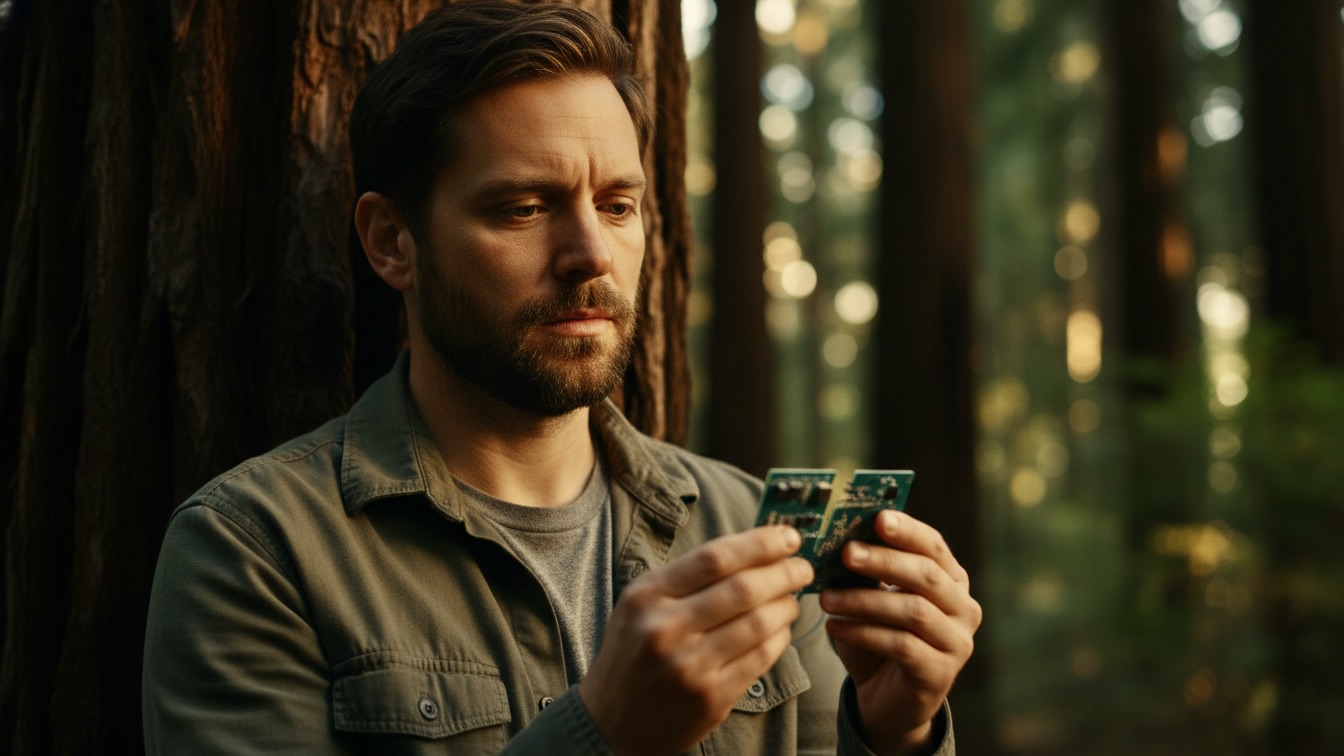
The story follows Victor, a retired twenty-eight-year-old intelligence operative living in a secluded cabin, who is forcibly re-enlisted by Director Carlisle of the Agency. Carlisle informs him that Dr. Aris Petries, a brilliant but disillusioned scientist, has stolen a designer pathogen named "Selective Extinction" which targets individuals with high cortisol levels. Petries intends to release this virus to "prune" humanity of the stress-ridden, hyper-connected urban population he views as a cancer on the planet. Victor tracks Petries through the Redwoods and into Yosemite National Park, discovering that the scientist is using the forest's root systems as a biological communication network.
The confrontation reaches its climax at the Mist Trail in Yosemite, where Victor finds Petries preparing to release the pathogen into the waterfall's spray. After a desperate physical struggle on the slick granite, Victor manages to neutralize the virus using a chemical agent and Petries’ own emergency equipment. Rather than handing over the research to Carlisle, Victor destroys the biological data and the server to prevent the Agency from weaponizing it. In the end, Victor abandons his career and his digital identity entirely, choosing to disappear into the wilderness to find a life free from the "noise" of the modern world.
The central theme of the narrative is the conflict between modern technological connectivity and the primal, silent reality of nature. Petries views the digital world and the resulting human stress as a "noise" that has corrupted the species, turning humanity into a virus that the earth must reject. The story suggests that our constant state of digital engagement has created a biological vulnerability, represented by the cortisol-seeking pathogen. This theme highlights the psychological toll of the "silent exchange" of information that defines contemporary existence.
Another significant theme is the dehumanization inherent in institutional power structures. Director Carlisle represents the "machine," viewing every person and natural resource as a mere asset or data point to be exploited for situational awareness. Victor is caught between two extremes: Petries’ genocidal environmentalism and Carlisle’s cold, transactional authoritarianism. The story posits that both sides are equally "rot," as they both seek to control or eliminate the chaotic, messy reality of human life for the sake of a perceived higher order.
Finally, the story explores the concept of personal agency and the necessity of disconnection as a form of salvation. Victor’s journey is one of de-escalation, moving from a high-stress operative to a man who literally breaks his connection to the world by destroying his SIM card. His survival and ultimate peace depend on his ability to reject the roles assigned to him by others. The narrative suggests that in a world drowning in static, the only way to remain human is to become a "ghost" to the systems that demand constant presence and productivity.
Victor is a protagonist defined by a profound sense of weariness that transcends his young age. He views his life through the lens of "dog years," suggesting that his time with the Agency has aged his spirit and body prematurely. His internal conflict stems from his realization that he is the very type of person Petries’ virus is designed to kill. He is a high-cortisol individual, a tool of the system who has been used until he is frayed and worn like his old boot laces.
Throughout the mission, Victor displays a cynical pragmatism that masks a lingering moral compass. Unlike Carlisle, he sees the humanity in the "noise" and recognizes that even a broken species deserves to survive its own mistakes. His decision to destroy Petries’ research is his ultimate act of rebellion, proving that he is no longer a "tool" for the Director to wield. By the end of the story, he chooses a path of radical isolation, seeking to heal his own psychological wounds by aligning himself with the honesty of the dirt rather than the deception of the screen.
Aris Petries serves as a dark mirror to Victor, representing what happens when intellectual brilliance is consumed by environmental despair. He is a man who has looked too deeply into the "loneliness" of the modern world and concluded that the only cure is a surgical extinction. His obsession with the "Bio-Link" reveals a desire to replace human static with the pure, silent communication of the forest. He does not see himself as a murderer, but as a gardener performing a necessary, if painful, pruning.
Despite his radical actions, Aris is depicted with a certain level of tragic empathy. He is clearly suffering from the same stress and obsession he seeks to eliminate in others, making him a hypocritical host for his own pathogen. His failure to see the value in human struggle makes him a fanatic, yet his critiques of modern society resonate deeply with Victor. Ultimately, he is a man who wanted to save the world by killing it, falling victim to the very "rot" he believed he could outrun.
Director Carlisle functions as the personification of the cold, calculating nature of government authority. He is described through artificial scents like air conditioning and high-end stationery, marking him as a "glitch" in the natural world of the woods. He is entirely focused on the transaction of information and the acquisition of power, showing no concern for the lives at stake beyond their utility. To him, the "Selective Extinction" pathogen is not a horror to be stopped, but an expensive asset to be recovered and refined.
His interactions with Victor are defined by a lack of empathy and a constant pressure to perform. He represents the systemic pressure that creates the cortisol-driven stress Petries hates so much. Carlisle’s inability to understand why Victor would walk away from the machine highlights his own limitations; he cannot conceive of a life that isn't measured in data points and situational awareness. He is the true architect of the "noise," a man who would turn the entire planet into a motherboard if it meant he could control the signal.
The narrative voice of the story is heavily influenced by the hard-boiled noir tradition, utilizing a clipped, rhythmic prose that reflects Victor’s military background and mental exhaustion. Sentences are often short and punchy, creating a sense of urgency and directness. This style mirrors the protagonist's internal state, where every movement and thought is a calculated expenditure of energy. The tone is consistently gritty and weary, yet it possesses a lyrical quality when describing the natural world, highlighting the contrast between the "machine" and the forest.
Sensory details are employed with surgical precision to ground the psychological themes in a physical reality. The author frequently uses smells and tastes—the sour mix of subway sweat, the metallic tang of ozone, and the scent of expensive stationery—to define characters and settings. These details create a visceral experience for the reader, making the abstract concept of "urban stress" feel like a tangible, suffocating presence. The transition from the thick, salt-tasting heat of the cabin to the cold, sharp spray of the Yosemite mist parallels Victor’s journey toward a perceived purity.
The pacing of the story is expertly handled, beginning with a slow, atmospheric opening that gradually accelerates into a high-stakes confrontation. The "Bio-Link" and the cortisol-seeking virus provide a unique technological hook that blends science fiction with a traditional thriller. The resolution avoids a typical heroic ending, opting instead for a quiet, contemplative conclusion that reinforces the story's themes of disconnection and personal peace. This stylistic choice ensures that the emotional impact of Victor's "retirement" is felt as a heavy, necessary silence.


