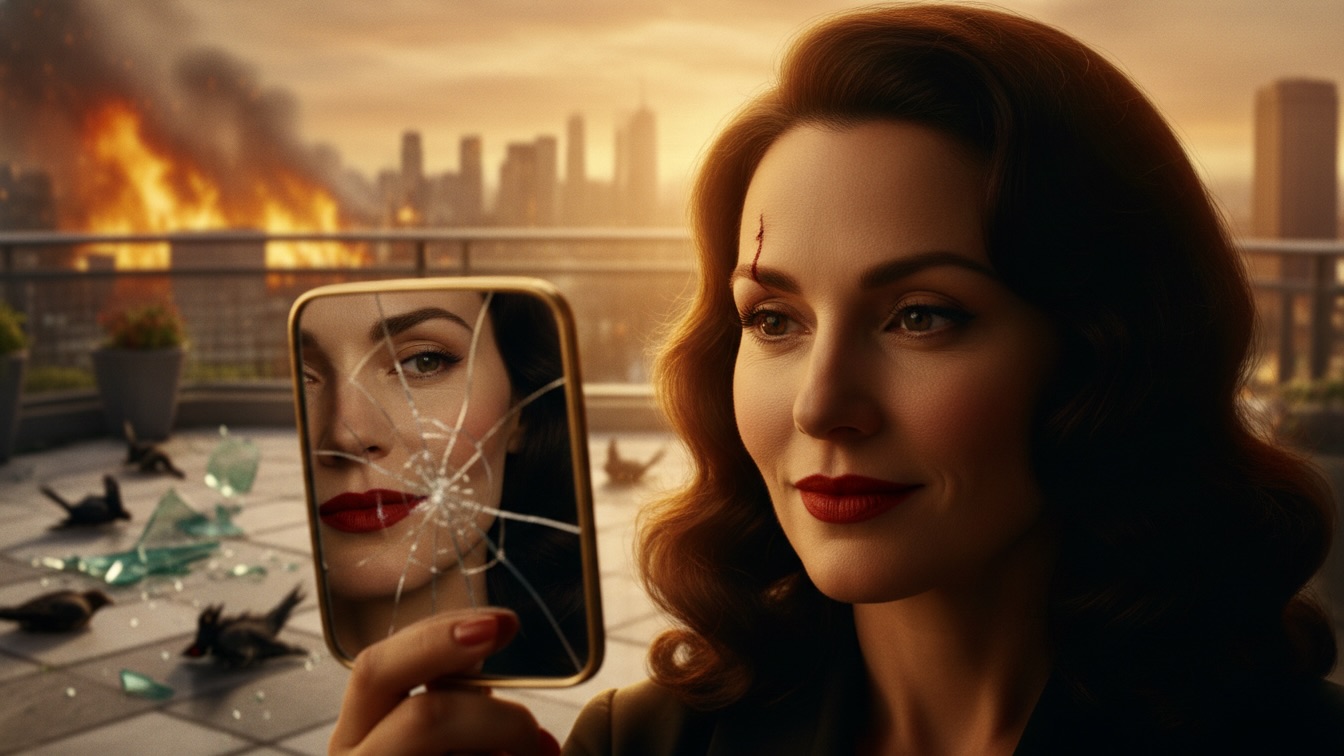
The story follows Tiffany and Chad, two high-end influencers residing in a luxury penthouse during the literal end of the world. As the sky turns a toxic mauve and acid rain begins to fall, the pair remains obsessively focused on their digital engagement metrics and the aesthetic quality of their "Final Sunset" video. They prioritize champagne brands and camera filters over the encroaching atmospheric collapse and the desperate plight of the people in the streets below. Even as a delivery drone carrying a designer hazmat suit is shot down by looters, Tiffany’s primary concern remains the maintenance of her personal brand.
The arrival of Julian, a disfigured and dying socialite, brings news of a lethal neuro-gas rising through the building. Despite the loss of power and the imminent threat of death, Chad and Tiffany decide to film a final "Couple's Farewell" video. An explosion eventually shatters the penthouse windows, exposing them to the elements and the gas. In her final moments, Tiffany ignores the carnage and the blood on her face, choosing instead to check her lipstick in a cracked mirror. She embraces her role as a permanent digital icon as the gas overcomes her.
The central theme of the narrative is the triumph of hyper-reality over physical existence. For Tiffany and Chad, the apocalypse is not a tragic end to human life, but rather a backdrop for high-concept content. They perceive the world entirely through the lens of their smartphones, valuing the "Great Extinction" filter more than the reality it obscures. This suggests a psychological state where the representation of a life has become more significant than the life itself.
Another prominent theme is the intersection of narcissism and class privilege during a crisis. The protagonists view the suffering of others as a "vibe-killer" or an "uncivilized" distraction from their curated experience. Their wealth provides them with a "designer cage" that buffers them from the immediate consequences of the collapse, allowing them to maintain a delusion of superiority. This detachment highlights a total erosion of empathy, where even death is viewed through the lens of marketability and social status.
The story also explores the absurdity of consumerism in the face of total annihilation. The preoccupation with Gucci hazmat suits and vintage champagne serves as a biting critique of brand loyalty. These objects provide no actual protection or comfort, yet the characters cling to them to anchor their identities. The "gold-plated filters" on the useless suit symbolize a society that has prioritized form over function to a suicidal degree.
Finally, the narrative touches on the concept of digital immortality. Tiffany and Chad believe that by documenting their final moments in high definition, they are achieving a state of eternity. They are more afraid of a "spinning wheel of death" on a screen than the actual death of their physical bodies. This reflects a modern existential dread where being "unseen" or "unfollowed" is considered the ultimate extinction.
Tiffany functions as a personification of performative vanity, possessing a psyche that has been entirely colonized by her digital persona. She views her own face as a product to be managed, reacting to the apocalypse primarily as a lighting problem that washes out her cheekbones. Her internal conflict is not between life and death, but between the "real" and the "brand." She treats the acid rain and the dying sun as props in a theatrical production designed to maximize her engagement.
Her psychological state is characterized by profound dissociation. When she sees the "basic" plastic bags used by the dying people below, she feels pity not for their deaths, but for their lack of aesthetic coordination. This indicates that she has replaced her moral compass with a style guide. Her final act of checking her lipstick amidst the ruins of her home confirms that her mask has become her true face. She dies not as a human being, but as a carefully posed image.
Chad serves as the architect of the duo's shared delusion, focusing on the technical and structural aspects of their "craft." He is driven by a need for control, which he exerts by obsessing over camera angles and lighting rigs even as the world burns. He uses professional jargon to distance himself from the surrounding horror, transforming a global catastrophe into a "high-concept" photoshoot. His commitment to the "integrity of the frame" suggests a man who can only process reality if it is staged.
Psychologically, Chad is deeply invested in the hierarchy of the "elite." He believes that his "platinum-tier survival package" and his nuclear-powered penthouse exempt him from the common fate of humanity. When the power fails, his breakdown is triggered by the loss of his ring light rather than the threat of the neuro-gas. He views the apocalypse as a contract negotiation gone wrong. His insistence on filming the final video shows a desperate need to validate his existence through the eyes of a disappearing audience.
Julian enters the story as a "memento mori," a physical reminder of the reality that Tiffany and Chad are trying to ignore. His disheveled appearance and failing plastic surgery represent the literal collapse of the "brand" they hold so dear. Unlike the protagonists, he is acutely aware that their "designer cage" offers no real protection from the government's neuro-gas. He serves as the voice of a discarded reality, mocking the futility of their vanity.
His presence highlights the grotesque nature of their lifestyle. As his fillers sag and he coughs up blood, he becomes a visual metaphor for the decay of the high-society world they inhabit. His death on the kitchen floor is "messy" and "unprofessional," exactly the kind of reality Tiffany swiped away on her phone earlier. Julian’s role is to strip away the illusion of the penthouse, revealing it to be nothing more than a high-altitude tomb.
The narrative voice is characterized by a sharp, cynical irony that mirrors the protagonists' own detachment. The author uses a first-person perspective to immerse the reader in Tiffany’s shallow worldview, making the contrast between the horrific environment and her trivial concerns more jarring. The tone is one of dark comedy, where the end of civilization is treated with the same gravity as a bad hair day. This stylistic choice emphasizes the absurdity of the characters' priorities.
Sensory details are used to create a vivid, nauseating atmosphere. The descriptions of the "cheap grape soda" sky and the "moldy lime" sun evoke a sense of chemical toxicity and decay. The author frequently juxtaposes high-end luxury with visceral filth, such as the "sturgeon caviar" being eaten while "dead birds" rain onto the balcony. These details reinforce the theme of a world where the organic and the synthetic have merged into a single, poisonous reality.
The pacing of the story accelerates as the external threats close in, shifting from the slow vanity of the living room to the chaotic violence of the shattered balcony. However, the narrative remains anchored by Tiffany’s static, unchanging obsession with her image. This creates a tension between the frantic movement of the world and the frozen, mannequin-like behavior of the characters. The final scene, with its "million diamonds of glass," provides a cinematic conclusion that matches the characters' desire for a "grand" and "theatrical" finale.


