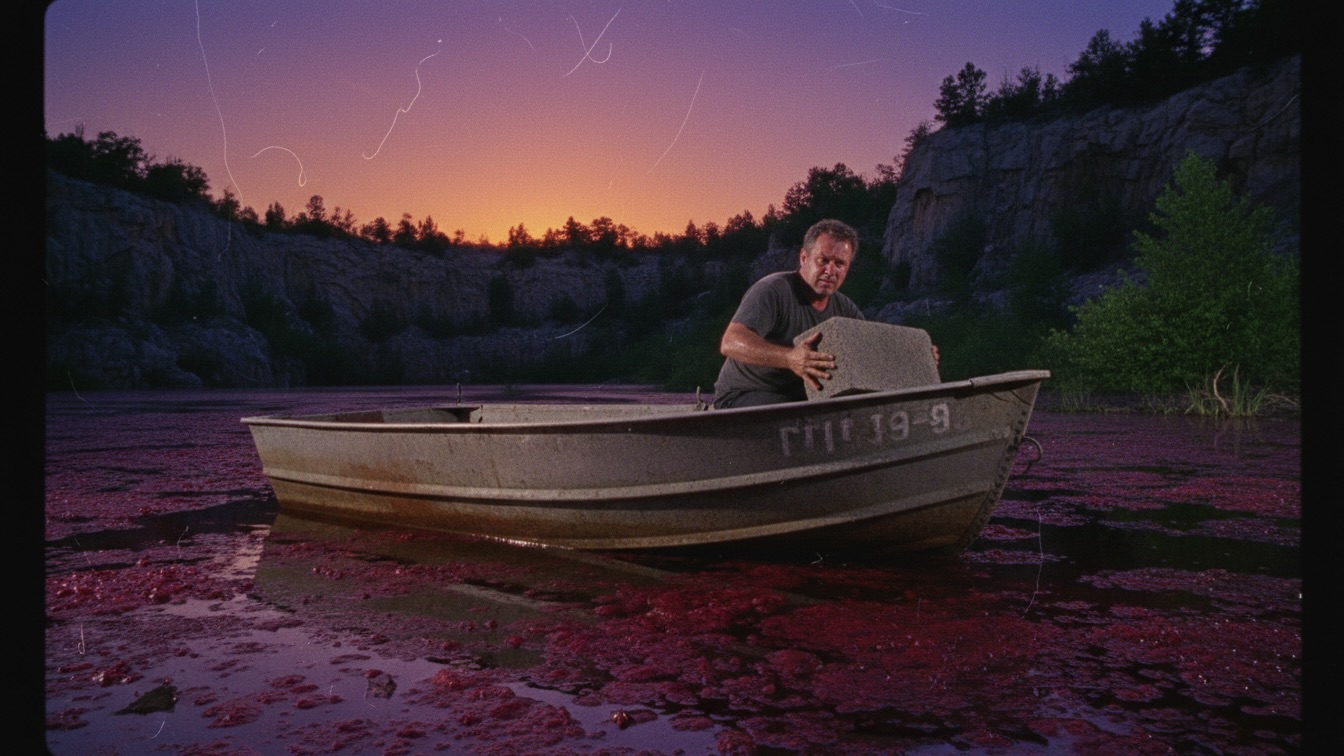
The narrative follows Martin as he returns to the site of a traumatic childhood crime, Poplar's Quarry, during a record-breaking heatwave. He is joined by his former friends Clarissa, Shawn, and Ben, all of whom are bound by the shared secret of Larry’s death twenty years prior. The receding water levels, caused by the extreme heat and toxic algae bloom, have begun to expose Larry’s remains, which are snagged on a submerged tree.
The group attempts to use a rowboat to reach the remains and weigh them down with cinder blocks to prevent the authorities from discovering the body. During the operation, a young boy on a mountain bike witnesses their actions, leading to a panicked escalation. Ben, suffering a total psychological collapse, murders the child to protect the group’s secret.
As the sun sets, the situation shifts from a tense cover-up into a surreal, possibly supernatural, confrontation with the past. The toxic red water and gnarled roots seemingly come alive, dragging the boat and its occupants into the depths. Martin ultimately surrenders to the water, realizing that the quarry has become a repository for the town's collective sins.
The central theme of the story is the inevitable resurfacing of repressed guilt, mirrored by the environmental "hemorrhaging" of the quarry. The toxic algae bloom serves as a visceral metaphor for a secret that has fermented and poisoned the characters' lives over two decades. Just as the heatwave forces the water to recede and reveal the physical remains of their crime, the pressure of the situation forces their carefully constructed personas to wither.
Another prominent theme is the failure of intellectualism and authority to provide moral protection. Clarissa attempts to use detached, academic language to distance herself from the horror of their actions, framing murder as a "utilitarian success." Similarly, Shawn relies on his police uniform and badge to provide a sense of order and immunity. However, both the law and logic prove useless against the primal, chaotic force of their shared trauma and the literal toxicity of the environment.
The narrative also explores the concept of the "snap point," where the psychological weight of a secret becomes unsustainable. Each character represents a different reaction to this pressure: Martin experiences sensory overload and paralysis, Ben undergoes a violent psychotic break, and Shawn retreats into animalistic survival instincts. The story suggests that guilt is not a static burden but a living, predatory force that eventually consumes the host.
Finally, the story touches upon the idea of collective sin and the "narrative of survival." Clarissa’s insistence that they are "productive members of society" highlights the arrogance of those who believe their lives are more valuable than their victims'. The ending suggests a form of cosmic justice, where the earth itself refuses to hold their secrets any longer, demanding a "homecoming" that equates the killers with the killed.
Martin serves as the narrative’s moral compass, though he is a broken and passive one. He is characterized by intense psychosomatic symptoms, such as the "knot" in his chest and his shallow breathing, indicating that he has lived in a state of chronic anxiety for twenty years. Unlike Clarissa, he cannot intellectualize his guilt; he feels it as a physical weight and a sensory assault.
His role in the group is that of the reluctant witness. He is paralyzed by the "snap point," unable to act effectively or flee the scene. This paralysis suggests a deep-seated belief that he deserves the impending doom he senses. He is the first to perceive the "voice" of the lake, indicating that his psychological boundaries have completely eroded under the pressure of the heat and the trauma.
Ultimately, Martin’s journey is one of surrender. By the end of the story, he stops struggling against the red water and the reaching roots. He accepts the "homecoming," transitioning from a man haunted by a secret to a man who becomes part of the secret. His final vision of the "collection" of shapes in the water reflects his realization that his individual sin is part of a larger, systemic rot.
Clarissa is the psychological architect of the cover-up, utilizing "theatrical" detachment as a defense mechanism. She views life through the lens of a "narrative," a strategy she uses to distance herself from the visceral reality of Larry’s death. Her speech is formal and clinical, designed to maintain a sense of superiority and control over the more emotionally volatile men in the group.
As a psychologist might observe, her behavior suggests high-functioning sociopathic traits or a severe form of compartmentalization. She views Ben’s murder of the child not as a tragedy, but as the "neutralization of a variable." To her, people are merely elements of a story that she must edit to ensure her own survival. She is the "adult supervisor" who believes she can manage the chaos of the natural world with rhetoric.
However, her composure is a fragile mask. When the situation moves beyond her control and the supernatural elements emerge, her theatricality vanishes, replaced by a "shrill scream." Her failure to "manage the information" at the end of the story represents the total collapse of her ego. She dies not as a master of the narrative, but as a victim of the very reality she tried to narrate away.
Shawn embodies the corruption of authority and the hypocrisy of the "lawman." He uses his position as a deputy to facilitate the crime, viewing his badge as a "magical ward" against the consequences of his past. His internal conflict is evident in the way he rests his hand on his holster, a habitual gesture that suggests he can only interact with the world through the threat of violence.
Psychologically, Shawn is driven by a profound sense of cowardice masked by aggression. He is the one who delivered the fatal blow to Larry, yet he spent years filing missing persons reports and lying to the victim's mother. This double life has left him "hard and cynical," his jaw muscles constantly pulsing with the strain of his deception. He is a man who has traded his integrity for a uniform.
In the boat, Shawn’s descent into "animalistic conflict" reveals the hollowness of his authority. When faced with the child witness and the rising remains of Larry, he loses his professional veneer and reverts to the terrified teenager he was in 2006. His decision to fire his gun into the water is a futile attempt to kill a ghost, proving that his weapon is useless against the weight of his own conscience.
Ben is the "weak link" whose psychological fragility serves as the catalyst for the story's final escalation. He is described as a "walking nervous breakdown," a man whose sobriety is a thin veil over a deep well of trauma. His tremors and frantic movements indicate that he has never integrated the events of 2006 into his psyche, leaving him vulnerable to "triggers."
His murder of the young boy is the ultimate expression of his psychological collapse. In his warped state of mind, he believes he is protecting the group, but his actions are actually a desperate attempt to stop the "screaming" inside his own head. He becomes a vessel for the violence they all share, acting out the group's collective shadow in a frantic, uncoordinated burst of lethal force.
By the end, Ben achieves a terrifying form of "clarity" through his madness. He is the only one who willingly enters the toxic water, claiming that Larry "just wants to show us what’s at the bottom." His transition from a shivering addict to a smiling herald of the deep suggests that he has found a dark peace in the total abandonment of his sanity and his humanity.
The pacing of the story is masterful, beginning with a heavy, stagnant atmosphere that mirrors the "104-degree blanket" of the heatwave. The initial descriptions are slow and sensory-laden, focusing on the "metallic tang" of the air and the "electric scream" of the cicadas. This creates a sense of claustrophobia, making the reader feel as trapped as Martin is on the limestone ridge.
The tone shifts from psychological thriller to surreal horror as the sun sets. The use of the color red—the "bruised, sickly purple-red" of the water and the "searing crimson" of the bioluminescence—creates a visual motif of blood and emergency. The author uses these sensory details to blur the line between the physical environment and the characters' deteriorating mental states.
The narrative voice is deeply introspective, focusing on Martin’s internal sensations to ground the more theatrical elements of the dialogue. The contrast between Clarissa’s cold, formal speech and the "wet, tearing noise" of the environment creates a jarring dissonance. This stylistic choice emphasizes the theme that no amount of human language can adequately cover the "vomit" of the earth or the reality of death.
Finally, the use of the "snap point" as a structural device gives the story a feeling of inevitable momentum. Every action, from flipping the boat to the murder of the child, feels like a necessary step toward the final "homecoming." The ending, with its imagery of a "predatory red eye," leaves the reader with a sense of nihilistic closure, suggesting that some secrets are too toxic to ever truly be buried.


