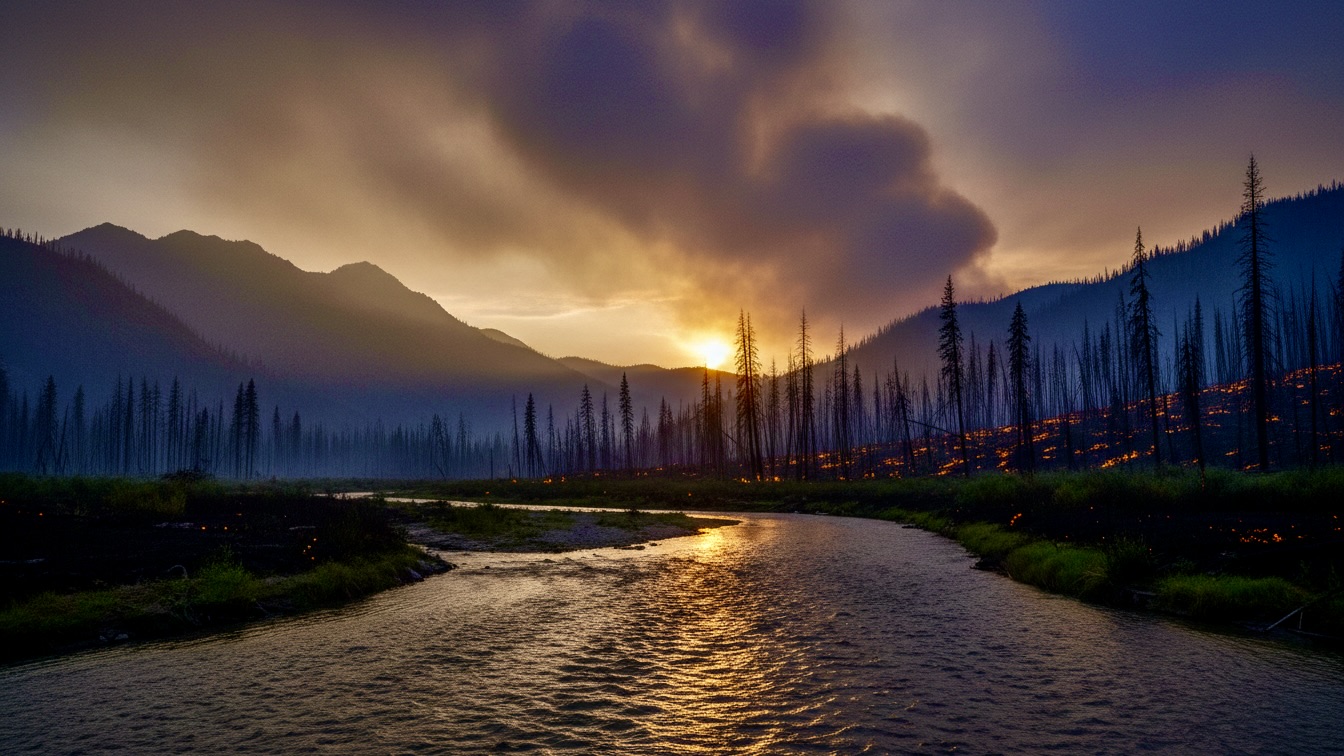
The story begins with Kara, a high-profile social media influencer, struggling with a failing internet connection at an ultra-luxury glamping resort in the Sierra foothills. Driven by the pressure of a looming contractual live stream, she ignores the warnings of a park ranger named Andy regarding an imminent wildfire threat. Her obsession with maintaining her digital persona leads her into a restricted area, where a lightning strike ignites the parched landscape, instantly transforming her curated paradise into a death trap.
As the fire rapidly consumes the ridge, Kara finds herself trapped and stripped of her technological lifeline when her phone battery dies. Andy, who has pursued her into the danger zone to ensure her safety, discovers her on a rocky outcropping just as the smoke begins to overwhelm the area. During their desperate descent into a nearby ravine, a shale slide pins Andy’s leg, forcing Kara to abandon her expensive camera gear and transition from a passive consumer to an active survivor.
Guided by Andy's expertise and a simple analog compass, Kara drags the injured ranger through suffocating smoke and intense heat toward a distant river. They survive the fire's most violent surge by huddling together in the freezing water beneath a reflective mylar blanket. In the aftermath, Kara is rescued and returned to the sterile safety of a hospital, where she ultimately chooses to silence her new phone, signaling a profound internal shift away from her previous digital existence.
The narrative primarily explores the violent collision between digital artifice and physical reality. Kara’s initial world is defined by "imported rugs," "carefully applied contouring," and "engagement metrics," all of which prove utterly useless when faced with the "raw, indifferent violence" of a wildfire. The story suggests that the modern obsession with curation creates a dangerous illusion of control, leading individuals to believe they can negotiate with nature as if it were a service provider.
Another prominent theme is the deconstruction of identity through trauma. At the start of the chapter, Kara’s sense of self is entirely external, tethered to the one point four million people watching her screen. As the fire strips away her tools—her phone, her drone, and her "PR mask"—she is forced to rediscover a primal, grounded version of herself. This transformation is highlighted by her decision to prioritize Andy’s life over her twenty-thousand-dollar camera gear, marking a shift from vanity to empathy.
The story also examines the concept of "The Restricted Zone," both as a physical location and a psychological state. Physically, it is the dangerous terrain Kara enters against orders; psychologically, it represents the space where social hierarchies and digital influence vanish. In this zone, the only currency that matters is survival and human connection. The "plastic compass" becomes a symbolic replacement for the smartphone, representing a return to fundamental truths and basic navigation in a world that has become too complex for its own good.
Kara begins the story as a personification of digital anxiety, her internal rhythm dictated by the "frantic" tapping of her boot and the "spinning gray circle" of a loading screen. Her initial reaction to the wildfire threat is not fear for her life, but anger at the "unacceptable" disruption of her brand deal. This reflects a deep psychological dissociation, where she views the natural world merely as a "greenhouse" backdrop for her content rather than a living, dangerous entity.
As the crisis escalates, her psychological defenses shatter, revealing a capacity for resilience she did not know she possessed. The moment she drops her heavy backpack to drag Andy to safety signifies the death of her influencer persona and the birth of a survivor. By the end of the narrative, her silence in the hospital room suggests a state of post-traumatic growth. She has moved from a state of constant digital noise to a quiet, somber appreciation of the physical world, ultimately rejecting the very device that once defined her existence.
Andy serves as the narrative’s moral and physical anchor, representing a grounded reality that Kara has long forgotten. He is described through his connection to the earth—his "deeply tanned" skin, the "gray dust" on his uniform, and his "flat" voice that lacks the theatricality of Kara’s world. His role is not just to save Kara’s life, but to act as a catalyst for her psychological awakening by forcing her to confront the "only thing that exists": the fire.
Even when incapacitated by a broken leg, Andy maintains his role as a guide, providing the "leverage" and "navigation" necessary for their survival. His willingness to sacrifice himself by telling Kara to leave him behind highlights his selflessness, which stands in stark contrast to Kara’s initial narcissism. Through his interactions with her, he strips away her delusions of VIP status, treating her instead as a human being whose only priority must be the next breath.
The pacing of the story mirrors the progression of a wildfire, beginning with a slow, stifling tension and exploding into a frantic, high-stakes survival sequence. The author uses sensory details to create a sense of claustrophobia, focusing on the "one hundred and four degrees" heat, the "stinging" smell of burning pine, and the "jet-engine howl" of the fire crowning. These descriptions pull the reader out of the digital world and into the visceral, punishing reality of the Sierras.
The narrative voice undergoes a subtle shift in tone as the story progresses. In the beginning, the language is peppered with technical and luxury jargon like "sponsored electrolyte beverage," "contouring," and "router." As the fire takes over, the prose becomes leaner and more elemental, focusing on "mud," "ash," "blood," and "cold." This linguistic evolution mirrors Kara’s own journey from the complex fluff of social media to the stark simplicity of survival.
Symbolism is used effectively to reinforce the story's themes, particularly through the contrast of objects. The "white plastic drone" that "drops like a stone" represents the fragility of technology, while the "silver tarp" and "analog compass" represent the enduring utility of basic tools. The final image of the "dead phone face down" serves as a powerful concluding metaphor for Kara’s rejection of her former life, leaving the reader with a sense of quiet, somber resolution.


