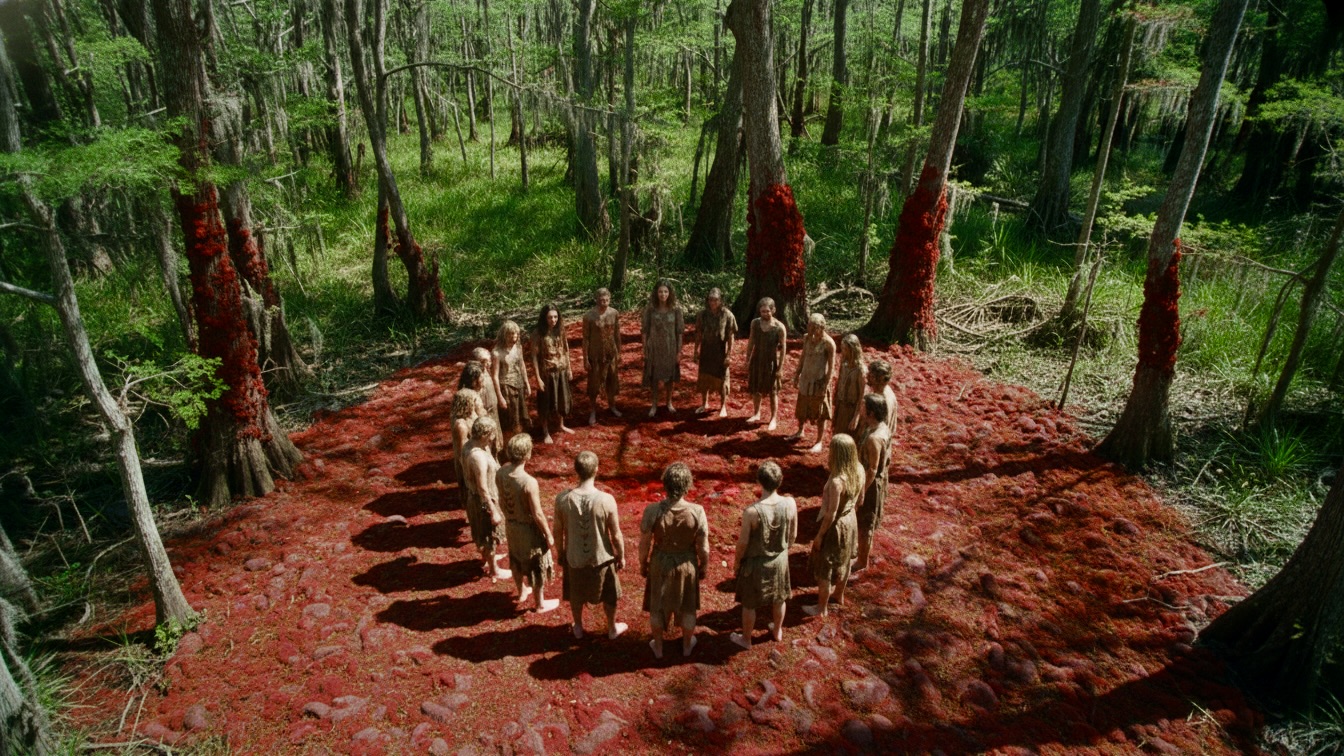
Jamie Miller, a young podcaster seeking a career-defining story, travels deep into the Florida Everglades to investigate a reclusive commune known as Unity Grove. His primary motivation is personal, as he hopes to find his missing sister, Stacey, who vanished into the group six months prior. Upon arrival, he encounters Father Yates, the enigmatic leader who seems to possess an impossible knowledge of Jamie’s identity. Jamie quickly observes that the commune is not merely a social experiment but a biological anomaly centered around a pervasive, invasive red moss that appears to connect the inhabitants.
The atmosphere of the Grove is defined by an eerie, synchronized silence and the absence of natural swamp sounds. Jamie discovers that the community members are physically and mentally linked by the fungal parasite, which replaces individual thought with a collective "pulse." When he finally locates Stacey, he finds her transformed into a hollow vessel for the hive-mind, devoid of her former personality. Despite his frantic attempts to escape the encroaching moss and the members of the Grove, Jamie is eventually captured. He is submerged into the Source Pool, a central biological hub where his individual consciousness is stripped away and integrated into the expanding collective.
The central theme of the narrative is the tension between individuality and collectivism, framed through the lens of biological horror. Father Yates presents the "I" as a prison of loneliness and ego, suggesting that the modern human condition is one of painful isolation. The red moss offers a radical solution to this suffering by removing the boundaries of the self. However, the story posits that the cost of this "peace" is the total erasure of the human soul, transforming people into mere biological nodes for a predatory organism.
Another significant theme is the subversion of nature as a sanctuary. While many seek the wilderness to find themselves, Jamie finds a version of nature that is actively seeking to unmake him. The Everglades are portrayed as an oppressive, sentient force that uses the moss to "heal" the perceived wound of human individualism. This highlights a deep-seated fear of losing one's agency to a mindless, yet efficient, natural process. The moss does not hate its hosts; it simply processes them, which is perhaps more terrifying than active malice.
The story also explores the seductive nature of belonging and the psychological vulnerability of the lonely. The members of the Grove appear peaceful and devoid of stress because they no longer carry the burden of choice or self-reflection. For characters like Stacey, the transition from a "lonely voice" to a "part of the fire" is an escape from the complexities of the modern world. The narrative suggests that the desire for connection is so powerful that humans might willingly embrace a parasitic existence if it promises an end to their internal discord.
Jamie is characterized by his skepticism and his reliance on technology as a barrier between himself and the world. As a podcaster, he views life through the lens of a "lead" or a "story," using his digital recorder and camera to maintain a sense of professional distance. This intellectual shield initially protects him from the psychological pull of the Grove, but it also makes him a "discordant note" that the collective feels a biological need to resolve. His motivation is a blend of professional ambition and deep-seated familial guilt over his sister’s disappearance.
Psychologically, Jamie represents the struggle of the ego to maintain its boundaries in the face of overwhelming pressure. He clings to his memories and his identity even as the moss begins to hijack his nervous system. His final thoughts of a cat and a summer day are desperate attempts to anchor himself to a reality that is being systematically deleted. Ultimately, his tragedy lies in the fact that his very strengths—his curiosity, his memories, and his drive—are what make him a valuable resource for the Grove to consume.
Father Yates serves as the primary antagonist and the biological mouthpiece for the red moss. He does not exhibit the typical traits of a cult leader, such as megalomania or a desire for personal wealth; instead, he displays a chilling, detached calm. He views himself not as a master, but as a "primary antenna" for a superior way of being. His language is a blend of spiritual philosophy and biological determinism, reflecting his status as a bridge between human consciousness and the fungal hive-mind.
From a psychological perspective, Yates is a man who has completely surrendered his "I" to the "We." He no longer experiences fear or doubt because he is backed by the collective memory of the Grove. He treats Jamie’s resistance with pity rather than anger, viewing the young man’s struggle for independence as a symptom of a "cancerous" ego. Yates represents the ultimate end-point of the Grove’s ideology: a human shell that has been entirely repurposed to serve the growth of the collective organism.
Stacey is the emotional heart of Jamie’s quest and the primary evidence of the Grove’s transformative power. Before her assimilation, she was a young woman searching for a "deeper connection," making her the ideal host for the parasitic moss. By the time Jamie finds her, she has been reduced to a "waxen" version of herself. She no longer recognizes the bond of siblings as a unique or important connection, seeing Jamie only as a potential addition to the collective.
Her character illustrates the horror of total psychological assimilation. She speaks with a voice that is a "recording," suggesting that her personality has been archived rather than preserved. Stacey’s terrifying, symmetrical smile reflects the loss of human nuance and emotion in favor of a perfect, empty harmony. She functions as a cautionary figure, showing that the "peace" offered by the Grove is indistinguishable from the death of the person she used to be.
The narrative utilizes a claustrophobic and sensory-heavy style to mirror Jamie’s increasing entrapment. The author leans heavily into the "wet" and "heavy" atmosphere of the Everglades, using descriptions of "old vegetables" and "standing water" to create a sense of decay. This visceral imagery establishes a world where the boundary between life and rot is blurred. The red moss itself is described in unsettlingly organic terms, compared to "raw steak" and "tongue," which heightens the biological horror of the setting.
Pacing in the chapter moves from a slow, investigative trudge to a frantic, nightmare-like sprint. The initial sections focus on the physical discomfort of the heat and the psychological unease of the community’s silence. As the sun sets and the moss begins to glow, the narrative shifts into a more surreal and kinetic mode. This transition mimics the way a predator might slowly stalk its prey before finally closing the trap, reflecting the "teeth" of the Grove closing in on Jamie.
The narrative voice is deeply rooted in Jamie’s perspective, allowing the reader to experience his transition from a cynical observer to a terrified victim. The use of technological metaphors—such as "digital recorder," "flickering ghost," and "discordant note"—contrasts sharply with the organic, ancient power of the swamp. This stylistic choice emphasizes the futility of human technology when faced with a primal, biological force. The ending of the chapter, where the "I" is replaced by the "We," is marked by a shift in tone from frantic struggle to a hollow, terrifyingly calm resolution.


