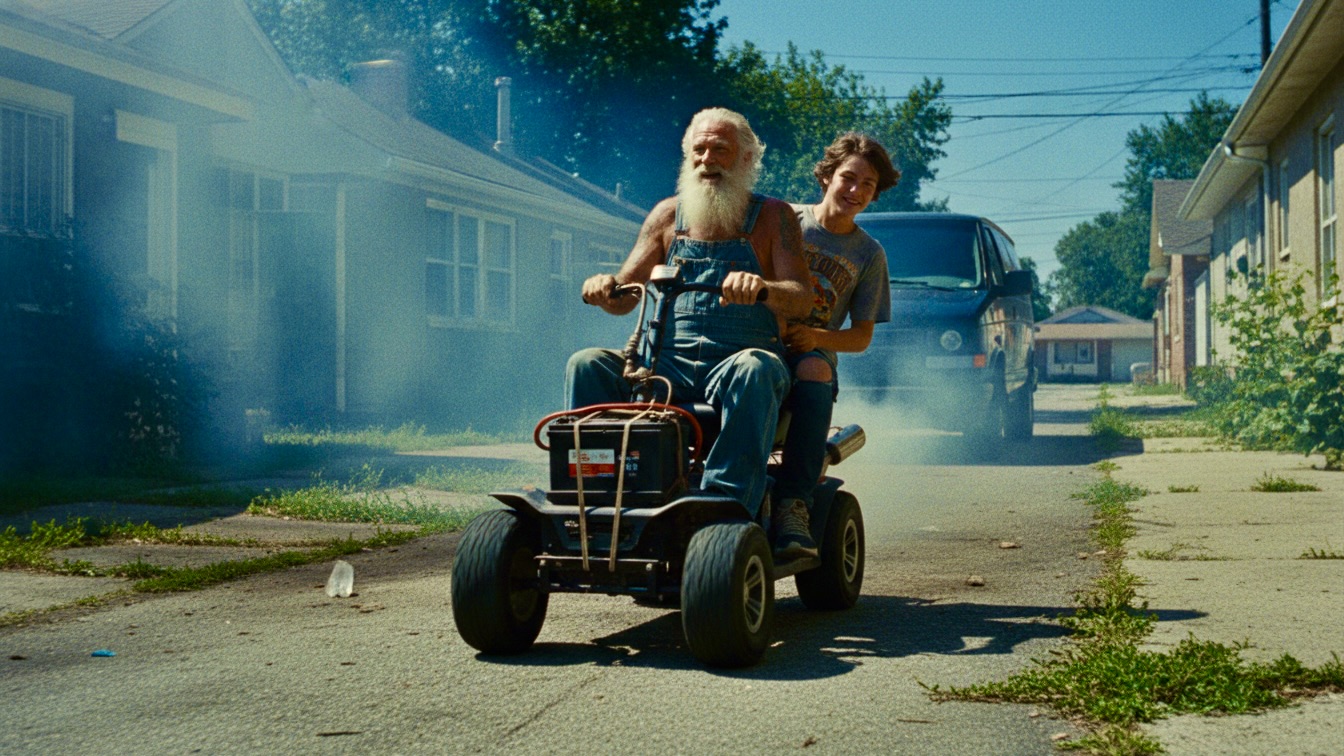
Zack is a nineteen-year-old spending a sweltering, monotonous summer in the suburbs when his augmented reality game, Leyline Drifters, leads him to a surprising discovery. In a muddy drainage ditch, he finds his eccentric neighbor, Arthur, unearthing a glowing, frozen sphere that the app identifies as a Mythic Energy Core. The situation escalates rapidly when unidentified federal agents in black vans begin pursuing them, forcing a desperate escape on Arthur’s heavily modified mobility scooter.
The pair seeks refuge at a local community center during a crowded dog audition, hoping the presence of witnesses will deter their pursuers. Arthur, a retired engineer, realizes the sphere is an unstable thermal battery and decides to discharge its energy through the building’s massive sound system. The resulting sonic blast incapacitates the agents and causes the sphere to implode, leaving behind nothing but ordinary water. With the evidence gone and the agents forced to retreat due to the crowd of recording teenagers, Arthur and Zack form an unlikely bond over their shared adventure.
The narrative primarily explores the intersection of digital escapism and physical reality. Zack’s reliance on a mobile game to navigate his "dead end" suburbia highlights a modern psychological condition where reality is perceived as insufficient or boring. When the digital "loot" manifests as a tangible, dangerous object, the story suggests that the extraordinary is often hidden in plain sight, waiting for the right lens to reveal it. The transition from a virtual quest to a life-threatening chase forces Zack to reconcile his digital habits with the visceral demands of the real world.
Another central theme is the restoration of purpose through crisis and intellectual stimulation. Arthur is initially presented as a man stagnating in the wake of his wife’s death, his vast technical knowledge relegated to a cluttered, unused garage. The discovery of the sphere acts as a catalyst for his psychological rebirth, transforming him from a grumpy hermit into a decisive, energized leader. His mechanical ingenuity provides him with a sense of agency that he had clearly lost in his retirement, proving that competence remains a powerful antidote to grief.
The story also examines the power of the collective in the age of surveillance. The federal agents represent a cold, institutional force that operates best in the shadows of an alleyway or a private driveway. However, they are ultimately defeated not by superior firepower, but by the presence of a "flash mob" of teenagers with smartphones. The narrative suggests that in a modern context, the democratization of recording technology serves as a potent check against clandestine authority, turning the mundane act of social media posting into a shield for the protagonists.
Zack functions as the viewpoint character whose internal state is defined by a mix of late-adolescent ennui and sudden, overwhelming anxiety. He represents a generation that mediates its experiences through screens, as evidenced by his initial refusal to put his phone away even when faced with federal agents. Despite his fear, he displays a high degree of adaptability, moving from a passive observer of Arthur's actions to an essential accomplice. His psychological journey in the chapter is one of moving from a state of "insanity from boredom" to a state of heightened, purposeful existence.
By the end of the encounter, Zack’s priorities have shifted from digital rewards to tangible human connection. He willingly sacrifices his valuable digital vault to create a distraction, signaling a maturation of his values. The high-five he shares with Arthur at the end of the chapter marks his acceptance into a world of real-world mechanics and consequences. He is no longer just a "kid" playing a game; he is a participant in a reality that is far more vibrant than any augmented reality app could provide.
Arthur is a complex figure who embodies the "grumpy old man" archetype while subverting it through his hidden depths of technical brilliance. He is a man of action who uses his mechanical skills to navigate a world that has largely forgotten him. His decision to modify a mobility scooter into a high-performance vehicle reflects a psychological refusal to accept the limitations of age or social expectations. He is motivated not by a desire for wealth or power, but by a pure, scientific curiosity that seems to have been dormant for years.
His interactions with Zack reveal a latent paternal instinct that has been sharpened by the loss of his wife. While he is initially abrasive, he quickly takes Zack under his wing, recognizing the boy's potential and providing him with the direction he lacks. Arthur’s excitement during the sound booth climax suggests a man who finds his greatest joy in the elegant solution of a complex problem. He does not fear the agents as much as he fears the loss of the intellectual challenge the sphere represents.
The author utilizes a striking contrast between sensory details to establish the tone and tension of the piece. The oppressive, "wet blanket" heat of the August afternoon is constantly juxtaposed with the unnatural, freezing radiance of the ice sphere. This sensory conflict mirrors the intrusion of the extraordinary into the mundane suburban setting. The descriptions of the smells—hot garbage, motor oil, and ozone—add a layer of grit to the story, ensuring that the science fiction elements feel grounded in a recognizable, physical world.
Pacing is a significant strength of the narrative, as it mirrors the escalating heartbeat of the protagonist. The story begins with a slow, lethargic crawl through the neighborhood, reflecting Zack’s boredom, before exploding into a fast-paced chase sequence. The use of short, punchy sentences during the alleyway escape creates a sense of urgency and physical impact. This rhythmic shift keeps the reader engaged and emphasizes the sudden transition from a quiet summer day to a high-stakes thriller.
The narrative voice is cynical yet observant, providing a grounded perspective on the fantastical events. Zack’s internal monologue is peppered with modern slang and technological references, which contrasts sharply with Arthur’s more traditional, utilitarian dialogue. This linguistic divide highlights the generational gap while also showing how the two characters eventually find a common language through the crisis. The final scene, where they discuss mounting a turbine to a lawnmower, serves as a stylistic "cool down" that cements their new partnership.


