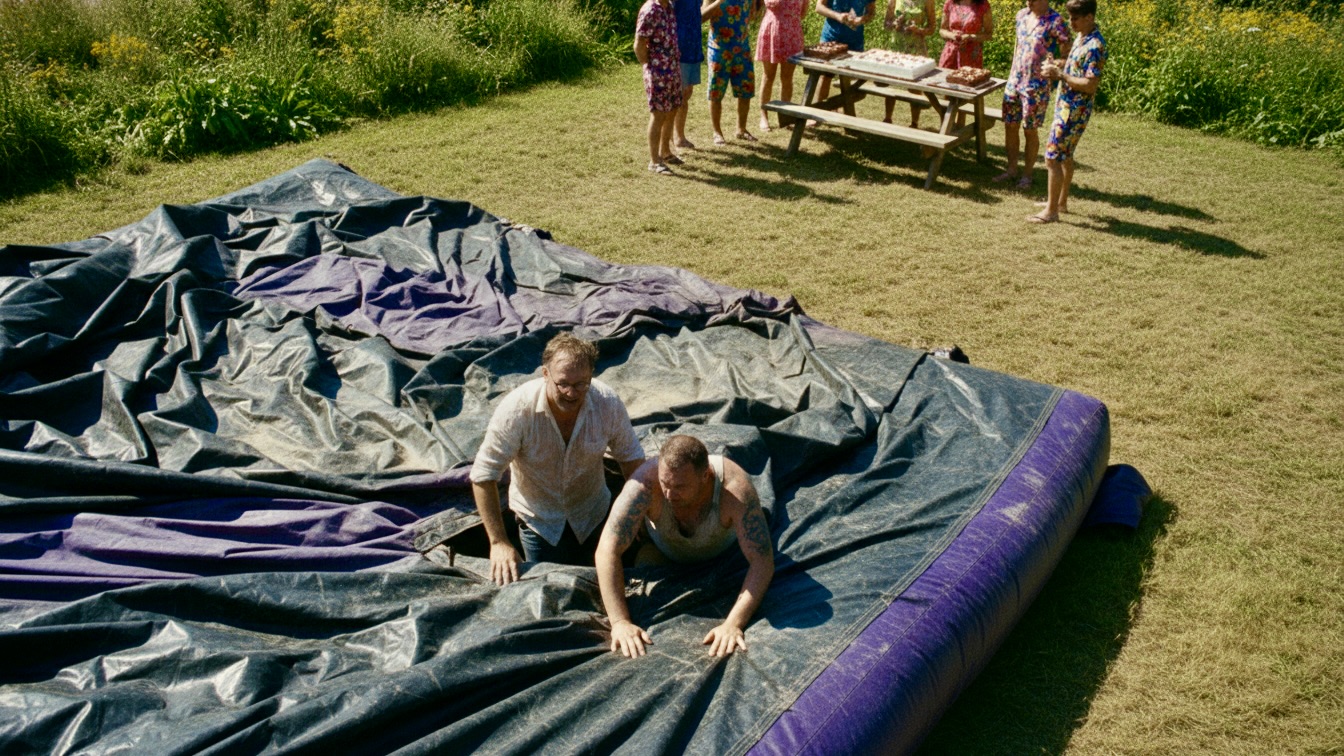
The story follows Emmond, a high-strung architect struggling with professional failure, as he attends a sweltering and superficial family reunion. Tasked by his sister to find a lost toy, he enters a massive, "Gothic Gargoyle" themed inflatable bouncy castle, only to find his cousin-by-marriage, Mike, hiding there to avoid social interaction. The situation takes a claustrophobic turn when the generator fails, causing the heavy black vinyl to collapse and trap both men inside the sweltering, airless structure.
While trapped, the two men share a flask of bourbon and engage in a surprisingly vulnerable dialogue about their respective lives and the pressures of societal expectations. They bond over their shared sense of being "losers" and the phoniness of the family event happening just outside their plastic prison. After a tense moment involving a swarm of wasps on the exterior of the deflating structure, a backup blower suddenly reinflates the castle with violent force. The men are unceremoniously ejected from the entrance directly in front of their assembled family, leading to a moment of shared levity and a promise to reconnect in a more authentic setting.
The narrative explores the profound tension between social performance and authentic selfhood. The Henderson family reunion is depicted as a stage where everyone follows a "pre-programmed script," focusing on superficial markers of success like careers and cars. Emmond’s mother "curates" his image to others, masking his professional crisis with architectural jargon. This performative atmosphere creates a sense of alienation, driving both Emmond and Mike to seek refuge in a literal void—the hollow interior of an inflatable gargoyle.
Structural and emotional integrity serves as a secondary core theme. As an architect, Emmond is obsessed with rigid blueprints and the "correct" way to build, yet his own life and projects are crumbling. Mike challenges this rigidity by introducing the concept of "sacred geometry" and the flexibility of PVC. The story suggests that true resilience does not come from unyielding strength, but from the ability to adapt and change shape when the "air pressure" of life drops.
The metaphor of the "Gothic Gargoyle" bouncy castle represents the absurdity of modern existence. It is a cheap, mass-produced mockery of a grand architectural style, mirroring how the characters feel their lives have become "mid-tier" versions of their original dreams. The castle is both a "death trap" and a "confessional," providing a liminal space where the rules of the outside world no longer apply. In this airless, purple-hued environment, the characters are finally able to speak truths that the bright sunlight of the reunion would never permit.
Finally, the story touches on the idea of utility versus beauty. Emmond has sacrificed his artistic passion for "useful" architecture, only to find that utility is a trap that leads to compromise and failure. Mike, the tattoo artist, argues that beauty and function are intertwined, suggesting that a building or a tattoo can have "soul" regardless of its practical use. This realization allows Emmond to find value in his past work, even as his current project fails, offering a glimmer of hope for his future creative life.
Emmond is a man defined by a crushing sense of inadequacy and a desperate need for control. His professional identity as an architect is his primary defense mechanism, yet it is currently failing him as his latest project loses its structural integrity. He views the world through a lens of technical perfection, which makes the "good enough" attitude of his firm and the tacky aesthetics of his family reunion physically painful for him. This rigidity makes him high-strung and prone to panic when he cannot force the world to fit his blueprints.
Psychologically, Emmond is suffering from an identity crisis triggered by his impending career collapse. He feels like an "NPC" in his own life, a background character providing exposition for others rather than the hero of his own story. The experience of being trapped in the bouncy castle acts as a forced intervention, stripping away his professional pretenses. By the end of the narrative, his encounter with Mike and the literal "reinflation" of his surroundings helps him embrace a more flexible, less scripted version of himself.
Mike serves as the cynical yet grounded foil to Emmond’s neuroticism. He is a man who has opted out of the social "synergy" that defines the rest of the Henderson family, choosing instead to "ghost" his responsibilities and hide in the shadows. While he describes himself as a "comfortable loser," his tattoos and his appreciation for Emmond’s work suggest a deep, latent artistic sensibility. He possesses a level of emotional intelligence that allows him to see through Emmond’s defenses and offer genuine, if blunt, perspective.
Despite his laid-back "vibe," Mike is also running away from his own failures and the shadow of his ex-girlfriend, Vanessa. He uses the bouncy castle as a literal and figurative bunker to avoid the judgment of others. However, his willingness to share his bourbon and his philosophy on "sacred geometry" shows a desire for connection that he lacks in his daily life. He is the catalyst for Emmond’s transformation, teaching him that "structural integrity" is as much about the spirit as it is about the materials used.
The narrative voice is marked by a blend of cynical humor and vivid, sensory-heavy prose. The author uses the extreme heat as a physical character, describing it as a "weight" and a "hand pressed against the back of your neck." This atmospheric pressure mirrors the psychological pressure felt by the protagonist, making the setting feel as claustrophobic as the inflatable castle itself. The descriptions of the "Gothic Gargoyle" are particularly effective, using "sun-baked vinyl" and "recycled breath" to evoke a visceral sense of discomfort.
Pacing in the story follows a deliberate arc that mimics the inflation and deflation of the central metaphor. The beginning is slow and oppressive, reflecting the lethargy of the heat and the boredom of the reunion. Once Emmond enters the castle, the pace tightens, focusing on the intimate and increasingly tense dialogue between the two men. The climax is a "pneumatic explosion," a sudden burst of action and noise that shatters the stagnant atmosphere and propels the characters back into the world.
The use of dialogue is sharp and serves to highlight the vast personality difference between Emmond and Mike. Emmond’s speech is often technical and frantic, while Mike’s is "gravelly" and understated. This contrast creates a rhythmic quality to their interaction, moving from conflict to a shared, bourbon-fueled harmony. The author successfully balances the absurdity of the situation—two grown men trapped in a purple plastic monster—with genuine emotional stakes, ensuring the story feels meaningful despite its comedic premise.


