The narrative begins in the sterile, oppressive atmosphere of a hospital room where Mandy watches her grandfather, Arthur, linger in a state of frailty and dementia. While her mother, Lorna, and uncle, David, are preoccupied with the stresses of the "adult world," Mandy discovers a hidden compartment within her grandfather’s green notebook. Using a bone-handled knife found in a previous cache, she reveals a secret letter and a hand-drawn map. This discovery transforms the family's grief into a mission of cultural reclamation as they realize Arthur has hidden the legendary Copper Shield.
The tension rises when Officer Porsen enters the room, representing the bureaucratic and dismissive "protocol" of the state. He attempts to exert authority over the family’s possessions, but Lorna and Mandy firmly rebuff him, asserting their ancestral rights. This confrontation solidifies the family's resolve to find the artifact before the authorities can intervene. They decide to leave immediately for the Oxbow, a dangerous and remote location on the mountain that Arthur had meticulously marked.
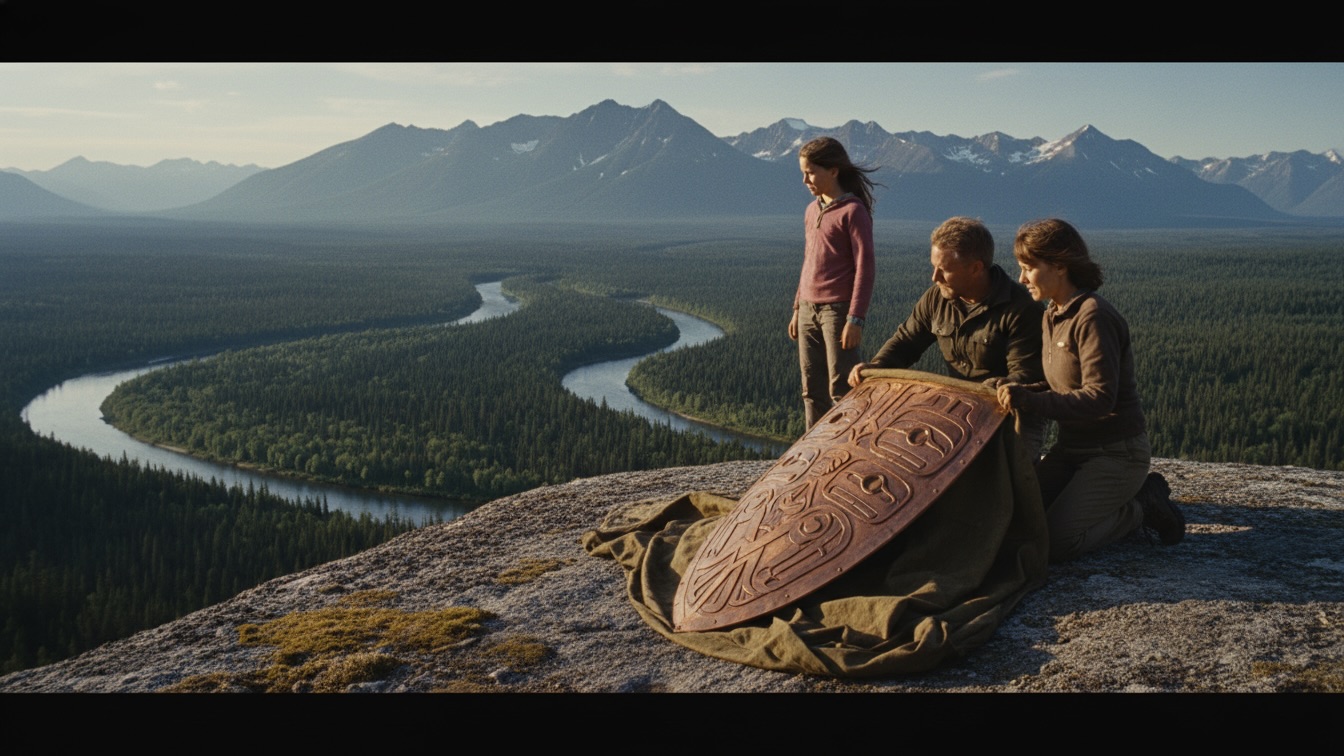
The final act follows the family as they trek through the rugged wilderness, guided by Arthur’s landmarks rather than modern technology. At the Oxbow, they locate the third cache hidden within a granite wall. They recover the Copper Shield, a profound symbol of their heritage that had been stolen by the residential school system decades earlier. The story concludes with a sense of generational healing, as Mandy recognizes her new role as the keeper of her family’s maps and history.
The central theme of the story is the reclamation of cultural identity and the resistance against systemic erasure. The "school" mentioned in Arthur’s letter serves as a haunting reference to the residential school system, which sought to strip indigenous people of their language and history. The Copper Shield is not merely an artifact; it is a physical manifestation of a culture that refused to be silenced. By hiding the shield, Arthur performed an act of quiet rebellion, ensuring that the "words" and "names of the trees" would eventually return to his descendants.
Another prominent theme is the contrast between the "box world" of modern society and the "open world" of ancestral land. The hospital and the police officer represent a world governed by rigid protocols, sterile white walls, and digital screens that fail to capture the truth of the landscape. In contrast, the mountain and the Oxbow represent a space of clarity and connection. The recurring motif of "Sudden Oxygen" highlights the psychological shift the characters experience when they move from the suffocating constraints of the town to the liberating purpose of the wilderness.
The narrative also explores the complexity of memory and legacy, particularly through the lens of Arthur’s dementia. While the medical professionals and the police view Arthur’s condition as a decline into confusion, the story suggests a deeper, more deliberate form of memory. Arthur’s "map" is a bridge between the past and the future, proving that even as his mind fades, his commitment to his family’s survival remains sharp. Mandy’s discovery of the seedling drawing at the end suggests that legacy is not a static object but a living, growing responsibility.
Mandy serves as the protagonist and the perceptive bridge between the generations. She possesses a keen sense of observation that allows her to see the "lump" in the notebook that the adults missed. Her transition from a child being "pinched" by a plastic chair to a "surgeon" wielding a bone-handled knife signifies her coming-of-age. She rejects the passive role assigned to her by the adults and the state, choosing instead to become the active seeker of her family’s truth.
Psychologically, Mandy experiences a profound shift in her sense of self-efficacy throughout the journey. Initially, she feels small in the "big, white room," but the act of finding the map empowers her to challenge authority figures like Officer Porsen. By the end of the story, she has embraced the title of "Little Bear" not as a diminutive nickname, but as a mark of her strength and intuition. She recognizes that she is no longer just a follower of trails but a leader who understands the language of the land.
Lorna represents the "middle generation" burdened by the immediate stresses of survival and the trauma of her father’s past. She begins the story in a state of defensive exhaustion, viewing her father’s actions through a lens of liability and medical concern. Her skepticism regarding the Copper Shield is a protective mechanism, shielding her from the disappointment of a "myth" that might not be real. However, the discovery of the physical letter forces her to confront the reality of what was stolen from her family.
As the story progresses, Loris shifts from a woman governed by fear to one governed by ancestral pride. Her confrontation with Officer Porsen is a pivotal moment where she reclaims her voice and her right to the land. She moves from worrying about "spending another night in a blizzard" to reverently wrapping the shield in canvas. This transformation suggests a healing of the psychological rift caused by the "silence" her father endured, allowing her to finally connect with her heritage.
David acts as the physical guide and the bridge to the family’s more recent past. He is a man who once "left" the community, and his initial presence is marked by a restless, nervous energy. He carries a sense of guilt or inadequacy that is reflected in his "slumped" shoulders and his busy, picking fingers. The quest for the shield provides him with a path toward redemption, allowing him to use his knowledge of the river and the rocks for a higher purpose.
By the end of the narrative, David has regained his sense of place and utility within the family unit. He is the one who recognizes the Oxbow and understands the physical demands of the mountain. His laughter at the officer’s inability to navigate without a GPS signals his rejection of the "box world" and his return to the values of his father. He acknowledges Mandy’s growth, signaling a restored family hierarchy where wisdom is valued over mere age or authority.
Arthur is the silent architect of the entire journey. Although he is physically confined to a hospital bed and lost in the "tangled" world of dementia, his presence dominates the narrative through his meticulous planning. He is a guardian of secrets who spent his life protecting a piece of history from those who would "claim it for the province." His decision to hide the map in the stitches of a notebook shows a profound understanding of how to preserve truth in a world of surveillance.
Psychologically, Arthur represents the enduring power of the subconscious and the cultural soul. Even when his "words" were taken by the school, he maintained a connection to the "ground" that could not be severed. His twitching fingers and his stare at the ceiling suggest he is mentally traversing the very trails Mandy and David are physically climbing. He is the one who "built the ladder," ensuring that his family had the tools to climb out of their silence.
The pacing of the story mirrors the psychological state of the characters, moving from the stagnant, humming quiet of the hospital to the brisk, rhythmic movement of the mountain trek. The initial scenes are heavy with sensory details of decay and confinement, such as the "color of old paper" and the "angry bees" of the ceiling lights. This creates a sense of claustrophobia that makes the subsequent transition to the "sharp" and "needle-like" mountain air feel like a physical relief for the reader.
The author uses the bone-handled knife as a potent symbol of agency and revelation. The "satisfying snap" of the threads as Mandy cuts the notebook signifies the breaking of the silence that has held the family captive for generations. This motif of "cutting through" is central to the narrative voice, which is direct and unadorned, reflecting the ruggedness of the landscape. The contrast between the "red numbers" of the monitor and the "deep, dark patina" of the copper shield emphasizes the difference between clinical existence and meaningful life.
The narrative voice is deeply grounded in the perspective of Mandy, which allows for a blend of youthful wonder and sharp intuition. The use of the phrase "SUDDEN OXYGEN" acts as a recurring linguistic anchor, signaling moments of epiphany and clarity. The imagery of the "water turning back on itself" and the "granite spire" provides a sense of mythic scale to the family’s journey. Finally, the closing image of the "seedling" provides a hopeful, organic resolution to a story that began in a sterile, white box.


