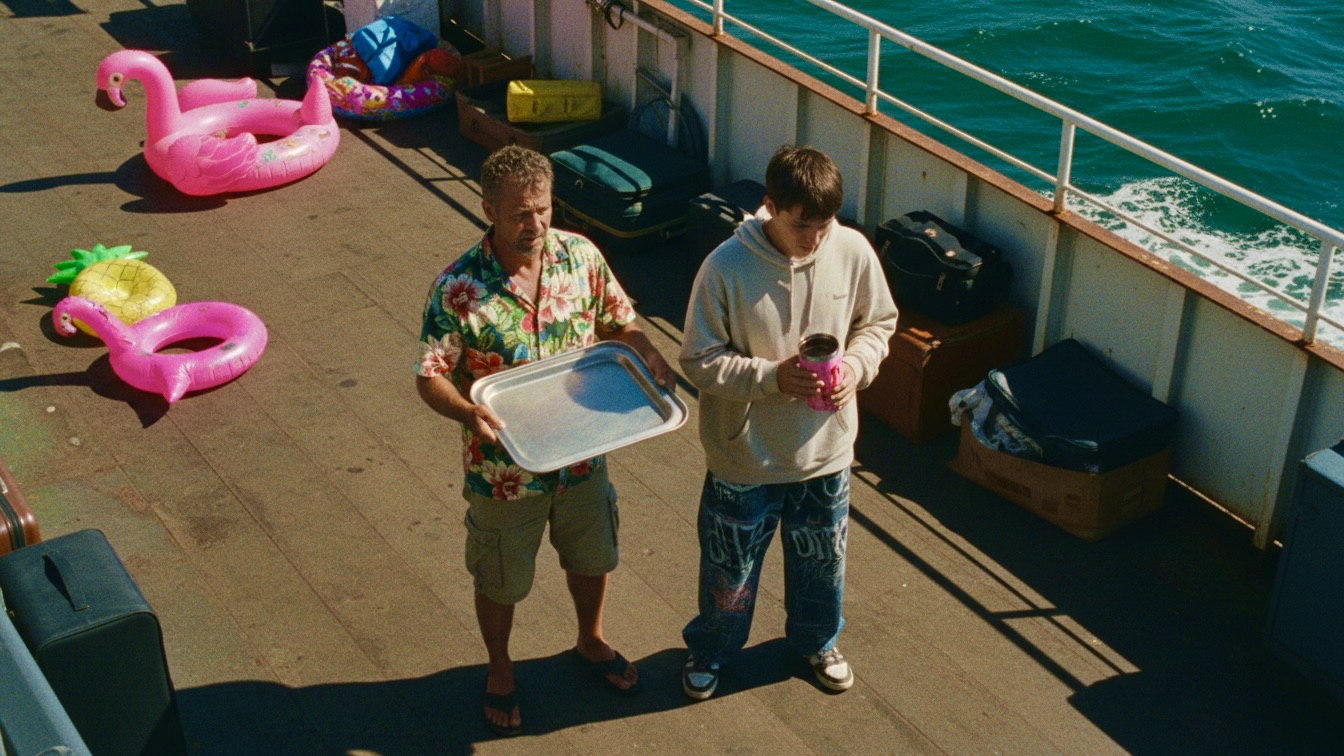
The story begins with Greg Matthews and his family aboard the S.S. Meridian Queen, enduring a sweltering and miserable ferry ride. Greg is desperately trying to maintain a facade of "rustic charm" despite losing the itinerary and facing the palpable annoyance of his wife, Louise, and daughter, Cassie. The mundane tension of their dysfunctional vacation is shattered when a group of mercenaries boards the vessel, seeking a black duffel bag that Greg accidentally swapped at the airport. Greg initially suffers from a delusional break, believing the violent intrusion is a choreographed "murder mystery" experience he purchased as a vacation upgrade.
The situation escalates into supernatural horror when the bag is revealed to contain cursed gold that emits a transformative green mist. This mist turns anyone who breathes it into a violent, zombie-like creature with distended jaws and black sludge for blood. After a mercenary is infected and attacks his own team, the Matthews family is forced to fight for their lives using whatever tools are at hand. They navigate the blood-slicked corridors of the ferry, utilizing improvised weapons and tactical advice crowdsourced from Cassie’s social media followers.
In the climax of the chapter, the family reaches the engine room with the intention of destroying the cursed gold to break the infection's hold. They face off against infected mercenaries in a flooded, oily chamber, nearly losing Cassie to the churning machinery of the ship. Greg and Louise manage to overpower the remaining monsters, allowing Cassie to hurl the gold into the massive spinning propeller shaft. The gold is shredded into dust, neutralizing the curse and saving the surviving passengers. The story concludes with the family back on deck, battered and covered in filth, but having survived a nightmare that far exceeded the typical stresses of a family holiday.
One of the most prominent themes in the text is the juxtaposition of suburban consumerism and primal survival. Greg’s initial reaction to the mercenaries—viewing them as a "premium package" or a "TripAdvisor" experience—highlights a modern detachment from reality. He has been so conditioned by a world of curated experiences that he can no longer recognize genuine danger when it threatens his life. This "suburban delusion" serves as a critique of a society that sanitizes every interaction into a commercial transaction.
The narrative also explores the theme of resilience through dysfunction. The Matthews family is clearly fractured at the start of the journey, with each member retreating into their own form of escapism, whether it be Greg’s forced optimism, Louise’s drug-induced haze, or Cassie’s digital obsession. However, when the crisis hits, these very flaws are repurposed into survival mechanisms. Their bickering is replaced by a high-stakes cooperation that suggests their bond is forged more effectively by trauma than by a forced vacation.
The story also examines the loss of control in the modern age. Greg loses his itinerary, Cassie loses her Wi-Fi, and the mercenaries lose control over their own biological humanity. The "green mist" acts as a physical manifestation of chaos that cannot be managed by digital tools or tactical gear. The only way the characters regain control is by descending into the literal and metaphorical "bowels" of the ship to destroy the source of the corruption. This suggests that survival requires a return to physical, messy intervention rather than passive observation.
Greg is a man defined by his desperate need to be the successful patriarch of a family that has clearly outgrown his leadership. His insistence on "rustic charm" and his attempt to hide the lost itinerary show a deep-seated fear of being perceived as incompetent. He uses a forced, "strained smile" as a psychological shield, trying to manifest a happy vacation through sheer willpower. This optimism is his greatest weakness, as it nearly leads to his death when he refuses to take the mercenary threat seriously.
As the story progresses, Greg undergoes a painful transition from a delusional consumer to a pragmatic survivor. The moment the metal barrel of a rifle is pressed under his chin, his suburban facade finally shatters, and he is forced to confront the reality of his own mistakes. He moves from a state of comical denial to one of physical action, eventually wielding a heavy iron wrench to protect his daughter. His journey is one of shedding the "New Balance" sneakers persona and embracing a more visceral, protective role.
Louise begins the chapter as a character who has completely checked out of her reality. By consuming an edible in the terminal parking lot, she attempts to "smooth the sharp edges" of her life and her marriage. Her silence and methodical chewing of a gummy represent a passive-aggressive retreat from Greg’s incompetence. She is a woman who is exhausted by the performative nature of her family life and chooses chemical dissociation as her primary coping mechanism.
However, the threat to her daughter acts as a catalyst that snaps her back into a state of hyper-awareness. She transforms from a lethargic observer into a "primal" warrior, constructing a spear from a mop and a broken vodka bottle. This shift suggests that her suburban malaise was merely a mask for a dormant, formidable strength. Louise becomes the tactical backbone of the family, demonstrating a cold, calculated violence that is far more effective than Greg’s frantic scrambling.
Cassie represents the modern youth's detachment from physical reality in favor of a digital persona. Her concern about her "last post" being a blurry seagull while facing potential death shows a profound preoccupation with how she is perceived online. She views the world through her phone screen, which serves as a protective barrier between her and the unpleasantness of the ferry trip. To her, the physical world is "literally the backrooms," a place that is only real if it can be shared with her audience.
Despite this, Cassie is arguably the most adaptable member of the family. She does not panic in the traditional sense; instead, she integrates the horror into her digital workflow, using her followers to gain technical knowledge of the ship. Her use of the Stanley cup as a weapon is a brilliant subversion of a consumerist icon, turning a symbol of "aesthetic" hydration into a tool of blunt force trauma. By the end of the chapter, she has successfully merged her online identity with her survival instincts, ending the ordeal with a "vlog" update.
The pacing of the chapter is expertly crafted to mirror the escalating tension of the plot. It starts with a slow, visceral description of physical discomfort—sweat, grease, and the throb of a diesel engine—which grounds the reader in a mundane, unpleasant reality. This slow burn makes the sudden arrival of the matte-black speedboat feel like a violent rupture in the narrative. The transition from a family drama to a high-octane horror story is handled with a jarring efficiency that keeps the reader off-balance.
The author makes extensive use of sensory details to heighten the sense of revulsion and danger. The "neon-pink plastic beak" of the flamingo is a sharp, colorful contrast to the "thick, violently green mist" and the "black sludge" of the infected. These visual cues serve to emphasize the absurdity of the situation, where vacation toys are scattered among corpses. The auditory descriptions, such as the "wet, tearing sounds" and the "shrieking metal," add a layer of auditory horror that makes the environment feel truly hostile.
The narrative voice maintains a tone of dark irony throughout the chapter. The contrast between Greg’s "TripAdvisor" comments and the "blood spraying across the seafoam green wall" creates a sense of macabre humor. This irony serves to highlight the ridiculousness of the characters' predicament while never undermining the actual stakes of the violence. The final line of the story, Cassie’s "Slay," perfectly encapsulates this tone, blending Gen Z slang with the literal carnage they have just survived.


