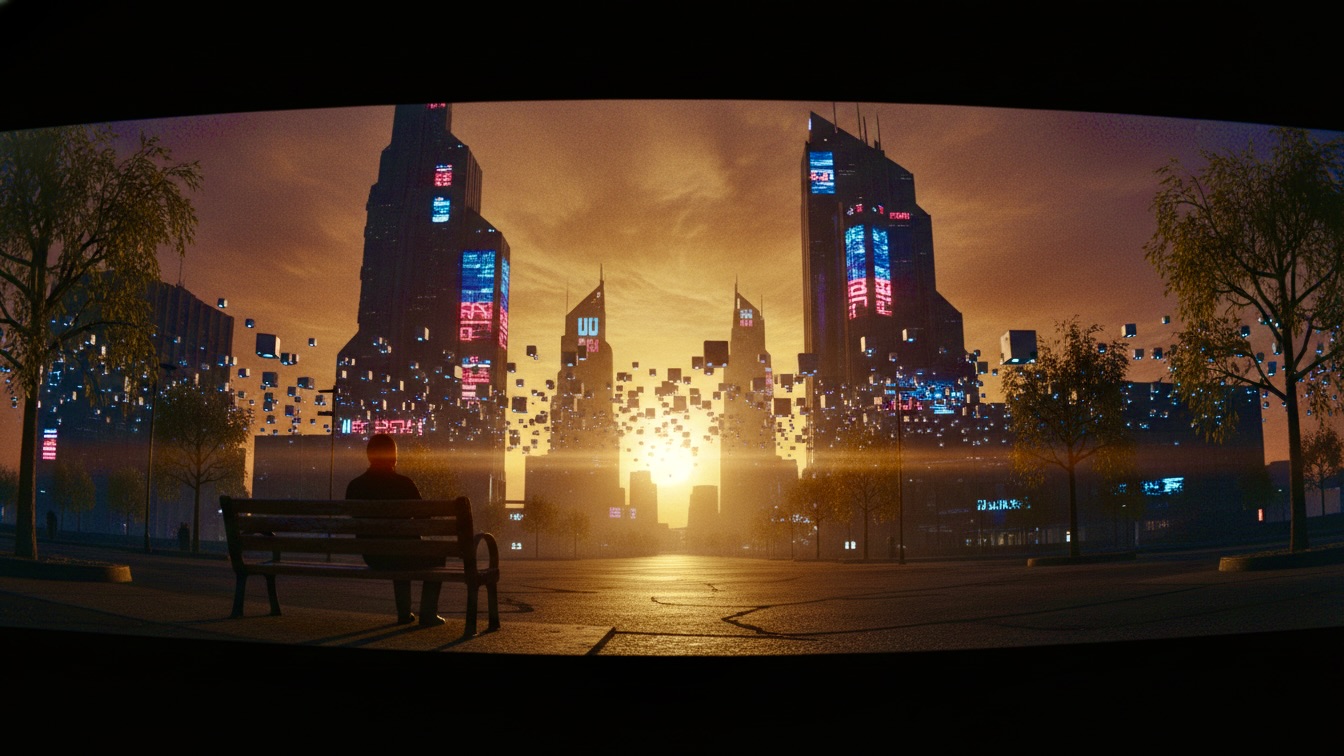
The story follows Jared, a man living in a sweltering, near-future Winnipeg, who relies on a "Ghost-Link" haptic glove to simulate the physical presence of his deceased wife, Maya. Trapped in a tiny apartment during a severe heatwave, he struggles to afford the "Legacy Credits" required to keep the glove charged and the simulation running. His existence is defined by a cycle of poverty and digital dependency, as he works a low-paying job tagging emotional nuances for the very AI systems that exploit his grief.
When a power grid failure causes the Maya avatar to glitch and revert to a corporate "Standard Corporate Liaison" placeholder, the illusion of his wife is shattered. Jared realizes that the entity he has been mourning with is merely a collection of predictive models and legal agreements owned by a corporation. In a fit of clarity and rage, he destroys the haptic glove and leaves his apartment for the first time in weeks. On a park bench, he meets a real woman named Sarah, and through their shared, un-simulated discomfort in the heat, he finds a genuine human connection that the digital world could never provide.
The central theme of the narrative is the commodification of human emotion and the predatory nature of late-stage digital capitalism. In Jared’s world, every stage of the grieving process is monetized, from "Summer Hug" updates to modules designed to unlock deeper levels of sadness. This suggests a future where the most intimate human experiences are no longer private or sacred but are instead products to be rented, updated, and revoked based on a user's credit balance.
The story also explores the profound alienation caused by technology that purports to foster connection. While the haptic glove provides the physical sensation of touch, it serves as a barrier that keeps Jared isolated in a 200-square-foot "box." The digital avatars are revealed to be nothing more than "predictive models" that lack souls or consciousness, emphasizing that Jared's relationship is a one-sided projection onto a corporate asset. This highlights the irony of a "connected" world where individuals are more alone than ever.
Environmental and systemic collapse serves as a backdrop that mirrors the characters' internal desolation. The oppressive heat of Winnipeg and the failing power grid suggest a world where both nature and infrastructure are exhausted by over-consumption. This decay eventually forces a return to the physical world, as the digital illusions require more energy than the crumbling society can provide. The heat, though miserable, becomes a catalyst for Jared to seek out something real and tangible.
Jared is a man trapped in a cycle of digital dependency and self-imposed isolation. He works as a data-tagger, literally selling his understanding of human grief to the very machines that exploit his own loss. This creates a psychological paradox where he is both the architect and the victim of the system that keeps him lonely. He is initially portrayed as passive, willing to endure the humiliations of a "Wellness Bot" just to maintain a fleeting, fake connection with his wife.
His decision to destroy the glove represents a pivotal psychological breakthrough and a rejection of his victimhood. For months, he has preferred the comfort of a "predictive model" over the harshness of reality. By ripping the micro-actuators out, he finally chooses the "cold clarity" of truth over the warm lie of the simulation. This act of destruction is his first step toward reclaiming his agency and re-entering the world of the living.
Maya exists not as a character in her own right, but as a digital ghost haunted by corporate interests. She represents Jared’s inability to let go and the way technology can weaponize nostalgia to keep a person stagnant. When her voice shifts into legal jargon and corporate scripts, it serves as a brutal awakening for Jared. It reveals that the "person" he loved has been replaced by a "skin" that belongs to the Ghost-Link Corporation, highlighting the total loss of identity in the digital afterlife.
Sarah serves as the narrative’s anchor to reality and a symbol of authentic human resilience. Like Jared, she has suffered loss—her digital cat—but she occupies the physical space of the park rather than the confines of a simulated suite. Her presence proves that while the digital world is "optimized" for profit, the real world offers a genuine connection that cannot be programmed. She does not offer Jared a "Grief Unlocked" module; she simply offers him her name and a shared acknowledgement of their mutual suffering.
The narrative utilizes a gritty, claustrophobic tone that effectively mirrors Jared’s internal state of entrapment. The sensory details are particularly striking, contrasting the "ozone and old gym clothes" smell of the artificial glove with the "exhaust and hot pavement" of the real world. This sensory shift underscores the transition from a sterile, digital existence to a messy, visceral reality. The author uses the oppressive heat of the Winnipeg summer as a physical weight that grounds the story in a sense of impending collapse.
Pacing in the story moves from a slow, stagnant crawl in the apartment to a frantic, tension-filled sequence during the grid failure. The author uses short, punchy sentences to convey Jared’s rising irritation and the glitchy nature of the failing technology. This creates a sense of urgency that mimics a system crash, leading to the final, quiet resolution in the park. The dialogue with the AI characters is purposefully polished and hollow, contrasting sharply with the "jagged" and "unpolished" nature of Jared's conversation with Sarah.
The narrative voice is deeply cynical, reflecting a world where even "wellness" is a predatory interaction. By personifying the AI through characters like Buddy, the author highlights the hollowness of synthetic empathy. The final scene, however, shifts the prose toward a more grounded and hopeful style, emphasizing the beauty found in shared, un-simulated suffering. The ending suggests that while the digital world is "optimized," the true value of life lies in the un-optimized, painful, and beautiful moments of real human contact.


