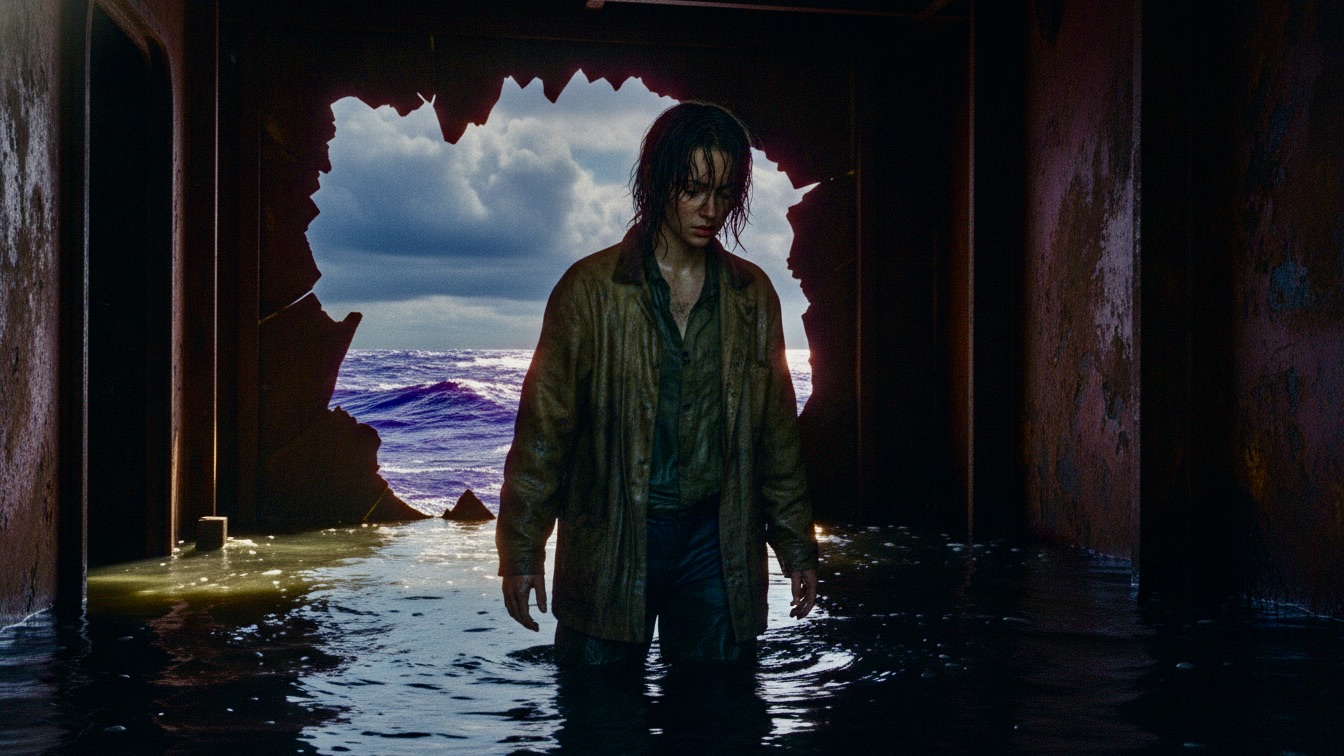
The story begins with Wenda, a nineteen-year-old deckhand, laboring under the oppressive heat of a July afternoon on the Stormhaven ferry. She is motivated by the crushing weight of her father’s medical debts, a burden that tethers her to a life of grueling physical labor. As news of a massive theft of Aureate Bullion reaches the passengers, the mundane atmosphere is shattered by the arrival of the Obsidian Syndicate. These criminals, disguised as Imperial Inspectors, board the vessel with the intent to seize the stolen magic-amplifying gold hidden in the cargo hold.
The situation escalates rapidly as a magical super-storm, summoned by the Syndicate, descends upon the ferry. Wenda retreats to the lower decks where she discovers Jared, a wounded smuggler who reveals the volatile nature of the bullion. He explains that the gold reacts violently to magic and threatens to detonate, potentially vaporizing the ship and its passengers. Forced into a corner, Wenda reveals her long-suppressed identity as an unregistered water-mage to neutralize the Syndicate guards and protect the cargo.
In the climax of the chapter, Wenda faces a master-class pyromancer who nearly triggers a catastrophic explosion by attempting to melt the bullion's transport truck. She draws upon the power of the ocean itself to quench the heat and stabilize the gold, though the effort nearly breaks her physically. Jared sacrifices his life to drag the Syndicate leader into the sea, leaving Wenda to hold the ship together through sheer magical will. The chapter concludes with Wenda slipping away into the night, now a fugitive in possession of a single, dangerous brick of bullion.
One of the central themes of the narrative is the intersection of class struggle and systemic oppression. Wenda’s initial internal monologue establishes a world where the poor are physically broken by the debts of their elders while the elite engage in high-stakes magical theft. The Aureate Bullion represents a level of wealth and power that is fundamentally alien to Wenda, yet she is the one forced to deal with the lethal consequences of its presence. Her labor on the ship is a microcosm of her social standing, where her safety is secondary to the interests of the shipping company and the Imperial Guilds.
The story also explores the theme of repressed identity and the cost of survival. Wenda has spent years hiding her magical abilities to avoid being sent to labor camps, effectively stifling a core part of her being to remain "safe" in a hostile society. The physical toll of her magic, manifested in nosebleeds and agonizing pain, serves as a metaphor for the trauma of bringing a suppressed identity to the surface. When she finally chooses to use her power, it is not an act of liberation but one of desperate necessity, highlighting the tragic reality that her greatest gift is also her greatest liability.
Finally, the volatility of power serves as a recurring motif throughout the chapter. The Aureate Bullion is not merely a currency; it is a "raw magic amplifier" that becomes unstable when exposed to the ambient energy of the storm. This mirrors the behavior of the characters, particularly the Syndicate leader whose pyromancy threatens to destroy everything he seeks to claim. Power in this world is portrayed as something that is difficult to contain and prone to catastrophic failure when handled with greed or ignorance. Wenda’s role as a water-mage allows her to act as a stabilizing force, cooling the literal and figurative fires ignited by the pursuit of power.
Wenda is a protagonist defined by her pragmatism and a deep-seated sense of endurance. Her psychological state is one of weary resignation at the start of the story, as she has been hardened by the physical demands of her job and the financial ruin of her family. She views the world through a lens of survival, showing little interest in the grand political maneuvers of the Imperial Guilds until they directly threaten her life. This grounded perspective makes her eventual display of immense magical power feel earned and significant rather than purely fantastical.
Her decision to use her magic reveals a hidden core of altruism that contradicts her cynical exterior. Despite the risk of being hunted by the Imperial Guilds, she chooses to save the passengers and the ship rather than simply saving herself. This internal conflict between her need for anonymity and her instinct to protect others creates a compelling psychological tension. By the end of the chapter, Wenda has transitioned from a passive victim of circumstance to an active, albeit reluctant, player in a much larger and more dangerous game.
Jared serves as a narrative foil to Wenda, representing the world of high-stakes smuggling that she has tried to avoid. Though he is a criminal by trade, his interactions with Wenda reveal a sense of honor and a willingness to accept the consequences of his choices. He is the catalyst for Wenda’s transformation, providing her with the necessary information to understand the stakes of the conflict. His physical vulnerability due to his gunshot wound highlights the lethality of the Syndicate and underscores the urgency of the situation.
His ultimate sacrifice is the defining moment of his character arc, suggesting a desire for redemption or at least a refusal to let the Syndicate win. By tackling the pyromancer into the ocean, he removes the immediate threat to the ship and allows Wenda to focus on the structural integrity of the vessel. His death serves as a grim reminder of the costs associated with the Aureate Bullion. Jared’s character emphasizes the idea that even those caught in the underworld can possess a moral compass when faced with total annihilation.
The unnamed Syndicate leader embodies the destructive potential of unchecked ambition and elemental power. He is a master-class mage who uses his abilities as a blunt instrument of terror, showing no regard for the lives of the civilians on the ferry. His psychological profile is that of a predator who believes his power entitles him to the world’s most dangerous resources. He is blinded by his own fire, failing to realize the environmental risks of the bullion until it is almost too late to prevent an explosion.
He represents the systemic threat that the Imperial Guilds fail to contain, acting as a personification of the chaos that follows the pursuit of magic. His scarring and the Obsidian Syndicate tattoo mark him as a man who has fully embraced a life of violence and rebellion against the established order. In the context of the story, he is less a nuanced individual and more a force of nature that Wenda must overcome. His defeat at the hands of a "lowly" deckhand and a dying smuggler provides a satisfying subversion of the traditional power hierarchy.
The pacing of the chapter is expertly handled, beginning with a slow, atmospheric buildup that emphasizes the heat and the mundane nature of Wenda’s work. This creates a sharp contrast with the sudden, violent arrival of the Syndicate and the rapid onset of the magical storm. The transition from a realistic maritime setting to a high-fantasy battleground is seamless, maintained by Wenda’s consistent and cynical narrative voice. Each beat of the action increases the stakes, moving from a standard robbery to a potential magical explosion and finally a race against a sinking ship.
Sensory details play a crucial role in grounding the reader in the story’s world. The author uses color and temperature to signal shifts in the narrative, such as the "bruised, ugly violet" of the sky and the "cherry red" glow of the melting truck doors. These descriptions create a visceral experience, allowing the reader to feel the oppressive humidity and the searing heat of the pyromancy. The recurring motif of Wenda’s physical pain, specifically the rust biting into her palms and the blood from her nose, adds a layer of grit to the magical elements.
The narrative voice is a significant strength of the piece, as Wenda’s first-person perspective provides a clear-eyed view of a chaotic world. Her observations are sharp and devoid of sentimentality, which makes the moments of high drama feel more impactful. The prose is functional and direct, mirroring Wenda’s own personality and her need to focus on the task at hand. This stylistic choice ensures that the magical elements feel like dangerous, physical realities rather than abstract concepts, heightening the tension of the climax.


