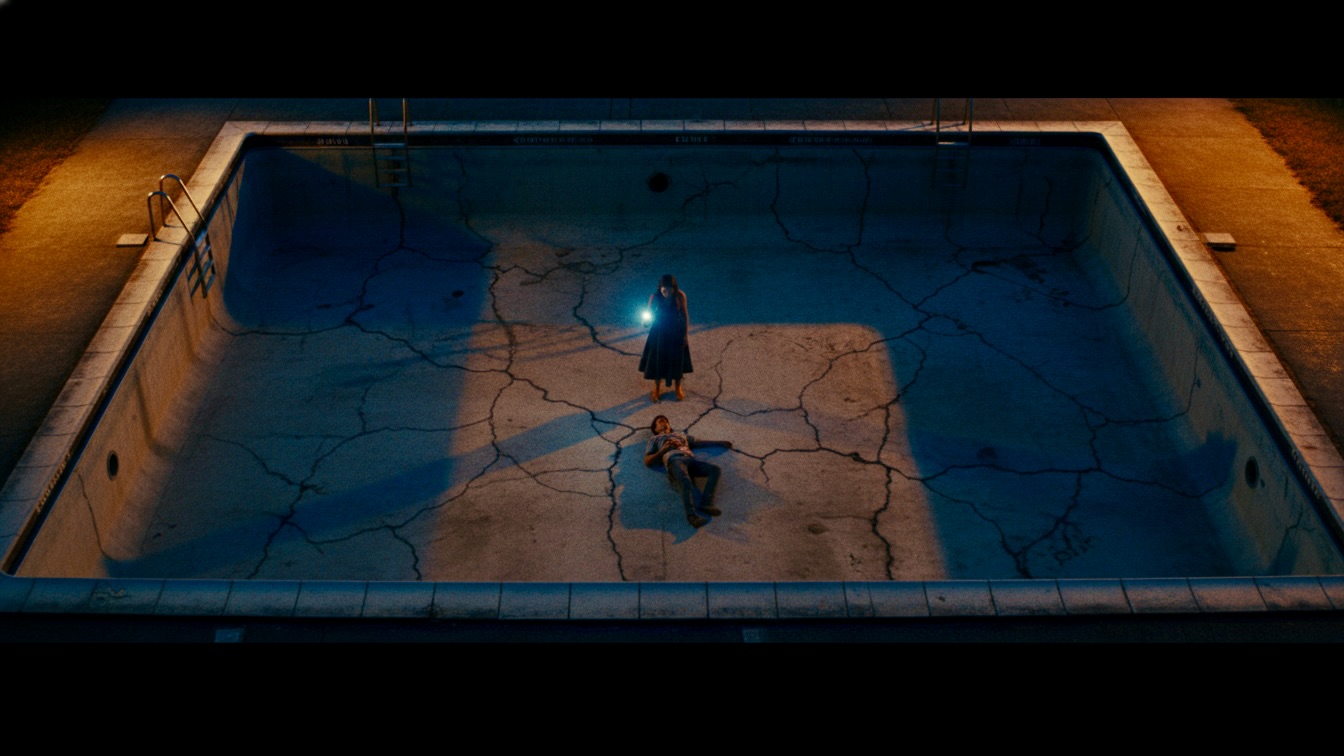
Harris, a detached and observant teenager, spends her summer nights on her roof, documenting the lives of her wealthy neighbors through a long-range camera lens. During one of these sessions, she captures a violent confrontation between the neighborhood "golden boy" James, his friend Trent, and a girl named Marie. The following morning, James is found dead in a drained swimming pool, his death initially ruled an accidental fall. Harris, however, possesses photographic evidence of blood on Marie’s shoe and uses it to blackmail her way into their inner circle.
Upon gaining access to James’s personal files, Harris discovers he was running a sophisticated deepfake and blackmail operation targeting local girls. She realizes Trent was being extorted by James and likely killed him to stop the abuse. When Trent discovers Harris’s interference, he attempts to kill her with a golf club, leading to a high-stakes chase through the neighborhood. Harris lures him to the site of James’s death—the empty Miller pool—where she maims him with a stone and asserts total psychological and social dominance over him.
One of the primary themes explored in the text is the corruptive nature of power and the transition of authority. James and Trent represent a traditional, patriarchal power structure built on athletic prowess and digital exploitation. Harris, however, represents a new, more calculated form of power that thrives on information and observation rather than physical strength. She does not seek to destroy the corrupt system she finds; instead, she seeks to occupy the vacuum left by James’s death.
The narrative also delves deeply into the theme of suburban rot and the artifice of the American dream. The setting is characterized by expensive SUVs, manicured lawns, and "golden" children, yet beneath this surface lies a world of deepfakes, crypto-extortion, and casual violence. The empty pool serves as a recurring symbol for this moral vacuum. It is a hollow, concrete pit that consumes the neighborhood’s youth, acting as a stage where their curated identities are stripped away to reveal their predatory instincts.
Voyeurism and the "male gaze" are subverted through Harris’s character. Typically, the act of watching and recording is used as a tool of exploitation by characters like James. Harris reclaims this tool, using her camera not for sexual gratification, but for strategic leverage. She turns the lens back on the predators, proving that in a digital age, the person who holds the data holds the life of the subject in their hands.
Harris is a cold, pragmatic protagonist who exhibits traits of a high-functioning sociopath. She displays a remarkable lack of empathy, viewing the death of her classmate not as a tragedy, but as an opening for advancement. Her psychological state is defined by a need for control, likely born from her status as a social outsider. She uses her camera as a literal and figurative shield, allowing her to interact with the world without having to feel its emotional weight.
Her evolution throughout the chapter is marked by her transition from a passive observer to an active predator. She does not hesitate to use violence when necessary, as seen when she maims Trent in the pool. Harris is not a hero seeking justice for the girls James victimized; she is a strategist who recognizes the value of the "machine" James built. Her final smile indicates a terrifying self-actualization, as she realizes she is more capable of cruelty than the boys who once intimidated her.
Trent serves as the embodiment of fragile masculine entitlement. His power is entirely reactive and physical, making him easily manipulated by those with superior intellect. Psychologically, he is driven by a desperate fear of losing his social standing, which led him to commit a frantic act of violence against James. He is a character who crumbles without the protection of his status, as evidenced by his transformation from a threatening attacker into a sobbing victim at the bottom of the pool.
His relationship with James was built on a foundation of mutual exploitation, and his relationship with Harris becomes one of total subjugation. He is a bully who is fundamentally weak when stripped of his physical advantages. By the end of the story, he is a broken tool, physically and mentally shattered by a girl he previously dismissed as a "freak." His trajectory highlights the theme that blunt force is no match for cold, calculated information.
Marie is a complex figure who exists as both a victim and a secondary antagonist. She is a victim of James’s digital abuse, yet she is also a willing participant in the cover-up of his death. Her character highlights the survival instincts required to navigate the toxic social hierarchy of her environment. She is quick to pivot her loyalty to Harris when she realizes the power dynamic has shifted, showing a cynical understanding of how her world works.
The pacing of the story is masterfully handled, utilizing a "slow burn" opening that explodes into a visceral, fast-paced thriller. The author uses short, declarative sentences to mirror Harris’s clinical and detached perspective. This stylistic choice creates a sense of coldness that permeates the narrative, making the moments of violence feel even more shocking. The transition from the sweltering heat of the roof to the "meat locker" cold of the basement reflects the shifting atmospheric tension.
Sensory details are used to ground the psychological elements of the story in a gritty, physical reality. The author focuses on unpleasant sensations—the "copper taste" of a dry mouth, the "wet, heavy crunch" of breaking bone, and the "suffocating warmth" of the asphalt. These details serve to strip the suburban setting of its beauty, emphasizing the decay beneath the surface. The use of technological jargon, such as Ethereum and deepfakes, adds a contemporary layer of realism to the noir-inspired plot.
The narrative voice is strictly objective, refusing to offer a moral compass for the reader. This lack of editorializing forces the reader to sit with the discomfort of Harris’s actions. There is no traditional "good" character to root for; instead, the style forces an engagement with the mechanics of power. The final scene in the pool is a stylistic mirror of the opening, bringing the story full circle from observation to participation, and finally, to total domination.


