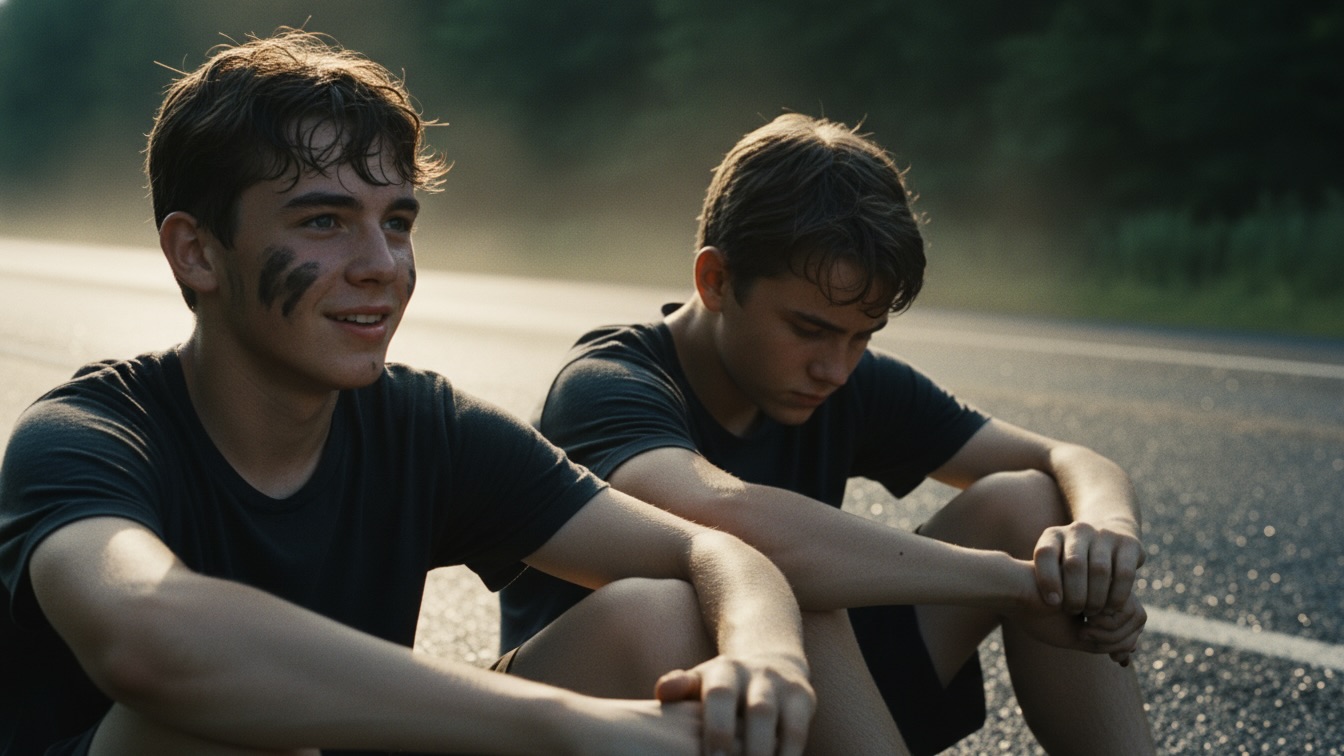
The narrative follows two high school seniors, Norm and Toby, who have abandoned their mandatory graduation rehearsal to venture into the woods toward an abandoned lumber mill. Norm is paralyzed by the bureaucratic pressures of impending adulthood, fixating on college applications and financial aid, while Toby presents a cynical, rebellious front. Their journey is interrupted by a territorial beaver that forces them into a frantic river crossing, serving as a visceral precursor to the dangers waiting at their destination.
Upon reaching the MacMillan mill, the true motivation for their excursion is revealed. Toby is not merely skipping school but attempting to recover a hidden cache of money left by his brother to fund a permanent escape from his dysfunctional home life. The tension escalates when three aggressive scrap thieves arrive, trapping the boys in the rafters. Norm suffers a debilitating panic attack, forcing Toby to abandon his search for the money to ground his friend.
The climax involves a daring distraction using an industrial air horn and a cart of iron gears to facilitate their escape. They flee back through the woods and the river, once again encountering the aggressive beaver before collapsing on the highway. In the aftermath, Toby realizes he cannot leave his mother behind, and Norm finds a newfound sense of clarity regarding his future. The story concludes with the two boys walking back to town, changed by the realization that life is an unplannable series of survival moments rather than a structured spreadsheet.
The central theme of the story is the jarring transition from the artificial structures of adolescence to the raw, unpredictable realities of adulthood. Norm represents the "digital hallucination" of modern success, where survival is measured in FAFSA deadlines and major selections. His anxiety is rooted in the fear of deviating from a prescribed path, viewing the "symbolic walk" of graduation as a high-stakes ritual. Toby, conversely, views these structures as a "capitalist scam," highlighting a socioeconomic divide where the luxury of worrying about a college major is contrasted against the immediate need for physical and financial escape.
Another prominent theme is the juxtaposition of natural chaos against human bureaucracy. The beaver serves as a powerful symbol of nature’s indifference to human social standing or academic achievements. It does not care about Norm’s GPA or Toby’s tragic backstory; it simply defends its territory with violent, physical force. This encounter strips away the boys' superficial concerns, forcing them into a state of primal awareness. The mill, a decaying monument to a dead industry, further reinforces the idea that human systems are temporary and prone to collapse, much like Toby’s hope for a hidden fortune.
Finally, the story explores the theme of loyalty and the burden of family obligation. Toby’s rebellion is revealed to be a mask for deep-seated trauma and a sense of duty toward his mother. His decision to stay, despite her flaws and the theft of his savings, suggests that adulthood often involves making peace with impossible situations rather than finding a clean exit. Norm’s shift toward majoring in history reflects a psychological need to find meaning in the survival of others, suggesting that the best one can do in a chaotic world is to learn how to endure the "mud" of existence.
Norm is characterized by a high degree of neuroticism and a desperate need for external validation and structure. He functions as the internalizer, turning the pressures of the future into physical symptoms of distress, such as his "vibrating" kneecaps and eventual panic attack. His obsession with the "portal" and the "walkthrough" reveals a psychological reliance on scripts; he feels that if he follows the rules perfectly, he can avoid the "pathetic demise" he so fears. This rigidity makes him ill-equipped for the unpredictability of the physical world, as seen in his clumsiness during the hike.
However, Norm undergoes a significant psychological shift when faced with genuine physical danger. The panic attack in the rafters is a breaking point where his internal stressors collide with an external threat, leading to a temporary total shutdown. Through Toby's grounding techniques, Norm learns to regulate his nervous system in real-time, moving from a state of paralyzed fear to one of "jagged clarity." By the end of the narrative, his decision to major in history indicates a move away from the fear of the unknown toward an appreciation for human resilience. He accepts the "weirdness" of his identity, finding power in his ability to survive the unexpected.
Toby serves as the story’s externalizer, using sarcasm and cynicism as armor against a world that has consistently failed him. He presents himself as a nihilistic rebel, but his actions reveal a deeply protective and responsible nature. His knowledge of the mill and his possession of the crowbar indicate a long-planned, desperate attempt to reclaim agency over his life. Unlike Norm, Toby’s stressors are not theoretical; they are grounded in the tangible reality of poverty and a mother who exploits him. He views the academic world with disdain because it offers no immediate solution to his survival needs.
Psychologically, Toby is defined by his "flat" eyes and his capacity for stoicism under pressure. When Norm has a panic attack, Toby immediately pivots from his own desperate mission to care for his friend, demonstrating that his loyalty outweighs his self-interest. This moment humanizes him, revealing that his "mid" persona is a defense mechanism against the pain of his brother leaving and his mother’s instability. His ultimate decision to remain in town is not an act of cowardice but a somber acceptance of his role as a caretaker. He chooses the "terrible situation" he knows over the uncertainty of flight, proving that his strength lies in his endurance.
The narrative employs a sharp, rhythmic pacing that mirrors the fluctuating anxiety levels of the protagonist. In the beginning, the dialogue is snappy and laden with teenage vernacular, creating a tone of dark comedy that masks the underlying tension. As the boys enter the mill, the prose shifts into a more atmospheric and oppressive style. The descriptions of the "rusted corrugated metal" and the "shimmering curtain of heat" create a sensory-heavy environment that reflects the gravity of Toby’s mission. The author uses short, punchy sentences during the action sequences to heighten the reader's pulse, effectively conveying the urgency of the escape.
Sensory details are used masterfully to ground the psychological states of the characters. The "green slime" on Norm's palm and the "violent, saturated green" of the canopy create a sense of nature as an overwhelming, almost aggressive force. The sound design of the story is particularly effective, from the "gunshot" crack of the beaver’s tail to the "catastrophic, earth-shattering blast" of the industrial air horn. These auditory cues serve as markers of transition, moving the characters from the silence of their internal thoughts to the loud, unavoidable reality of their surroundings.
The narrative voice is colored by a blend of irony and earnestness, reflecting the dual nature of late adolescence. The use of terms like "mid," "NPCs," and "debt machine" places the story firmly in a contemporary context, while the deeper emotional beats remain timeless. The ending provides a tonal resolution that is both somber and hopeful. By leaving the ruined money on the asphalt, the author provides a visual metaphor for the death of Toby’s childhood dreams and the birth of a more grounded, albeit difficult, adult perspective. The contrast between the freezing river water and the hot asphalt at the end emphasizes the sensory "aliveness" that the boys have discovered through their ordeal.


