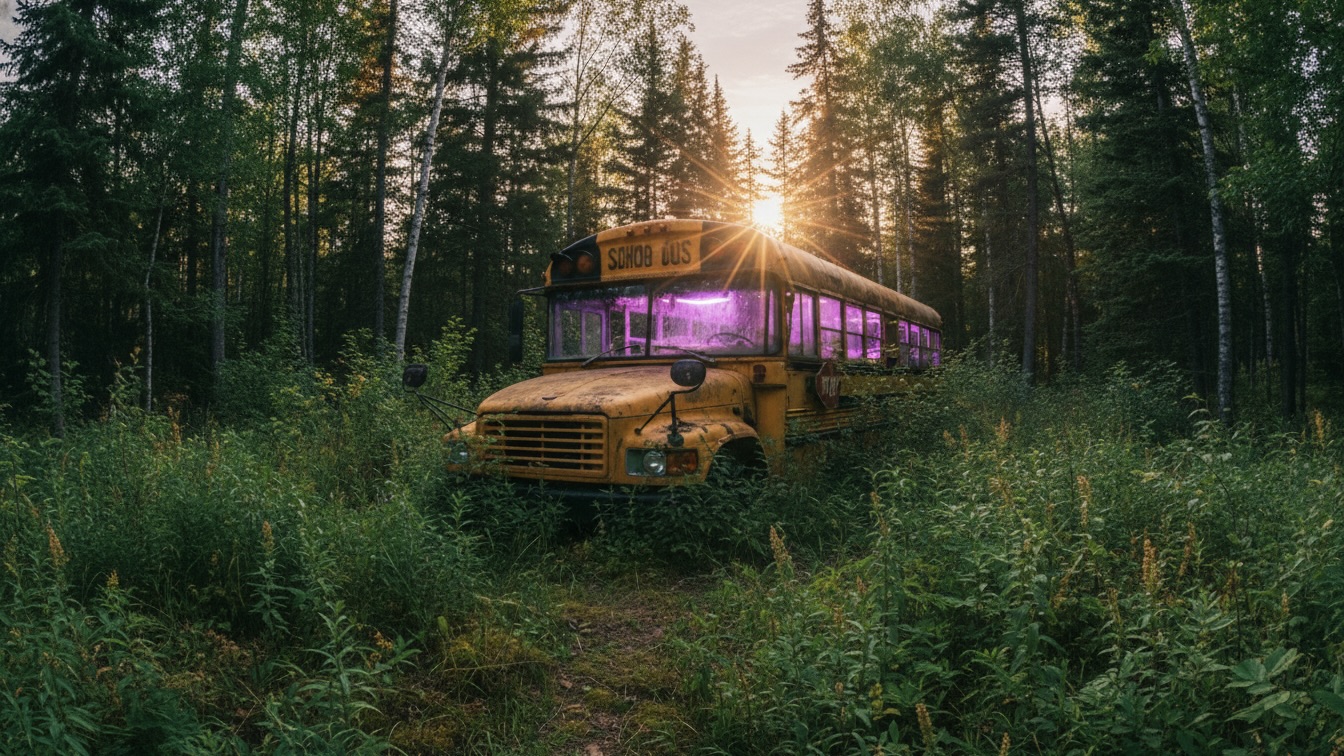
The story begins in a desolate Northern Store in the Kenora district, where a hungry teenager named Joe attempts to steal overpriced, rotting tomatoes. He is caught by the manager but saved by Marie, a girl from his community who trades her father’s stolen prescription pills for the food. Marie leads Joe to an abandoned school bus hidden in the woods, which she has converted into a rudimentary hydroponic garden. To provide the necessary light and warmth for the plants, the two teenagers embark on a series of desperate thefts, first stealing industrial grow lights from a defunct marijuana operation and later a generator from a local health clinic during a sudden, life-threatening cold front.
Their efforts are nearly derailed when Marie’s abusive father, Rick, discovers the bus and attempts to seize the generator for profit. Joe defends Marie in a violent confrontation, forcing Rick to retreat. The story concludes with a successful harvest of radishes and greens, which Joe shares with his struggling, alcoholic mother. The sight of the thriving garden attracts a social worker who, rather than punishing them for their illegal activities, offers a path toward a legitimate agricultural grant. This suggests a burgeoning sense of hope and stability for the two youths in an otherwise harsh and neglectful environment.
The central theme of the narrative is the struggle for agency within a system of neglect and scarcity. Joe and Marie live in a world where the basic necessities of life, such as fresh food and parental care, are either prohibitively expensive or entirely absent. The rotting fourteen-dollar tomatoes serve as a potent symbol of a broken system that prioritizes profit over human survival. By building their own greenhouse, the protagonists are not merely growing vegetables; they are reclaiming the power to sustain themselves. This act of defiance is a rejection of the passive suffering displayed by their parents, who have "checked out" through alcohol or pills.
Another significant theme is the moral ambiguity of survival. The protagonists are forced to commit several crimes, including theft and breaking and entering, to keep their plants alive. The story poses a difficult psychological question: is it wrong to steal from a clinic to prevent a source of life-giving food from freezing? Joe’s internal conflict highlights this tension, as he justifies his actions by noting that the clinic provides pamphlets rather than the tangible nourishment his mother needs. The narrative suggests that in a landscape of systemic failure, traditional morality is often a luxury that the starving cannot afford.
The metaphor of the "greenhouse in the snow" represents resilience in the face of a hostile environment. The bus, described as a "giant yellow monster" and later a "spaceship," stands as an alien presence in the thick woods, much like the teenagers' hope is an anomaly in their bleak reality. The artificial purple light creates a sanctuary that is physically and emotionally separate from the trauma of their homes. This sanctuary allows for a different kind of growth, one that is both literal in the form of the green sprouts and metaphorical in the form of the deepening bond and emerging confidence between Joe and Marie.
Joe begins the story in a state of physiological and psychological paralysis. His hunger is described as a "sharp ache" that dictates his movements, and his initial attempt at theft is clumsy and motivated by pure desperation. He suffers from a profound sense of smallness, particularly when confronted by authority figures like the store manager. This feeling of insignificance is rooted in his home life, where he is forced to witness his mother’s slow self-destruction. He is a character defined by his observational nature, noticing the "wrinkled skins" of tomatoes and the "loud, angry sound" of fluorescent lights, which reflects a heightened sensitivity to his decaying surroundings.
As the narrative progresses, Joe undergoes a psychological transformation from a passive victim to an active protector. His decision to steal the grow lights and the generator marks a shift in his self-perception; he begins to feel a "weird, fast energy" that replaces his previous shaking and stomach pain. This newfound bravery culminates in his physical defense of Marie against her father. By the end of the story, Joe has moved beyond mere survival. He finds a sense of pride in providing for his mother, suggesting that his self-worth is now tied to his ability to create and sustain life rather than his capacity to endure suffering.
Marie is the pragmatic catalyst of the story, possessing a survivalist instinct that Joe initially lacks. She is introduced as a figure of defiance, characterized by her "ripped jeans" and the "streak of dirt" on her cheek. Psychologically, she is much further along in her disillusionment with the adult world than Joe is. She views her father’s medication as a currency rather than a necessity, showing a cold-eyed realism about the addiction that plagues her household. Her "escape plan" is not a flight from the reserve, but a transformation of her environment, indicating a deep-seated need for control in a life characterized by chaos.
Despite her outward toughness, Marie harbors a deep vulnerability that is revealed during the cold front. Her panic when the plants are threatened shows that the garden is her emotional anchor; if the plants die, her hope for a different future dies with them. Her relationship with Joe provides her with the emotional support she lacks at home, evidenced by the "short, sharp" laugh she shares with him after their successful theft. She is a character who leads through necessity, but she also craves the simple human connection that Joe offers. Her tears at the end of the confrontation with Rick reveal the heavy emotional toll her resilience has taken on her.
Rick serves as the physical manifestation of the intergenerational trauma and addiction that haunt the community. He is described in predatory and sickly terms, with "wide and twitchy" eyes and a "scratchy" voice. His primary motivation is the immediate gratification of his own needs, as seen when he immediately calculates the resale value of the stolen generator. He represents the "darkness" that the purple light of the bus tries to keep at bay. His presence is a constant threat, not just of physical violence, but of the soul-crushing cynicism that threatens to extinguish the teenagers' project.
However, Rick is also a figure of pity. When Joe stands his ground with a rock, Rick does not escalate the violence; instead, he looks "very old and very tired." This moment reveals that his aggression is fueled by his own exhaustion and brokenness rather than true malice. He is a man who has been defeated by his environment and his addictions, and he sees his daughter’s efforts as something to be exploited because he can no longer imagine a world where things are built rather than sold. He retreats into the dark trees, a shadow of the man he might have been in a more supportive system.
Annie is a character defined by her absence and her silence. For most of the story, she is a static figure on a couch, "asleep" as a result of her alcoholism. Her neglect is the primary driver for Joe’s desperation, yet he does not seem to harbor outward resentment toward her. Instead, he views her with a quiet, protective sadness. She represents the potential future for Joe and Marie if they fail to break the cycle of their environment. Her role is to illustrate the stakes of the teenagers' struggle; she is the person they are trying to save, even if she is currently incapable of saving herself.
Her reaction to the harvest at the end of the story provides a crucial moment of emotional payoff. She does not experience a miraculous recovery, but the act of eating the fresh radish allows her to "really look" at her son for the first time in months. This brief moment of connection suggests that while the garden cannot fix the systemic issues of the reserve, it can create the conditions for small, human reconciliations. Her acknowledgement that the food is "really good" is a validation of Joe’s efforts and a sign that the "greenhouse" has successfully brought a sliver of light back into their home.
The author utilizes a gritty, naturalistic style that emphasizes sensory details to ground the reader in the harsh reality of the Kenora district. The descriptions of the rotting tomatoes and the "loud, angry" buzz of the store create an immediate sense of discomfort and tension. This sensory immersion continues with the contrast between the "wet blanket" of the summer heat and the "biting" wind of the sudden cold front. These environmental shifts mirror the emotional volatility of the characters' lives. The use of sharp, punchy sentences reflects the urgency of Joe’s internal state, particularly during the scenes of theft where every sound is amplified by his fear.
The color palette of the story is also significant, moving from the grey and rusted tones of the town to the "bright, intense purple light" of the bus. This purple light serves as a recurring visual motif for hope and artificial growth. It creates a surreal, almost science-fictional atmosphere within the woods, setting the bus apart from the "peeling houses" and "cracked pavement" of the reserve. The description of the bus as a "spaceship" suggests that the teenagers have created a world of their own, one governed by the laws of biology and care rather than the laws of the store or the band council.
Pacing is used effectively to build tension, particularly during the "Broken Glass" and "The Dark Cold" sections. The narrative moves quickly during the thefts, with a focus on physical actions and immediate consequences, such as the "sharp crack" of breaking glass or the "roar" of the generator. This high-stakes action is balanced by the slower, more contemplative scenes of the plants growing. These quieter moments allow the reader to breathe and appreciate the small victories, such as the "tiny, bright green stems" pushing through the dirt. The contrast in pacing underscores the central conflict: the frantic, often illegal actions required to maintain a slow, delicate process of growth.


