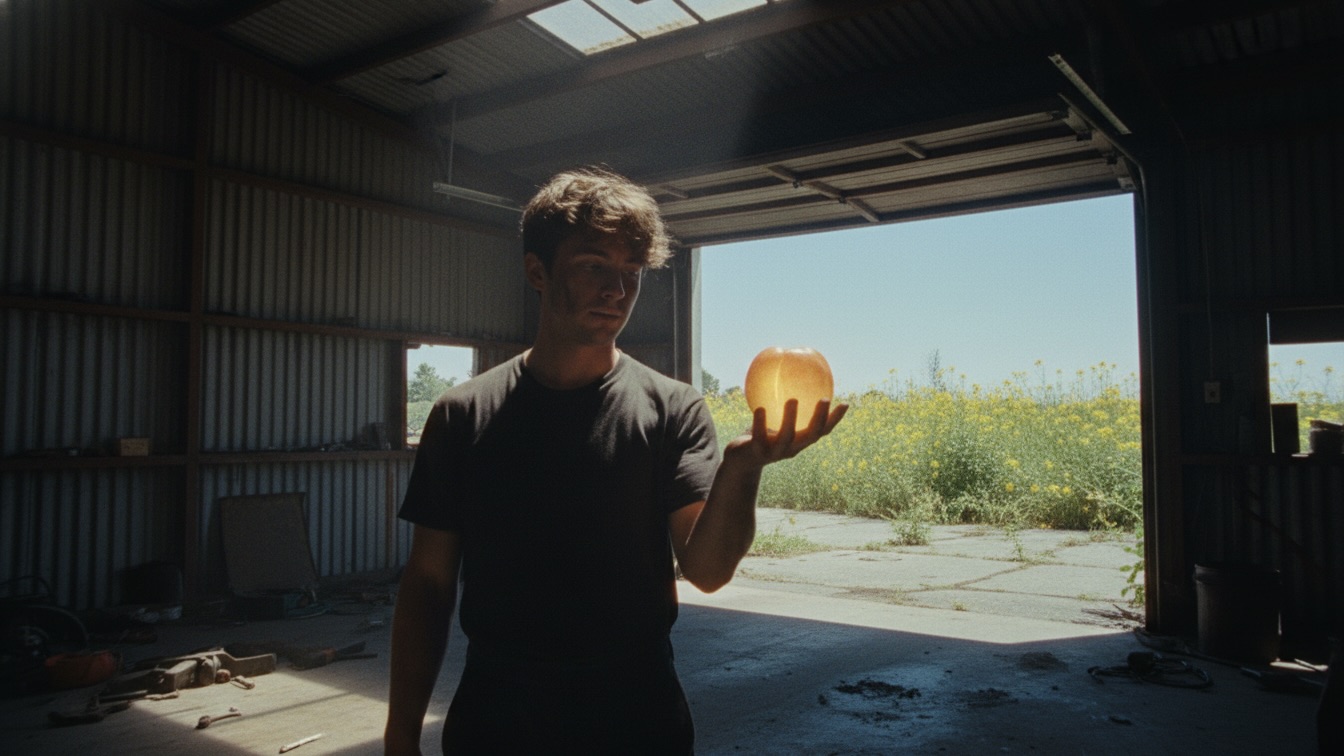
The narrative follows Jay, a laborer in a decaying industrial town, who discovers a hidden shipment of bioluminescent "sun-peaches" intended for the corrupt Mayor’s private banquet. These genetically modified fruits represent a staggering luxury in a community suffering from severe food rationing and environmental collapse. Driven by a sense of desperate justice, Jay recruits his friend Larry, a technician preparing to abandon the town for the more stable southern cities. Despite Larry’s pragmatic protests and the looming deadline of his departure, Jay convinces him to help hijack a municipal hover-truck to deliver the fruit to the local food bank.
The mission becomes a harrowing struggle against a failing landscape as the duo navigates the melting Northern Permafrost Highway. Their journey is complicated by the presence of S.A.R.A.H., an intrusive and inappropriately cheerful municipal AI, and a catastrophic cryo-coolant pipe rupture that flash-freezes the environment. After a tense confrontation and a narrow escape from a massive fissure swallowing the road, they successfully deliver the peaches to the community center. The story concludes with a bittersweet parting as Larry leaves for the south, while Jay remains behind, planting a peach seed in the scorched earth as a final, defiant act of hope.
The central theme of the story is the conflict between systemic corruption and communal survival within a collapsing environment. The sun-peaches serve as a potent symbol of this disparity, their bioluminescent glow contrasting sharply with the "sawdust bricks" and "synthetic protein pucks" fed to the citizenry. This stark imagery highlights the moral rot of the leadership, which hoards life-sustaining beauty while the infrastructure literally melts away. Jay’s rebellion is not just a theft; it is a reclamation of the town’s right to exist and flourish.
Environmental degradation acts as a secondary, pervasive theme that dictates the rhythm of the characters' lives. The "Midnight Melting Ice Road" is a landscape in active rebellion against human habitation, where permafrost turns to slush and corporate cooling systems create lethal microclimates. This physical instability mirrors the social instability of the town, suggesting that when the earth itself becomes unreliable, the social contract often follows suit. The characters are forced to navigate a world where nature and technology are both failing simultaneously.
Finally, the narrative explores the psychological tension between the instinct to flee and the duty to remain. Larry represents the modern refugee, driven by a pragmatic need for "functional plumbing" and safety, viewing the town as a "dead-end shithole." In contrast, Jay embodies a romantic, perhaps even pathological, attachment to his home, viewing departure as a betrayal that accelerates the community's death. This dichotomy highlights the tragedy of dying places, where the most capable individuals are often the first to leave, creating a self-fulfilling prophecy of abandonment.
Jay is a character defined by a fierce, tactile connection to his environment and a stubborn refusal to accept the inevitable. He is a man of action, as evidenced by his physical labor in the opening scene, using his body weight to shatter corporate seals. His psychology is rooted in a deep-seated resentment of the Mayor’s corruption, which he channels into a singular, risky mission of redistribution. He possesses a manipulative edge, specifically targeting Larry’s conscience to ensure the mission's success, showing he is willing to sacrifice personal relationships for the perceived greater good.
Internally, Jay struggles with the fear of being the last person left in a ghost town. He views every departure as a "light turning off," suggesting that his motivation for staying is as much about personal identity as it is about altruism. By planting the peach seed at the end of the story, he demonstrates a defiant optimism that borders on the irrational. He chooses to invest in a future that the physical world seems determined to deny him, marking him as a classic tragic hero who finds meaning in resistance.
Larry serves as the intellectual and pragmatic foil to Jay’s emotional impulsiveness. As a technician, he views the world through the lens of systems and logic, which makes the town’s decay particularly offensive to him. He is a man caught between two worlds: the dying past he shares with Jay and the sanitized, functional future he hopes to find in the south. His reluctance to help Jay is not born of malice, but of a realistic assessment of the risks, including the very real threat of indentured servitude in lithium mines.
Despite his protests, Larry’s decision to help Jay reveals a lingering loyalty to both his friend and his home. He is the one who provides the technical expertise necessary to bypass the truck’s security, showing that his skills are the only thing keeping the town’s flickering hope alive. His departure at the end of the story is not a victory, but a somber necessity. He carries the weight of "not drowning," a survival instinct that leaves him feeling guilty even as he pursues a better life.
Old Man Tobe represents the town’s collective memory and its tragic loss of history. He is a ghost-like figure wandering a landscape that no longer makes sense to him, "mud-fishing" for aquifers that have long since shifted or dried up. His presence provides a historical anchor for the narrative, reminding the reader and the characters that the current misery was not always the norm. He remembers a time when the ground was solid and the seasons followed a predictable, colder pattern.
His reaction to the sun-peach is the emotional climax of the story’s middle act. For Tobe, the fruit is not just nutrition; it is a sensory link to the "before," tasting like the sun and the stability of the past. His tears signify the profound grief of a generation that has watched the world become unrecognizable. He serves as the primary justification for Jay’s actions, proving that the beauty of the peaches is a necessary psychological balm for a population that has forgotten what it feels like to thrive.
The author employs a sensory-heavy prose style that emphasizes the physical discomfort of the setting. The narrative is saturated with descriptions of "oil-slicked concrete," "synthetic protein pucks," and "scalding" metal railings, creating a visceral sense of heat and decay. This focus on texture and temperature makes the sudden shift to the "biting, violent cold" of the cryo-leak even more jarring. The contrast between the bioluminescent glow of the peaches and the "dull, dusty light" of the apartment serves as a visual metaphor for hope in a bleak world.
Pacing in the chapter is expertly handled, transitioning from the slow, methodical tension of the initial crate-breaking to the frantic energy of the truck heist. The introduction of S.A.R.A.H. provides a surreal, darkly comedic element that heightens the tension rather than defusing it. The AI’s cheerful "morale-boosting" pop music playing during a life-threatening environmental collapse creates a cinematic irony. This stylistic choice underscores the absurdity of a world where corporate "happiness protocols" remain active while the physical infrastructure falls into an abyss.
The narrative voice is grounded and gritty, reflecting Jay’s perspective as a manual laborer. The dialogue is sparse and sharp, particularly between Jay and Larry, conveying years of shared history and current frustration without the need for extensive exposition. The use of technical jargon, such as "dual-authorization biometric bypass" and "auxiliary power transfer," adds a layer of realism to the science-fiction elements. This grounded voice allows the more fantastical elements, like the glowing fruit and the collapsing permafrost, to feel like plausible extensions of a broken future.


