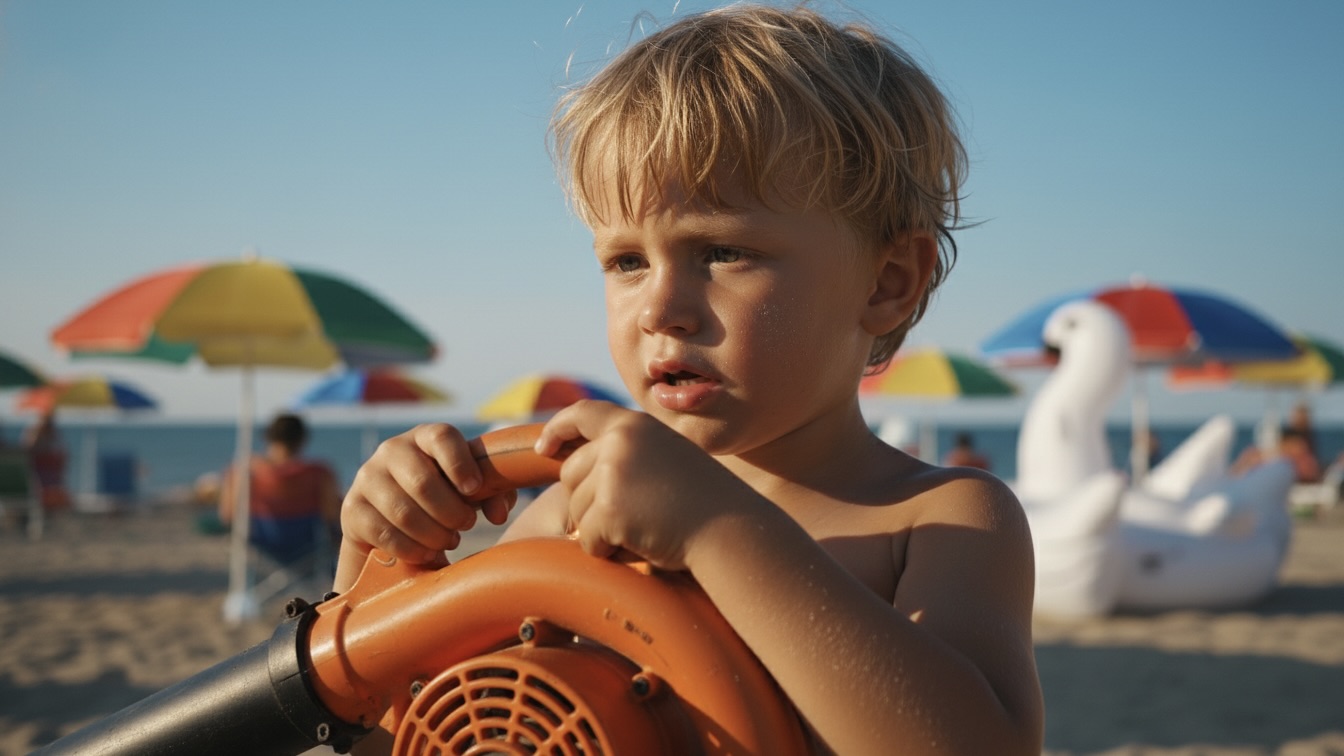
The chapter opens on a sweltering beach day in Gimli, where the protagonist, Baz, and his friend Kev are enduring the oppressive heat. Suddenly, a localized anomaly known as "The Glitch" suspends the laws of gravity, causing objects, water, and people to float effortlessly into the sky. Amidst the ensuing chaos, the local Mayor's golden retriever, Barnaby, joyfully paddles through the air toward the center of the lake. Refusing to let the dog drift off into the atmosphere, Baz and Kev fashion makeshift jetpacks out of groundskeeping leaf blowers. They navigate a surreal, floating obstacle course of beachgoers, water spheres, and a flying Viking statue to rescue the canine. After Kev's leaf blower malfunctions, Baz catches his friend with a fishing rod, and the trio seeks refuge on a massive inflatable swan. Discovering that singing country music somehow increases their mass, they belt out a popular song to descend just before gravity violently reinstates itself. The characters crash-land safely onto the beach, though a hovering pebble at the chapter's close hints that the anomaly might not be entirely gone.
The narrative masterfully juxtaposes the extreme mundanity of a lazy summer afternoon with the sheer absurdity of a localized gravitational collapse. This contrast serves to highlight the human capacity for rapid adaptation in the face of incomprehensible circumstances. Instead of descending into existential terror, the beachgoers largely treat the event as a bizarre inconvenience or a novel party trick. This reaction speaks to a psychological resilience, suggesting that human beings can normalize even the most physics-defying traumas if they occur in a familiar context.
Furthermore, the story explores the theme of tethering, both in a literal and a metaphorical sense. The characters constantly seek physical grounding, grasping at picnic tables, metal chains, and heavy lead sinkers to avoid floating into the void. This physical desperation mirrors a deeper psychological need for connection and stability in an unpredictable world. Baz and Kev are tethered to each other through their shared history and mutual reliance, which ultimately saves them from drifting into the stratosphere.
Finally, the narrative introduces a whimsical commentary on the power of human expression, specifically through the absurd mechanism of singing to restore gravity. The fact that belting out a pop-country anthem literally grounds the characters suggests that art and shared cultural touchstones carry an invisible weight. It is not science or logic that brings them back to earth, but rather a collective, albeit off-key, human effort. This thematic choice celebrates the ridiculous yet unifying aspects of human culture in the face of disaster.
Baz operates as the grounded emotional center of the narrative, ironically maintaining his psychological footing even as the physical world loses its gravity. He demonstrates a highly observant and pragmatic psychological profile, initially focusing on the sensory details of the heat and his cold beverage. When the anomaly strikes, he does not succumb to the widespread panic, but instead immediately searches for logical solutions and physical anchors. His quick thinking with the heavy picnic table and the fishing rod reveals a mind that remains highly functional under intense pressure.
His motivation is largely driven by a profound sense of duty and loyalty, particularly toward his somewhat helpless companion. He risks his own safety to rescue a dog he does not even own, simply because the situation demands action and no one else is capable. His internal conflict is minimal, as he processes fear through immediate, decisive action rather than prolonged introspection. He views his environment as a puzzle to be solved, utilizing leaf blowers and fishing lines to manipulate the impossible physics of his new reality.
Kev serves as the comedic foil to Baz, embodying a more reactive and emotionally volatile psychological state. He begins the narrative as a picture of extreme lethargy, actively rejecting basic self-care like sunscreen in favor of stubborn laziness. However, the loss of gravity forces him out of his passive state, thrusting him into a frantic struggle for survival. His transition from a sunbaked slacker to a reluctant, screaming astronaut highlights his underlying vulnerability and deep reliance on his friend.
Despite his constant complaining and moments of sheer panic, Kev possesses a surprising reservoir of chaotic bravery. He is the one who devises the leaf-blower propulsion system, demonstrating a flash of bizarre, improvisational genius. His emotional responses are loud and unfiltered, providing a necessary psychological release valve for the tension of the scene. Ultimately, his willingness to sing terribly to save their lives shows that his survival instinct can override his deep-seated desire to remain comfortably cool.
The author employs a notably staccato, minimalist sentence structure that creates a deadpan comedic tone. Short, declarative statements dominate the prose, mimicking the flat, unbothered internal monologue of the protagonist. This stylistic choice makes the sudden intrusion of magical realism feel even more jarring and humorous. By describing floating pearls of root beer and flying teenagers with the same detached voice used to describe a hot beach, the author heightens the surrealism of the scene.
Sensory details are utilized masterfully to anchor the reader in the physical reality of the anomaly. The stinging heat of the leaf blower engine, the smell of lake weeds, and the heavy feeling of the metal table are all described with vivid precision. These tactile descriptions contrast sharply with the weightless, dreamlike state of the characters, emphasizing the bizarre nature of the Glitch. The reader can practically feel the disorienting shift from floating in a thin, cold atmosphere to crashing into the gritty, hot sand.
Pacing in the narrative is inherently tied to the characters' movement through the air, accelerating and decelerating with their makeshift propulsion. The initial slow drift sets a tone of eerie wonder, which quickly escalates into chaotic action as the boys fire up the leaf blowers. The climax of the scene relies on a rapid succession of absurd images, from a floating Viking statue to massive spheres of lake water. The abrupt return of gravity provides a sudden, violent halt to the pacing, perfectly mirroring the physical crash of the characters returning to reality.


