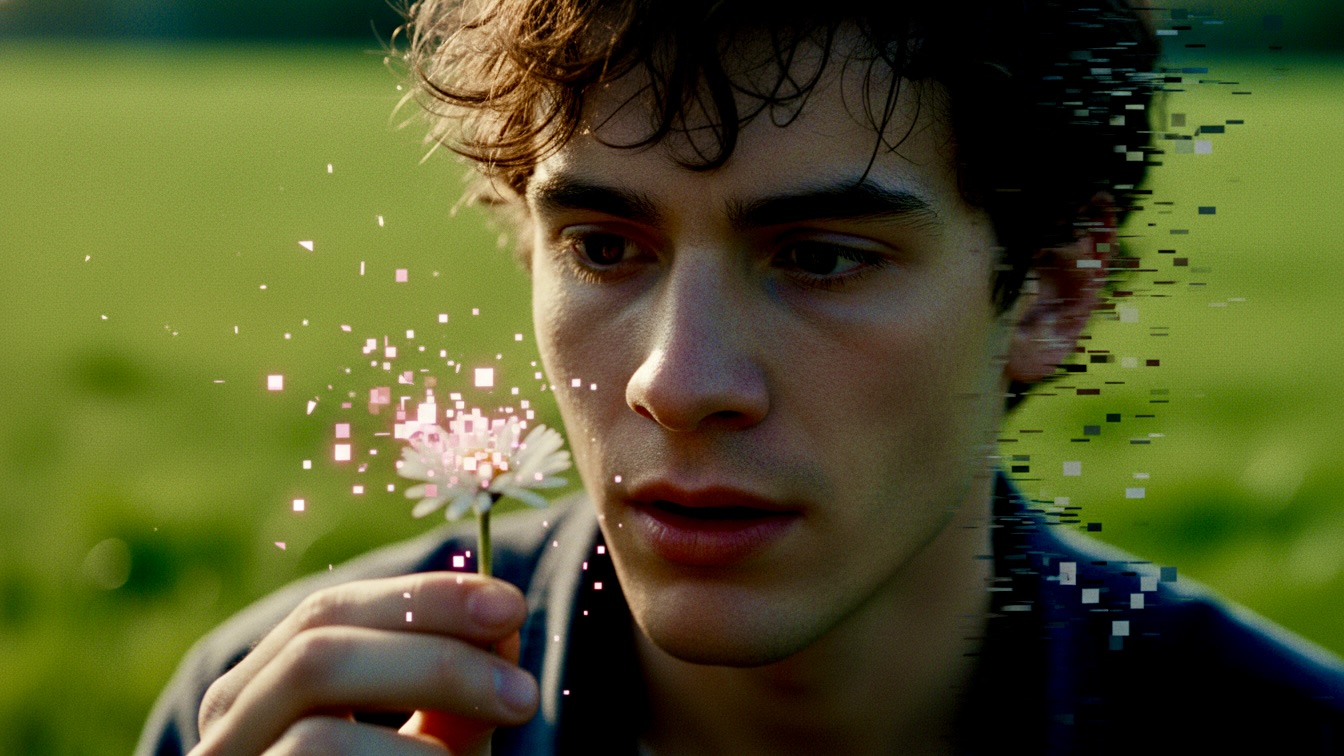
Format: Short Film / Anthology Episode | Est. Length: 10-12 minutes
This episode serves as a standalone entry in The Glitch Archive, an anthology series exploring a near-future world where reality is failing due to a systemic, unexplained degradation of the physical environment. Each episode focuses on different survivors navigating a landscape where the laws of physics, color, and matter are subject to unpredictable "patches" and "crashes," mirroring the anxieties of a hyper-digital society losing its grip on the tangible.
Nate steps out of his climate-controlled apartment for the first time in three months, only to find the world outside vibrating with high-definition intensity and localized frame-rate errors. As he navigates the sidewalk, he realizes the environment is no longer stable, with tree petals hovering in mid-air and the very pavement shifting under his feet.
A shut-in forced to confront a reality that is literally breaking apart must decide whether to retreat into his digital safety or embrace the terrifying uncertainty of a world undergoing a total system reboot. The survival of his own identity depends on his willingness to let go of the "render" and accept the raw, corrupted truth of existence.
The story explores the tension between curated digital comfort and the chaotic, often painful reality of physical existence. It examines the psychological toll of isolation, the fear of losing control, and the idea that beauty and truth are often found precisely where the system fails.
The narrative also touches on the concept of "The Big Quiet," a collective societal trauma that mirrors our current obsession with constant connectivity. It suggests that human connection is the only stable anchor when the external world—the "original file"—begins to dissolve into static.
Nate risks total psychological disintegration; if he cannot adapt to the shifting reality, he faces the threat of becoming a permanent, non-responsive part of the landscape. For Mina and Saul, the stakes are existential—they are actively choosing to witness the end of the old world, risking deletion or transformation in hopes of finding something more authentic on the other side of the crash.
The primary antagonist is the environment itself, a "corrupted" reality that is actively losing its collision data and stability. Internally, Nate fights his own deep-seated agoraphobia and the paralyzing need for the predictable, filtered safety of his digital existence, which acts as a barrier to his growth.
Nate ventures into a local park to meet his friends, Mina and Saul, only to discover that the "Spring patch" has rendered the world unstable and glitch-prone. As they witness the fountain water rising in jagged geometric steps and the grass swapping places, Nate struggles to reconcile his desire for safety with the overwhelming, aggressive beauty of the breaking world.
As the park begins a "total refresh," the ground loses its collision data and the sky tiles into empty black voids. Caught in a vortex of wireframes and primary colors, Nate must choose between clinging to his fading sense of self or surrendering to the void, ultimately finding himself in a blank, terminal-filled space that promises a new, unwritten beginning.
Nate is a cautious, agoraphobic shut-in who has spent months hiding behind screens; his arc moves from paralyzing fear and dependency on digital filters to a courageous acceptance of the unknown. Mina is a kinetic, high-energy catalyst who thrives on the chaos of the glitch; she serves as Nate’s anchor and guide, pushing him to abandon his digital safety. Saul is the cynical observer who provides the necessary context for the world’s decay, acting as a grounded, if slightly detached, voice of reason amidst the shifting reality.
Nate exits his apartment and enters the park, immediately overwhelmed by the sensory overload of a world that is visually "glitching" in real-time. He meets Mina and Saul, and they discuss the nature of the "Spring patch" while witnessing the fountain and the environment behaving in impossible, geometric ways. The midpoint occurs when the park begins its total system collapse, forcing the trio to physically hold onto one another as the ground dissolves into static. During the climax, the group is pulled toward a rip in reality, forcing Nate to confront his fear of deletion and finally let go of his need for control. The resolution finds Nate in a white void, standing before a glowing terminal, ready to initiate the next phase of existence.
The episode begins with a sense of claustrophobic anxiety, transitioning into a surreal, dreamlike state of wonder as Nate experiences the glitch. As the collapse intensifies, the mood shifts to high-stakes adrenaline and existential terror, finally settling into a quiet, contemplative resolution that leaves the audience with a sense of profound, open-ended potential.
If expanded, the series would follow the gradual, global expansion of the "Big Quiet," with characters across different cities attempting to track the source of the corruption. Each episode would reveal more about the "architects" of the reality-patch, building toward a season finale where the survivors attempt to reach the "root directory" of the world.
The thematic escalation would move from personal adaptation to collective resistance, questioning whether the glitch is a natural evolution of the world or a deliberate, malicious rewrite. Character arcs would involve the slow realization that their memories of the "pre-glitch" world might be as artificial as the current, failing landscape.
The visual style utilizes a mix of hyper-real, saturated cinematography for the "normal" world and jarring, experimental VFX to represent the glitches—think sharp wireframes, tiling textures, and frame-rate stuttering. The tone is akin to Black Mirror meets The Matrix, balancing grounded, intimate character drama with high-concept, surrealist science fiction.
Influences include the "new aesthetic" movement, where digital artifacts are treated as physical, tangible objects. The lighting should shift from the warm, golden pressure of the opening to the cold, clinical white of the void, emphasizing the loss of natural warmth as the world transitions into a digital-first state.
The target audience is young adults and adults (18-40) who are fans of speculative fiction, psychological thrillers, and "weird" sci-fi. It is designed for viewers who enjoy slow-burn narratives that prioritize atmosphere and philosophical questions over traditional action-heavy tropes.
The pacing begins deliberately, mimicking Nate’s hesitant steps into the world, before accelerating rapidly as the "total refresh" begins. The structure follows a tight 10-12 minute arc, with the first act establishing the status quo, the second act building the tension of the environment, and the final act delivering the surreal, transformative climax.
The production will require a heavy reliance on practical effects combined with post-production digital "glitch" overlays to ensure the environment feels like it is physically breaking rather than just being a CGI overlay. The "white void" sequence should be filmed in a high-key, minimalist studio space to create a stark contrast with the vibrant, chaotic textures of the park.
Special attention must be paid to the sound design, which should evolve from ambient, naturalistic city sounds to a low-frequency hum that eventually becomes a deafening, synthesized roar. This sonic shift is crucial for grounding the audience in Nate’s internal experience of the world’s instability.


