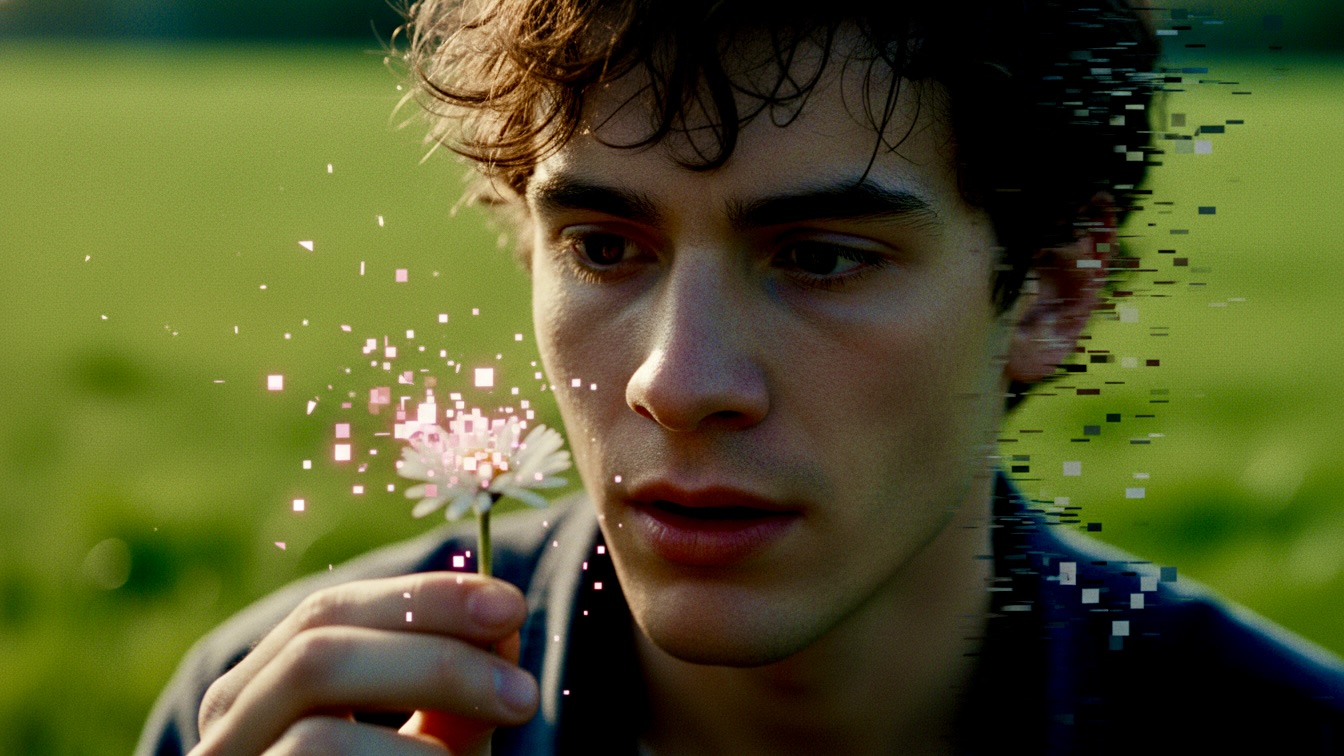
The story follows Nate, a man who has retreated from the world into a self-imposed, digital-centric isolation within his apartment. Driven by a rare excursion into the physical world, he meets two acquaintances, Mina and Saul, in a local park that is suffering from a reality-altering phenomenon known as the Bright Glitch. As the park begins to physically break down—with grass swapping places, water rising in geometric stairs, and reality losing its collision data—Nate realizes that the world is undergoing a massive, chaotic update. He transitions from a state of paralyzing fear to a newfound acceptance of the instability. Ultimately, the park dissolves into a void, leaving Nate in a white, empty space before a mysterious terminal, ready to participate in the rewriting of reality.
The central theme of the narrative is the tension between the safety of stagnation and the terrifying necessity of evolution. Nate’s apartment represents a desperate attempt to freeze time, where the absence of change provides a false sense of security. However, the author posits that existence without change is effectively a form of non-existence, as Nate feels he is only being rendered by his connection to the digital feed. The Bright Glitch acts as a metaphor for the unpredictability of human experience, forcing the characters to confront the fact that reality is not a fixed construct but a fluid, responsive process.
The narrative also explores the distinction between mediated reality and authentic experience. While Nate is initially repulsed by the sensory overload of the park, he eventually learns that the "raw" world—despite its corruptions and glitches—is more honest than the curated, filtered life he led inside. The act of burning a couch or feeling the texture of a friend’s skin serves as a rebellion against the sterile, predictable nature of his previous life. The story suggests that embracing the "glitch" or the chaos of the unknown is the only way to reclaim one's agency in an increasingly destabilized world.
Nate is defined by his profound alienation and his reliance on digital structures to mediate his relationship with the world. He views his life through the language of software, describing his own voice as a thin recording and his physical movements as having lag. His motivation for leaving his apartment is rooted in a fragile connection to others, yet he remains deeply uncomfortable with the lack of filters in face-to-face interaction. Throughout the chapter, he undergoes a significant psychological shift, moving from a state of existential dread to a courageous acceptance of the unknown. By the end, he sheds his desire for the predictability of the box, choosing instead to engage with the terminal as a participant in the unfolding of a new reality.
Mina acts as the catalyst for Nate’s transformation, serving as a bridge between the stagnant world he left behind and the chaotic potential of the new environment. She is characterized by her kinetic energy and her willingness to embrace the instability of the Bright Glitch. Her decision to invade Nate’s personal space is a deliberate attempt to shock him back into physical awareness. She possesses a level of comfort with the breakdown of reality that Nate lacks, suggesting she is more attuned to the changing nature of the world. Her presence provides the anchor that allows Nate to survive the transition without losing his sense of self.
Saul represents the pragmatic, albeit slightly detached, observer of the systemic collapse. He possesses a sardonic wit that helps deflect the terror of their situation, using humor to ground the group during the most extreme moments of the glitch. Saul is observant, noting the technical aspects of the park's failure, such as the texture pops and the loss of collision data. He functions as a stabilizing force, providing both context and levity while the world around them turns into wireframes. Despite his nonchalance, he is clearly aware of the gravity of the situation and remains committed to the group's survival.
The narrative voice is sharp, visceral, and deeply rooted in the vocabulary of digital technology, which effectively mirrors Nate’s internal state. By describing the sky as a "high-definition scream" and the grass as having a "refresh rate," the author creates a sensory experience that feels both futuristic and fundamentally broken. This stylistic choice emphasizes the protagonist's struggle to translate his digital-heavy worldview into the tactile, messy reality of the park. The pacing is intentionally erratic, starting with the slow, claustrophobic atmosphere of the apartment before accelerating into the frantic, high-stakes chaos of the park’s dissolution.
The tone shifts masterfully from initial anxiety to a transcendent, almost mythic conclusion. The use of sensory details—the ozone scent, the prickling static on the skin, and the jagged, geometric visuals—imbues the abstract concept of a "reality glitch" with a haunting, physical weight. By focusing on the texture of a scar or the warmth of a hand, the prose grounds the abstract digital elements in human emotion. This contrast ensures that the reader feels the weight of the stakes, making the final leap into the unknown feel like a natural, if terrifying, progression for the characters.


