Format: Short Film / Anthology Episode | Est. Length: 10-12 minutes
This story serves as the pilot episode for The Dome Chronicles, an anthology series set within a sprawling, multi-tiered subterranean structure where the last remnants of humanity live under the illusion of a dying planet. Each episode explores the disparity between the wealthy upper tiers, who curate their reality through expensive simulations, and the lower-tier laborers who maintain the machinery of their own oppression. The series focuses on the slow erosion of corporate control and the awakening of a population realizing that the "apocalypse" outside is a fabrication designed to maintain a monopoly on resources.
Deep within the sterile, gray archives of the lower levels, Ida discovers a data anomaly that proves the outside world is not only habitable but actively healing. When her shift-mate Terrence pressures her to delete the evidence, Ida realizes that the corporation is hiding the truth to sell the weather as a luxury commodity.
An exhausted archivist discovers that the toxic wasteland outside their dome has vanished, revealing a corporate conspiracy to monetize the planet's recovery. She must defy her programming and risk everything to trigger a manual override that will expose the truth to the entire population.
The episode explores the theme of manufactured scarcity, where the powerful hoard natural resources to maintain control over the desperate. It also examines the psychological weight of institutionalized agoraphobia, questioning how fear is used as a tool to keep populations confined within their own cages.
Beyond the political, the story touches on the human need for genuine experience in a world of digital simulations. The contrast between synthetic, "purchased" nature and the raw, unpredictable reality of a rainstorm serves as a metaphor for the struggle for authenticity in a hyper-controlled society.
Ida risks her life, her meager social standing, and her physical safety by challenging the atmospheric control protocols. If she fails, she faces permanent exile or termination, while the rest of the population remains trapped in a cycle of servitude, paying for air they could breathe for free.
The primary antagonist is Dr. Nande, the Chief of Atmospheric Operations, who represents the cold, profit-driven corporate machinery. Ida’s internal conflict is equally daunting; she must overcome years of conditioning and her own crippling agoraphobia to step out of the archives and into the vast, terrifying open space of the central hub.
Ida, a low-level archivist, uncovers evidence that the world outside the dome has recovered from the environmental collapse of the 2020s. Despite the pressure from her coworker Terrence to ignore the data, Ida uses her access to confirm that a massive, clean rainstorm is approaching, which the corporation plans to sell as a premium experience to the elite in the upper tiers.
Realizing the depth of the deception, Ida makes the harrowing decision to leave her safe, confined workspace to reach the central hub. She navigates the massive, empty structure, destroys a security drone in a desperate act of rebellion, and reaches the control room to force a system-wide vent opening, finally allowing the natural rain to fall on the entire population.
Ida: An archivist who has spent years in a confined space, suffering from deep-seated agoraphobia and corporate-mandated fatigue. Her arc moves from a state of passive, fearful compliance to an act of radical, defiant liberation as she chooses the truth over her own survival.
Terrence: A weary, broken laborer who has internalized the corporate hierarchy to the point of self-sabotage. He represents the "average" citizen who is too terrified of losing his small comforts to challenge the status quo, serving as a foil to Ida’s awakening.
Dr. Nande: The personification of corporate greed, Nande is detached and arrogant, viewing the environment as an asset to be managed. His arc is one of rapid descent from cold control to frantic, panicked authoritarianism as his monopoly is shattered.
Ida discovers the atmospheric data discrepancy in the archive room while Terrence pressures her to run a patch to clear their queue. She realizes the sensors are picking up real, non-toxic weather, leading her to bypass corporate firewalls and confirm the existence of a massive, impending rainstorm.
Ida makes the terrifying decision to leave her archive bunker, navigating the vast and intimidating central hub while suffering from intense agoraphobia. She is confronted by a security drone, which she destroys in a moment of panicked adrenaline, marking the point of no return.
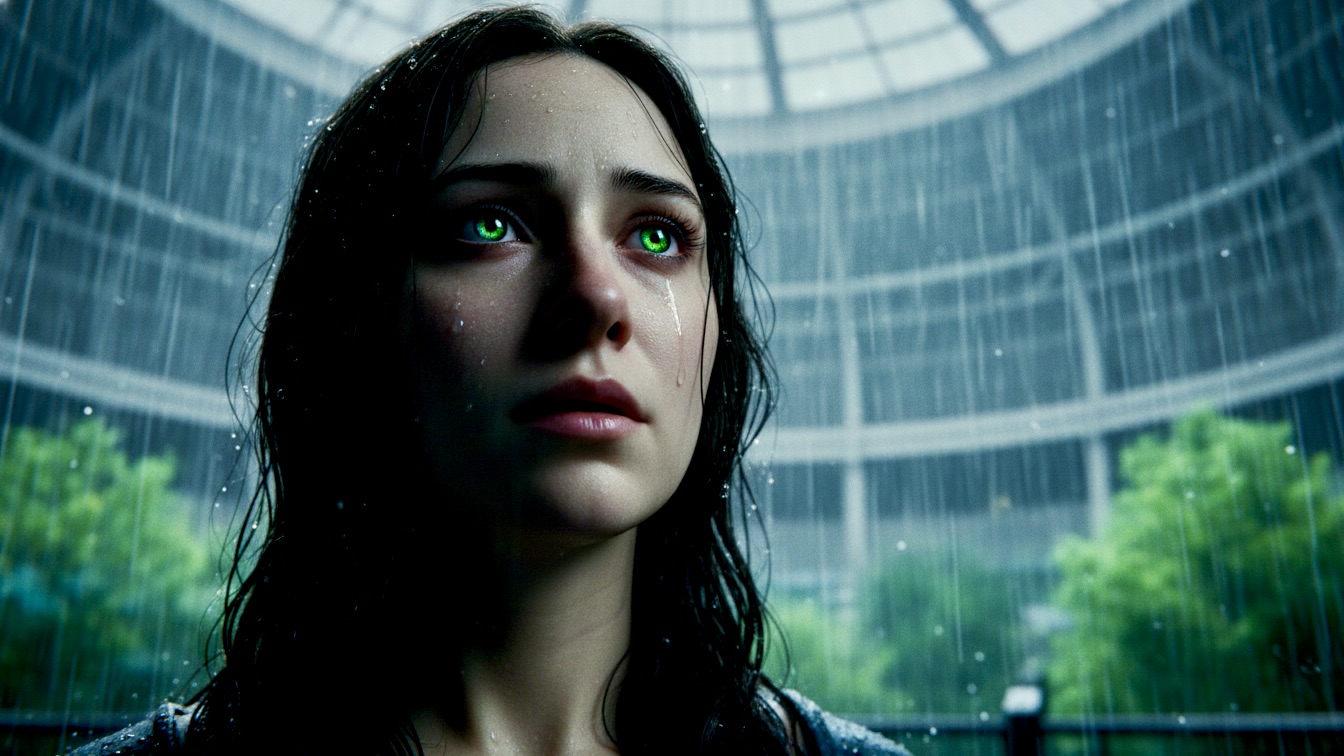
Ida reaches the weather control center and confronts Dr. Nande via a digital link, rejecting his bribes and threats. She pulls the manual override switch, triggering a system-wide purge that opens the dome to the outside world, bringing the real rain to the entire population as the guards close in on her position.
The episode begins with a claustrophobic, muted tone, characterized by the mechanical drone of the archives and the dull, gray lighting. As Ida moves into the central hub, the mood shifts to one of overwhelming scale and terror, eventually exploding into a cathartic, rain-soaked climax that feels both chaotic and deeply liberating.
The season would follow the immediate aftermath of the "Great Opening," as the corporation attempts to regain control and suppress the truth about the outside world. Ida becomes a reluctant symbol of the resistance, forcing the series to shift from a contained thriller to a broader story of societal collapse and the uncertain journey of humanity reclaiming the surface.
Thematic escalation continues as characters grapple with the reality that the "outside" is not a paradise, but a wild, untamed environment. The series would explore the power vacuum left by the corporation and the struggle to build a new society without the crutch of synthetic simulations.
The visual style relies on high-contrast lighting, using the oppressive, sterile blues and grays of the archives to contrast with the warm, chaotic colors of the external storm. The camera work emphasizes the scale of the dome, using wide, sweeping shots in the central hub to highlight Ida’s smallness and her intense, subjective fear of open spaces.
The tone is grounded in gritty, near-future realism, drawing tonal comparisons to Children of Men and Blade Runner. The focus is on tactile, lived-in environments—the smell of ozone, the texture of slick keys, and the physical weight of the rain—to ensure the audience feels the transition from the fake to the real.
The target audience is fans of dystopian science fiction, psychological thrillers, and character-driven dramas, typically aged 18-45. The viewing context is designed for streaming platforms where the visual and auditory immersion of the rain-soaked climax can be fully appreciated.
The pacing starts deliberately slow to emphasize the monotony of Ida’s life, utilizing short, sharp cuts during the archive discovery to build tension. Once Ida leaves the archive, the tempo accelerates significantly, mirroring her rising panic and the urgency of the impending storm, leading to a high-energy, climactic finale.
The production requires a strong contrast between the practical, claustrophobic sets of the archives and the massive, CGI-enhanced scale of the central hub. The "rain" sequence should be achieved through a mix of practical water effects and high-end digital compositing to ensure the rain feels heavy, cold, and genuinely immersive.
Special attention should be paid to the sound design, transitioning from the low-frequency mechanical hum of the archive's HVAC system to the roaring, organic sound of the storm. This sonic shift is crucial for the audience to experience the same sensory awakening that Ida feels when the dome finally opens.


