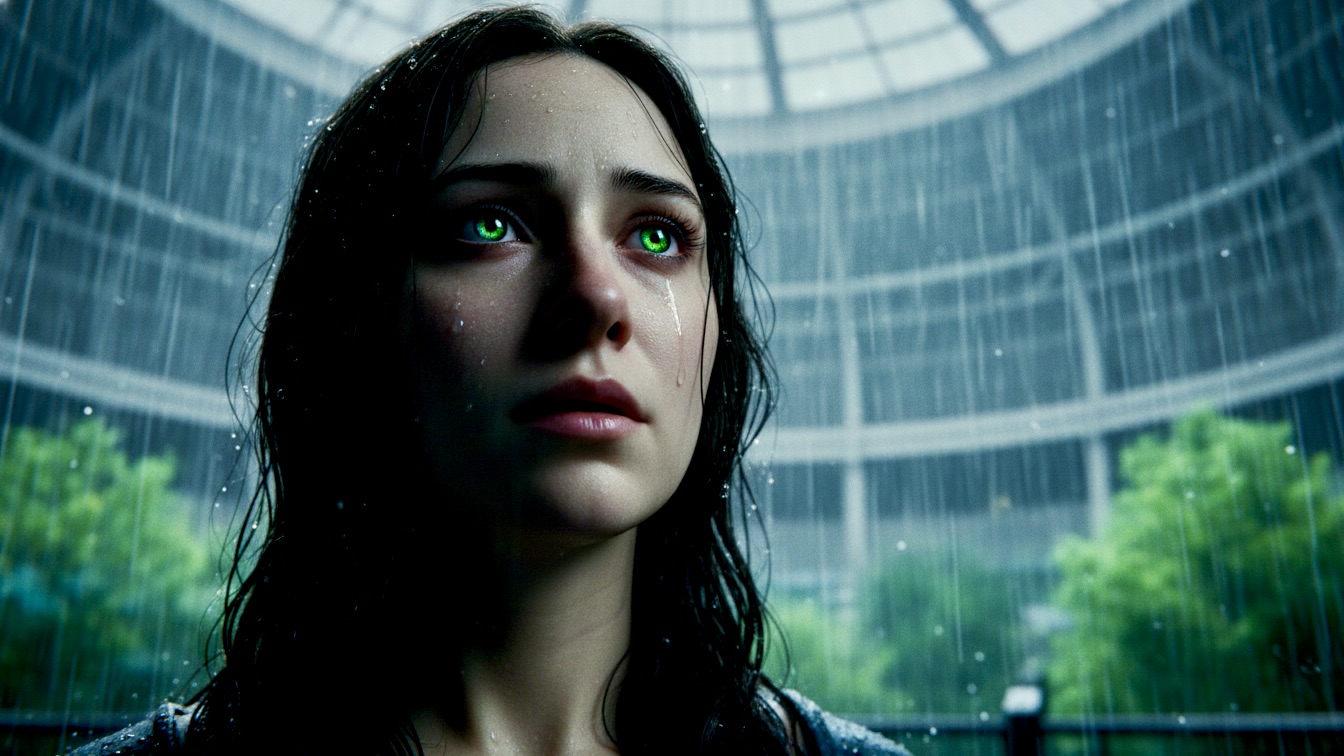
The simulation was flawless. But the real world outside the glass was finally waking up to wash it all away.
"Just run the patch, Ida. Seriously."
Terrence leans over my desk. He smells like stale synthesized garlic and three days of unwashed anxiety. His badge is flipped backward on his lanyard, the magnetic strip scratched to hell.
"It's not a glitch," I say. My throat is dry. I swallow, tasting copper.
"It's always a glitch. Run the diagnostic. Let the algorithm eat it. I want to go to sleep."
I stare at the monitor. The glare from the cracked display cuts a sharp line across my right eye, making the dull headache at the base of my skull throb in time with my pulse. It's 3:14 AM. The data stream reflecting off my glasses is a relentless waterfall of green and gray text.
"Look at the variance," I say, pointing a bitten fingernail at the lower quadrant of the screen. "Sector 7 external. Barometric pressure is dropping. Humidity is spiking. The sim parameters for the Spring package don't allow for a pressure drop that severe. The algorithm wouldn't write this."
Terrence groans. He rubs his face, dragging his hands down his cheeks like he's trying to pull the skin off. "Ida. Please. The external sensors have been broken since the dust storms in '24. They're picking up static. Or acid fog. Or nothing. Just overwrite it."
"It's not static."
"I don't care what it is," he snaps. His voice cracks. He looks around the empty archive room. The harsh fluorescent lights flicker, casting long, bruised shadows under the server racks. "If we don't clear the queue by shift change, Nande is going to dock our credits. Again. I can't afford another hit. Just press the button."
I look at him. His eyes are bloodshot. He's shaking slightly, just a faint tremor in his fingers. He's terrified of losing his sim-tier access. If you drop below a certain credit score, they shut off your window screens. You just stare at gray metal walls until you die or go crazy.
"Fine," I lie. "I'll patch it."
"Thank you." He exhales, a long, ragged sound. "I'm going to the vending unit. You want a synthetic heavy-water?"
"No. I'm good."
He shuffles away. His boots scuff against the linoleum. The heavy security door hisses open, then thuds shut, locking automatically behind him.
The silence in the archive room is immediate and heavy. It presses against my eardrums. Just the low, mechanical drone of the HVAC systems pumping recycled, sterile air into the room. The air tastes like dust and ozone.
I turn back to the screen.
I didn't run the patch.
My fingers hover over the mechanical keyboard. The keys are slick with oil from years of use. I type a quick command string, bypassing the standard diagnostic tool, and pull up the raw feed from the Sector 7 external sensors.
The dome we live in is a massive blister of glass and steel, built to keep the toxic fallout of the 2020s out. Inside, it's a controlled environment. A sterile, temperature-regulated cage. The wealthy live in the upper tiers, where they buy seasonal simulations. Right now, it's 'Spring.' They get synthetic cherry blossoms projected on their windows, mild breezes pumped through hidden vents, and UV-filtered sunlight.
Down here in the lower levels, we just get the gray.
I pull the data from the sensor array on the outer hull. The numbers scroll down the screen.
Moisture: 88%. Air quality index: 45. Wind speed: 12 knots.
My breath hitches. My chest tightens, a sudden, sharp band wrapping around my ribs.
AQI 45.
That's impossible. The outside air is supposed to be toxic. Lethal. The AQI hasn't been below 300 in five years. The dust storms, the chemical fires, the absolute collapse of the biosphere—that's what they teach us. That's why we stay inside. That's why we work our lives away to pay for filtered air.
I tap the screen. Once. Twice. The glass is cold.
I run a secondary diagnostic, routing it through an old, forgotten proxy server I set up last year to bypass the corporate firewalls so I could pirate old movies. The proxy masks my inquiry. It reaches out past the dome's internal network, grabbing the raw, unfiltered data from the external nodes.
The screen blinks. A new window opens.
It's not an anomaly. It's a weather pattern.
A massive low-pressure system is moving in from the west. The satellite data—which I'm definitely not supposed to have access to—renders as a pixelated topographic map. A huge, swirling mass of blue and green.
Rain.
Real, organic, un-simulated rain.
And the air... the air is clean. The storm has scrubbed the atmosphere. The soil out there, the dead, burned earth, is absorbing the moisture. The thermal imaging shows tiny, microscopic blooms of heat. Spores. Seeds.
The earth is healing.
My stomach turns over. A cold sweat breaks out on the back of my neck. I push my chair back. The wheels squeak against the floor.
If the outside is healing, why are the doors still locked? Why are we still paying for air?
I know the answer before the question even fully forms in my head. I just don't want to believe it.
I lean forward, my hands shaking. I pull up Dr. Nande's administrative directory. Nande is the Chief of Atmospheric Operations. He's the guy who prices the sim-packages for the upper tiers. His directory is encrypted, locked behind a biometric firewall.
But I'm an archivist. My entire job is organizing the digital trash this corporation leaves behind. People get lazy. They leave backdoors open. They reuse old passwords. Nande is arrogant. He thinks nobody down here knows how to read code.
I run a brute-force script against a forgotten legacy server connected to his personal terminal. It takes three minutes. The loading bar crawls across the screen, a slow, agonizing yellow line.
My heart hammers against my sternum. The pulse in my neck is erratic. I keep looking at the door, expecting Terrence to walk back in with his bad breath and his complaints.
Ding.
The firewall breaks.
I'm in.
I open a folder labeled 'Project Vernal.'
There are dozens of documents. Memos. Spreadsheets. Cost-benefit analyses. I click on the executive summary. The text is dense, written in that bloodless, corporate speak that makes my teeth grind.
...external atmospheric recovery exceeding projections by 400%. Toxicity levels dropping to safe parameters. Biome regeneration active in quadrants 4 through 9.
I scan down. My eyes burn.
...recommendation to maintain current lockdown protocols. Unrestricted access to natural weather events will severely devalue the Spring Simulation packages. Revenue from upper-tier seasonal subscriptions accounts for 68% of quarterly profits.
They know.
They've known for months.
...Project Vernal proposes a localized, controlled breach of the dome in Sector 1 (Penthouse Tier). We will open the vents during the upcoming organic precipitation event, allowing the upper tier to experience 'Real Rain' as a premium, ticketed luxury experience. Lower tiers will remain sealed to maintain scarcity and drive demand for synthetic alternatives.
I stop reading.
I stare at the words until they blur into meaningless shapes.
A premium, ticketed luxury experience.
They are going to sell the rain.
A sharp, physical wave of nausea hits me. I grab the edge of the desk, squeezing the cheap particle board until my knuckles turn white. I lean over, putting my head between my knees. The blood rushes to my face. I force myself to breathe. In through the nose, out through the mouth.
The air tastes like nothing. It has always tasted like nothing.
I sit up. The clock on my screen reads 3:42 AM.
The storm is projected to hit at 4:15 AM.
If Nande opens the vents in Sector 1, the rain will fall on the penthouses. It will wash their clean, fake streets. It will water their imported, genetically modified grass. And down here, we'll just hear the muffled thud of water hitting the glass roof, miles above our heads.
Unless the lower vents open too.
I look at the network map. The primary weather control center is located in the central hub, Level 4. It's an automated station. Nande and his team run it remotely from their offices in the upper tiers. But there's a physical console there. A manual override.
If someone triggers the manual override, it forces a system-wide purge. All vents open. The dome equalizes pressure with the outside.
I look at the door.
I haven't left the archive level in two years.
The thought of leaving this room, of walking through the wide, open concourses of Level 4, makes my vision swim. Agoraphobia isn't just a fear of open spaces. It's a physical assault. It's the feeling that the sky is going to crush you. The dome is massive, but down here, in the archives, the ceiling is low. The walls are close. It's safe. It's a coffin, but it's safe.
If I go up there, I'll be exposed. The security cameras. The drones. The sheer, empty volume of the central hub.
But if I stay here, I will rot. I will sit in this chair, staring at a cracked screen, typing patches for a broken simulation until I die.
I stand up.
My legs feel like lead. My joints ache. I haven't exercised in months. My diet consists of nutrient paste and caffeine. I am weak.
I grab my datapad, ripping the cord out of the terminal. I shove it into the pocket of my oversized, gray utility jacket. I pull the hood up.
I walk to the door. I hit the release button. The heavy steel slides open.
The hallway outside is empty. Long, straight lines of fluorescent lights stretching into infinity. The floor is spotless, polished by automated drones every hour.
I step out.
The silence out here is different. It's a heavy, expectant silence.
I start walking.
Left foot. Right foot.
My breathing is shallow. I keep my eyes on the floor. I count the tiles. One, two, three, four. If I look up, I'll see how far away the end of the hall is, and I'll panic.
I reach the elevator bank. I press the call button. The metal is cold against my skin.
The elevator arrives with a soft chime. The doors part. I step inside. The walls are mirrored. I catch a glimpse of myself. Pale skin, dark circles under my eyes, hair pulled back into a messy knot. I look like a ghost. I look like someone who doesn't exist.
I press the button for Level 4.
The elevator moves. The acceleration pushes me down into the floor. My stomach drops.
Level 2. Level 3. Level 4.
The doors open.
The central hub.
It's massive. A cavernous space of white marble and brushed steel. The ceiling is hundreds of feet high, lost in the shadows. Walkways bridge across the empty air. Massive pillars support the structure.
It's 3:55 AM. The hub is deserted.
My chest seizes.
The space is too big. There's too much air. I feel untethered, like gravity has stopped working and I'm going to fall upward into the dark. I grab the doorframe of the elevator, my fingers digging into the metal.
Breathe. Just breathe.
I force myself to let go. I take a step forward.
My boots click against the marble. The sound echoes, bouncing off the walls, returning to me distorted and loud. It sounds like a gunshot.
I walk toward the center of the hub. The weather control center is a glass-walled room suspended above the main floor, accessible by a spiral staircase.
I keep my head down. I focus on the stairs. Just the stairs.
Halfway across the floor, a security drone drops from the ceiling.
It hovers ten feet in front of me, a sleek, black sphere with a single, glowing red optic. It scans me. A thin beam of red light sweeps over my body, reading my biometrics, checking my badge.
I freeze. My heart stops.
Employee ID 4492. Ida. Archivist. Tier 3 access.
The drone chirps. It's a harsh, electronic sound.
"Access restricted," a synthesized voice says. "Level 4 is currently closed for maintenance. Please return to your designated sector."
I don't move. I don't speak.
"Compliance is mandatory. Return to your designated sector."
The red light blinks faster. It's prepping to alert central security.
I reach into my pocket. My fingers close around the heavy, metal edge of my datapad. I pull it out.
I don't think. I just react.
I throw it.
The datapad spins through the air and smashes directly into the drone's optic lens. The glass shatters. The drone emits a high-pitched squeal, spiraling backward, its anti-gravity thrusters misfiring. It crashes into a marble pillar and drops to the floor, twitching.
Silence returns.
I stare at the broken drone. My hands are shaking so badly I can barely feel my fingers.
I just destroyed corporate property. That's a felony. That's exile to the lower sublevels.
There's no going back now.
I run.
I sprint toward the spiral staircase. My lungs burn. The air is cold in my throat. I hit the stairs and scramble up, my boots slipping on the metal grates.
I reach the top. The glass door to the control room is locked with a heavy magnetic seal.
I pull my multi-tool from my belt. I jam the flathead attachment into the seam between the door and the frame. I lean my entire body weight against it. The metal groans.
I pry the cover off the lock mechanism. Wires spill out. Red, blue, green.
I don't know hardware. I know code.
I grab the wires and yank them all out at once.
The magnetic seal fails with a loud clack. The door swings open.
I stumble inside.
The room is dark, lit only by the glow of the massive primary console. Screens cover the walls, displaying the complex schematics of the dome's ventilation system.
I drop into the operator's chair. It's leather. Real leather. It smells expensive.
I pull the keyboard toward me. The UI is clean, completely different from the garbage we use down in the archives. It's intuitive.
I wake the system.
A prompt appears: Enter Administrator Credentials.
I pull a small thumb drive from my pocket. It's the brute-force script I used on Nande's terminal. I slot it into the console.
The screen flickers. Code runs down the left side.
Bypassing... Bypassing... Access Granted.
The main menu opens.
I check the clock. 4:08 AM.
The storm is here.
I look at the external cameras. The monitors show the outside of the dome. It's pitch black, but lightning flashes, illuminating heavy, bruised clouds. The wind is battering the glass.
I find the tab labeled Ventilation Control.
I click it.
A schematic of the dome appears. It's divided into sectors. Sector 1, the penthouse, is highlighted in gold. The rest of the dome is gray.
Next to Sector 1, a timer is counting down.
Scheduled Purge: 04:15:00.
They're getting ready to open the roof for the rich.
I look for the manual override. It's a physical switch on the console, housed under a clear plastic cover.
I flip the cover up.
The switch is heavy, made of cold steel.
I put my hand on it.
If I pull this, the entire dome opens. Every vent. Every louver. The pressure will equalize. The fake, sterile air will be sucked out, replaced by whatever is out there.
I hesitate.
The conditioning runs deep. For twenty-four years, I've been told the outside is death. That breathing the air will burn my lungs. That the rain is acid.
What if the sensors are wrong? What if the data is a glitch?
What if Terrence was right?
I look at the screen. I look at the thermal imaging. The tiny, microscopic blooms of life in the soil.
It's not a glitch.
I grip the switch.
Suddenly, the screens in the room flash red.
A loud, blaring alarm cuts through the silence. It's deafening.
WARNING. UNAUTHORIZED ACCESS DETECTED. SECURITY TEAMS DISPATCHED TO LEVEL 4 HUB.
Nande found me. The system flagged the override attempt.
A face appears on the main monitor. It's Dr. Nande. He's in his penthouse, wearing a silk robe. He looks furious, his face tight and pale.
"Who is this?" he barks. "Step away from the console immediately. You are initiating a catastrophic breach."
I stare at him. I don't say anything.
"I have armed security seconds away from your location. Step away!"
I look at his pristine face. I look at the silk robe. I think about Terrence eating synthetic noodles, terrified of losing a fake window.
"The rain isn't yours," I say. My voice is quiet, but the microphone picks it up.
Nande's eyes widen. He recognizes me. Or at least, he recognizes the gray jacket of a lower-tier worker.
"Don't be stupid," he says, his tone shifting to a rapid, panicked negotiation. "The lower levels aren't prepped for a pressure drop. You'll cause structural damage. People will panic. I can give you credits. I can move you to Tier 2. Just let go of the switch."
"People should panic," I say.
I pull the switch down.
It locks into place with a heavy, mechanical thud.
The alarm changes pitch. It goes from a siren to a deep, resonant klaxon.
MANUAL OVERRIDE ENGAGED. SYSTEM-WIDE PURGE INITIATED.
Nande screams something at the camera, but I hit the mute button. His face disappears, replaced by the schematic of the dome.
All the gray sectors turn green.
The building shudders.
It's a massive, physical vibration that travels up through the floor, into my boots, and up my spine. The sound is incredible. It's the grinding of gears that haven't moved in decades. Massive steel plates sliding against each other.
I stand up. I walk to the glass wall of the control room.
I look up.
High above the central hub, the fake, digital sky flickers. The projected stars glitch, turning into squares of static, and then wink out completely.
For a second, there is only darkness.
Then, the massive physical louvers of the dome begin to open.
They pull back like the iris of a giant eye.
The wind hits first.
It drops down through the open vents, a massive column of air that slams into the central hub. It smells... incredible.
It doesn't smell like ozone. It doesn't smell like floor polish.
It smells like wet dirt. Like crushed leaves. Like electricity and cold, dark space.
Petrichor.
I close my eyes. The wind tears through the hub, blowing papers off desks, knocking over trash cans. The sterile, dead air is pushed out, replaced by the heavy, wild breath of the earth.
Then, the rain falls.
It doesn't fall like the sim-showers. It doesn't fall in neat, predictable lines. It dumps. It crashes down in sheets, heavy and violent.
The water hits the marble floor of the hub with a deafening roar. It splashes up, soaking my boots, soaking my jeans.
I walk out of the control room. I stand on the metal walkway, looking down.
Below me, doors are opening. People are stepping out of the corridors. Tier 3 workers. Janitors. Maintenance crews. They are walking into the open space, looking up.
The water hits them.
They don't run. They don't scream. They just stand there, their faces turned upward, letting the freezing, real water wash over them. Some of them are crying. Some of them are just standing completely still, shocked into silence.
I look at my hands. They are wet. The water is cold. It's real.
The gray weight that has sat on my chest my entire life is gone. Washed away in a second.
Down on the floor, the heavy security doors burst open. Armed guards flood into the hub, their weapons drawn, shouting orders that are completely drowned out by the sound of the storm.
They look up at me on the walkway.
I don't care.
I lean against the railing, tilting my head back, and open my mouth to the sky.
The red warning light from the control room stopped flashing, replaced by a solid, blinding white as the heavy steel doors behind me finally blew off their hinges.
“The red warning light from the control room stopped flashing, replaced by a solid, blinding white as the heavy steel doors behind me finally blew off their hinges.”


