Format: Short Film / Anthology Episode | Est. Length: 10-12 minutes
Imagine a world where every sensory experience is curated by a digital veil, and "Bent Spiral Wire" serves as a claustrophobic, intimate entry in an anthology series exploring the fragility of high-tech dependency.
Set in a near-future "Shielded Era," the series The Unfiltered explores a society where humanity has retreated into a seamless Augmented Reality (AR) existence to escape a scarred planet. Each episode focuses on a different "glitch" in the system—a power failure, a corrupted file, or a manual override—that forces citizens to confront the raw, terrifying, and beautiful reality of the physical world they’ve forgotten. The series tracks the slow awakening of a generation that has never touched dirt or seen a face without a filter.
The constant industrial hum of a high-tech study room abruptly cuts to a heavy, watery silence before the holographic world vanishes, leaving two students trapped in a bare concrete box. Gina stares at a black tablet screen, realizing the "library" around her was nothing more than a digital illusion.
When a massive server crash strips away the digital veneer of their reality, two students must navigate the physical world and their own social anxieties to save their academic futures. They discover that the only thing more terrifying than a failing grade is the un-curated intimacy of another human being.
The primary theme explores the dichotomy between the "optimized" digital self and the "clumsy" biological reality, questioning whether technology serves as a bridge or a barrier to true human connection. It delves into "Analog Nostalgia," contrasting the frictionless ease of the cloud with the tactile, imperfect weight of physical objects like a bent spiral notebook.
The story also examines the "Fear of the Real," portraying the natural world not as a paradise, but as a chaotic, sensory-overloaded environment that modern humans are no longer evolved to handle. It suggests that true intimacy requires the risk of physical rejection, something the digital world has successfully engineered out of existence.
For Gina, the stakes are immediate and material: the loss of her quantum variance data means failing her finals and losing her housing stipend, potentially casting her out of the university system. For Vern, the stakes are psychological; the outage strips away his confident digital avatar, exposing his physical insecurities and forcing him to risk real-world rejection for the first time.
The primary external conflict is the "System Failure," an invisible, indifferent force that has rendered their tools useless and their environment hostile. Internally, both characters battle "Somatic Shock"—the overwhelming sensory input of the natural world—and the debilitating social paralysis born from a lifetime of mediated communication. The environment itself acts as an antagonist, with the failing air scrubbers and the "mutating" radiation of the sun providing a ticking clock for their survival.
In the sterile, concrete confines of Study Room 4B, the digital world dies, leaving Gina and Vern in total darkness until the harsh, unfiltered sun exposes the grime of their reality. Desperate to recover her lost quantum mapping notes before her final exam, Gina is forced to rely on Vern, who reveals a "barbaric" secret: a physical notebook filled with hand-written data. The two are forced to acknowledge their physical forms—Gina’s sweat-soaked synthetic clothes and Vern’s nervous leg twitch—which were previously hidden by their flawless digital avatars.
As the room’s life support fails, the two venture outside the university’s protective dome for the first time in years, confronting the chaotic sensory overload of wet grass and unpredictable wind. Under the shade of a real oak tree, they bridge the gap between their digital personas and their flawed physical selves, realizing that while the cloud is safe, it is also profoundly lonely. The episode ends in the fading light, with the two characters sitting in a heavy, pregnant silence, paralyzed by the terrifying prospect of touching one another without an interface.
Gina: A high-achieving, rigid student who views the world through the lens of data and optimization. Her arc moves from digital dependency and frantic denial to a reluctant acceptance of physical imperfection and human vulnerability. By the end of the episode, she realizes that the "mathematically optimized" world she craved was a hollow simulation of life.
Vern: An "analog purist" who hides his deep-seated physical insecurities behind a theatrical, broad-shouldered digital avatar. He begins the story as a performative nihilist but ends as a vulnerable young man who must choose between his safe, curated persona and the messy reality of his own body. His journey is one of shedding masks to find a genuine, if terrifying, connection.
The hum of the server dies and the holographic library vanishes, leaving Gina and Vern in a drab, concrete room smelling of ozone and floor wax. Gina panics over her lost data while Vern, stripped of his towering avatar, reveals his nervous physical habits in the harsh sunlight. They realize the "local" outage is actually a total severance from the collective digital memory.
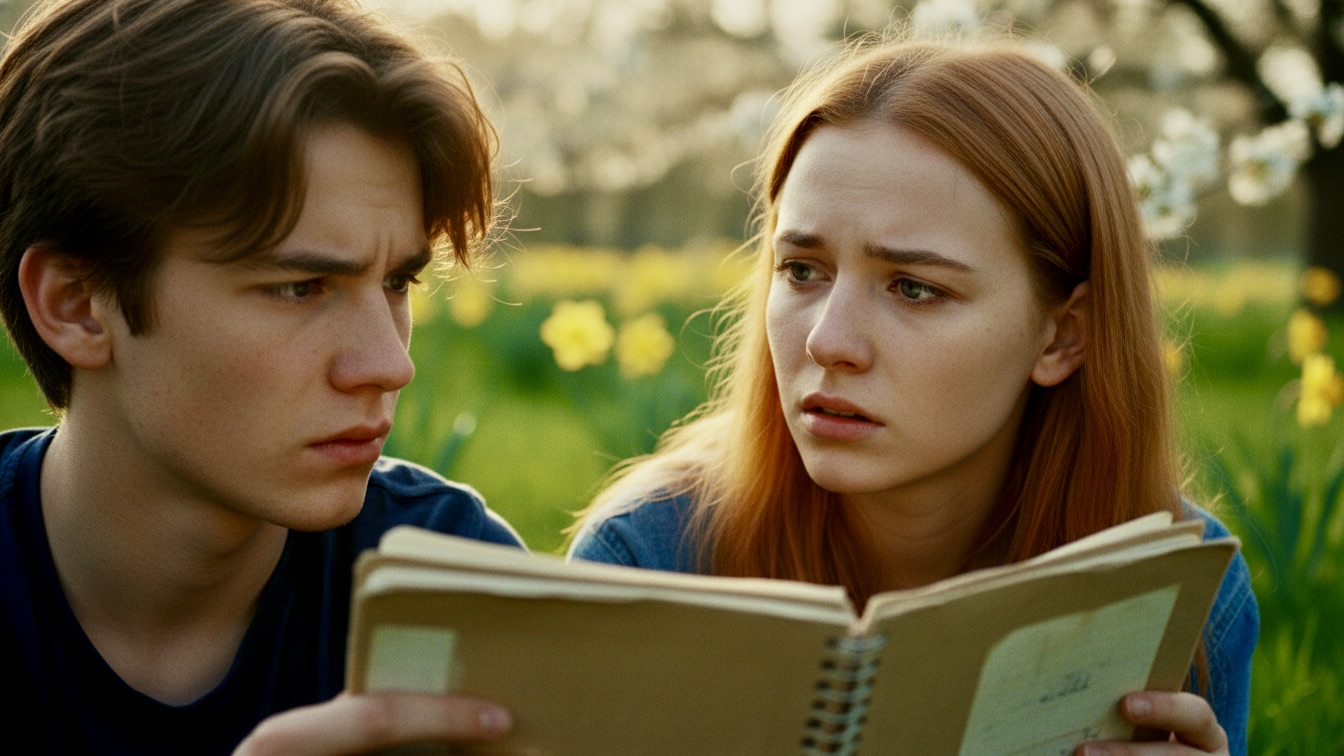
Vern presents a physical Mead notebook, a "barbaric" relic that Gina initially views with disgust because it carries the intimate, tactile oils of his skin. Realizing the air scrubbers have failed, they are forced to leave the building and step into the "Outside," a world of overwhelming smells and uneven ground. The physical shock of the unfiltered atmosphere causes immediate sensory distress for both students.
Under an oak tree, they struggle to decode Vern’s messy handwriting, finding that the physical act of learning together creates a terrifyingly real intimacy. As the sun sets and the cold sets in, they face a three-foot gap of grass that feels like an insurmountable canyon, neither yet brave enough to bridge the distance without a digital interface. The episode closes on their micro-expressions of fear and longing as the natural world grows dark around them.
The episode begins with high-tension claustrophobia and sensory deprivation, transitioning into a disorienting, "fish-out-of-water" middle act as the characters enter the natural world. The final third shifts into a quiet, melancholic intimacy, leaving the audience with a sense of "vulnerable hope" as the characters trade digital perfection for physical reality. The mood is one of profound isolation slowly giving way to a fragile, un-curated connection.
If expanded, the season would follow Gina and Vern as they become "Analog Underground" leaders, helping other students reconnect with the physical world despite university crackdowns. The overarching narrative would involve the discovery that the "server crashes" are actually intentional acts of sabotage by a group trying to force humanity to reclaim its biological autonomy.
As the season progresses, the characters would face the "Great Reconnection," a global movement to dismantle the atmospheric shields. The thematic escalation would move from personal intimacy to a societal revolution, questioning if humanity can survive the "violence" of the real world after centuries of digital domesticity.
The visual style utilizes a sharp contrast between the "Dead Digital" (cold, gray, flat concrete with harsh shadows) and the "Raw Natural" (over-saturated colors, handheld camera movements, and extreme close-ups on textures like skin and paper). The transition from the interior to the exterior should feel like a "sensory explosion," using lens flares and shallow depth of field to mimic the characters' overwhelmed vision.
The tone is grounded sci-fi, drawing inspiration from the "San Junipero" episode of Black Mirror but with the gritty, tactile realism of Children of Men. It avoids the "slick" look of traditional futurism in favor of something more weathered and organic, emphasizing the "bent" and "snagged" nature of physical existence.
Aimed at Gen Z and Millennial viewers (ages 16–35) who experience "digital fatigue" and are familiar with the pressures of curated online identities. It appeals to fans of cerebral science fiction and intimate, character-driven dramas that explore the intersection of technology and human psychology.
The pacing is "Breathless to Still," starting with a rapid-fire opening of system failure and panic, then slowing down significantly once the characters reach the oak tree. The 12-minute runtime follows a classic three-act structure: The Crash (0-3m), The Trek (3-7m), and The Tree (7-12m). The final three minutes should feel almost "real-time," emphasizing the awkward, unedited silence between the two leads.
The production requires high-quality foley work to emphasize the "newness" of physical sounds—the scratch of a pen, the rustle of leaves, and the squeak of sneakers—against the initial silence. This auditory contrast is crucial for conveying the characters' sensory awakening to the audience.
Visually, the transition from the concrete room to the outdoors should use a change in lens filtration to make the natural sunlight feel "painfully" bright and real. Practical effects should be favored over CGI for the notebook and the natural environment to reinforce the theme of "analog purity" and tactile reality.


