Format: Short Film / Anthology Episode | Est. Length: 10-12 minutes
This episode serves as a standalone entry in a speculative thriller anthology titled Infrastructure, which explores the intersection of human trauma and the decaying, forgotten industrial landscapes of the modern world. Each episode focuses on a different location—a crumbling dam, a derelict subway line, or an abandoned factory—where the environment acts as a physical manifestation of the protagonist's internal psychological collapse. The series arc investigates the theory that these man-made structures possess a residual, predatory sentience that feeds on the emotional vulnerabilities of those who trespass within them.
The ground beneath a remote, abandoned hydro plant begins to vibrate with a low-frequency hum that feels less like machinery and more like a heartbeat. As Jay and Marty push through the skeletal woods toward the concrete tomb, the air grows heavy with the scent of rot, signaling that the structure is not as dormant as it appears.
A trauma-stricken recluse is forced to confront his hyper-vigilance when a rave in a crumbling hydro plant turns into a fight for survival. He must choose between his instinct for self-preservation and the life of his only friend as the floor gives way to a subterranean river.
The episode explores the tension between isolation as a protective mechanism and the necessity of human connection for survival. It juxtaposes the cold, rigid nature of brutalist architecture with the fluid, unpredictable danger of the natural world, highlighting how trauma creates "walls" that are just as fragile as the decaying concrete surrounding the characters.
The narrative also delves into the concept of "toxic resilience," where the protagonist’s hyper-vigilance—intended to keep him safe—becomes the very thing that threatens to isolate him to the point of death. The bioluminescent algae serves as a visual metaphor for the beauty found in dangerous, decaying environments, suggesting that nature is reclaiming the spaces humans have abandoned.
Jay’s life is at risk, but more importantly, his psychological integrity is at stake; he must decide if he is willing to risk his own safety to save Marty, thereby shattering his self-imposed isolation. If he fails to overcome his trauma-induced paralysis, both he and Marty will be swept away by the rising, toxic waters of the underground river.
The external antagonist is the hydro plant itself, a decaying, unstable structure that actively punishes the intrusion of the party-goers through structural failure and rising floodwaters. Internally, Jay battles his own hyper-vigilance and a deep-seated belief that relying on others is a death sentence, a psychological barrier that must be dismantled to survive the crisis.
Jay, suffering from severe anxiety and trauma, is coerced by his friend Marty into attending a clandestine rave inside an abandoned 1970s hydro plant. Despite Jay’s mounting dread and the obvious structural instability of the site, the pair descends into the turbine hall, where the bass and the crowd’s energy temporarily mask the building’s imminent collapse.
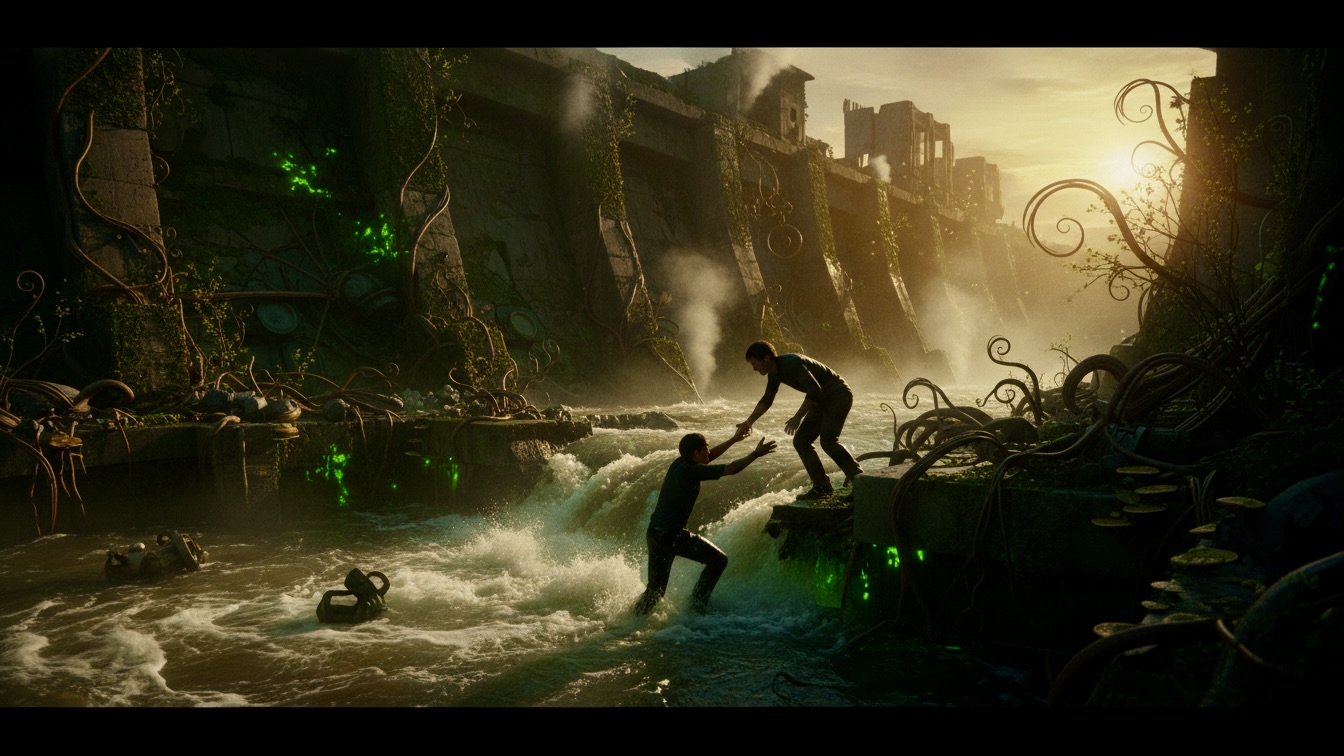
When the floor suddenly gives way, plunging the attendees into a freezing, subterranean river, Jay manages to reach safety on a narrow ledge. Faced with the choice to remain secure in his isolation or risk his life to save a drowning Marty, Jay breaks his own internal "wall," diving back into the lethal current to pull his friend to safety before the rising water consumes them both.
Jay is a young man struggling with debilitating panic attacks and a trauma-induced need for total environmental control. He begins the episode as an isolated, guarded individual who views others as liabilities, but ends it having accepted the vulnerability required to maintain a human bond.
Marty is the impulsive, optimistic catalyst who refuses to let Jay fade into total reclusion. He represents the tether to the outside world, serving as both the source of Jay's frustration and the ultimate reason for Jay's emotional breakthrough.
The opening sequence establishes the oppressive atmosphere of the woods and the plant, emphasizing Jay’s hyper-vigilant state through sensory overload. The midpoint occurs when the floor collapses, shifting the genre from a psychological drama into a high-stakes survival thriller as the environment turns actively hostile. The climax sees Jay fighting the current and his own survival instinct to drag Marty onto the ledge, marking the definitive moment where he chooses connection over isolation.
The episode begins with a low-grade, simmering anxiety that builds into a claustrophobic, sensory-heavy peak during the rave. Following the collapse, the mood shifts to one of primal, cold terror, eventually resolving into a quiet, exhausted sense of clarity and shared survival as the two friends face the unknown darkness of the tunnel together.
If expanded, the season would follow a team of urban explorers or investigators who notice a pattern of "accidents" at these specific industrial sites. The overarching mystery would reveal that these locations are being reactivated by an unknown, possibly non-human force that uses the structures to harvest the heightened emotional states of the people drawn to them.
As the series progresses, the protagonist of each episode would be revealed as a pawn in a larger, darker design, with the "walls" of their trauma being systematically exploited. The season finale would culminate in a confrontation at the source of these vibrations, forcing the survivors of previous episodes to unite against an entity that feeds on the very trauma they are trying to heal.
The visual style is defined by high-contrast, moody lighting, utilizing the sickly, bioluminescent green of the algae as the primary light source in the dark, damp tunnel. The camera work is handheld and frantic during the collapse, shifting to static, wide shots of the massive, brutalist architecture to emphasize the characters' insignificance against the scale of the decaying plant.
The tone is grounded in gritty realism, drawing inspiration from films like Chernobyl for its industrial decay and The Descent for its claustrophobic, survival-horror elements. The aesthetic is cold, wet, and tactile, designed to make the audience feel the dampness and the vibration of the concrete.
The target audience is young adults and adults (18-35) who enjoy psychological thrillers, survival horror, and atmospheric, character-driven narratives. It is best suited for streaming platforms that cater to fans of elevated genre fiction and dark, suspenseful storytelling.
The pacing starts deliberately slow to mirror Jay’s internal state, gradually accelerating as the rave begins and the structural integrity of the plant fails. The act structure is compressed, with the first act establishing character, the second act delivering the catastrophic inciting incident, and the third act focusing on the visceral, high-tempo struggle for survival.
The production will require significant practical effects to simulate the collapsing concrete floor and the freezing, rushing water of the underground river. The bioluminescent algae should be treated as a practical lighting element, using reactive, high-viscosity gels to create the glowing, pulsing effect on the set walls.
Safety for the actors is paramount, necessitating a controlled water tank environment for the underwater sequences to ensure the realism of the struggle without compromising the performers. The sound design must be hyper-focused on low-frequency vibrations to create a physical sense of unease in the audience, mimicking the protagonist's own sensory experience.


