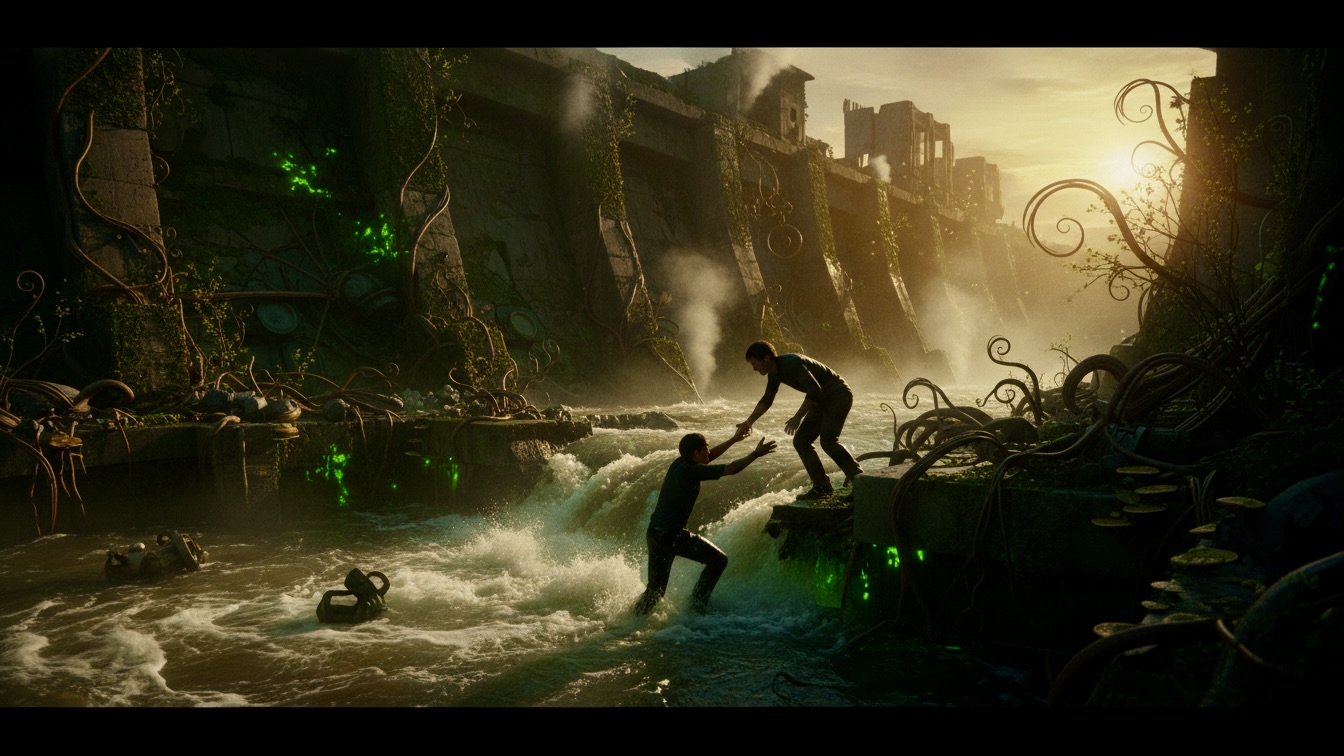
The story follows a young man named Jay, who is struggling with severe anxiety and a hyper-vigilant trauma response, as he is coerced by his friend Marty into attending a clandestine party at an abandoned, brutalist hydro plant. Upon arrival, Jay senses an immediate atmospheric wrongness, feeling the vibrations of the structure and noticing the instability of the environment. His fears are realized when the floor of the turbine hall collapses, plunging the attendees into an freezing, underground river. After managing to pull himself to safety on a narrow ledge, Jay faces a moral and psychological crisis as he watches Marty struggle in the current. Ultimately, Jay abandons his defensive isolation to save his friend, leading to a temporary resolution of his internal anxiety as the two survivors face the looming threat of the rising, bioluminescent waters.
The central theme of this narrative is the tension between self-preservation and human connection. Jay’s internal state is defined by a wall he has built around himself, a psychological defense mechanism meant to protect him from the unpredictability of others. The author uses the physical setting of the decaying hydro plant to mirror this internal architecture, showing how both the man and the building are crumbling under the weight of suppressed pressure. The collapse of the floor serves as a literal manifestation of Jay’s fears, forcing him to decide if his safety is worth more than the life of his companion.
Furthermore, the story explores the concept of the sublime through the lens of terror. The bioluminescent algae, described as toxic and alien, represents a beauty that is inextricably linked to danger. This duality reflects the nature of Jay’s recovery; he finds that the only way to break his cycle of panic is to be thrust into a situation so extreme that his hyper-vigilance is replaced by the raw, kinetic necessity of survival. The freezing water acts as a crucible, stripping away his intellectualized anxieties and replacing them with the visceral, primal reality of life and death.
Jay is a deeply fractured individual whose trauma has rendered him hyper-aware of his surroundings to the point of paralysis. He treats his isolation as a survival strategy, viewing his therapist’s advice as an intrusion upon his necessary autonomy. His internal monologue reveals a man who feels constantly under threat, living in a state of perpetual bracing for an unseen blow. When he is forced into the water, his initial instinct is to prioritize his own life, illustrating the extent to which his trauma has alienated him from altruism. However, his decision to save Marty marks a significant shift in his arc, proving that his humanity is still stronger than his fear.
Marty acts as the catalyst for the story, representing the external world that Jay is so desperate to avoid. He is characterized by a reckless optimism and a lack of awareness regarding the structural and psychological hazards around him. Marty’s insistence that Jay needs a reset suggests a well-meaning but ultimately superficial understanding of trauma. Despite his apparent carelessness, his struggle in the water becomes the anchor that forces Jay back into the world of the living. Marty’s dependence on Jay in the final moments of the chapter forces their dynamic to evolve from one of annoyance to one of shared, profound survival.
The pacing of the narrative is meticulously calibrated to reflect Jay’s psychological deterioration. The beginning of the chapter is slow and heavy, mirroring the thick, damp atmosphere of the woods and the protagonist's own sluggish, anxious thoughts. As they enter the hydro plant, the sentences become shorter and more staccato, mimicking the erratic beat of the music and the overwhelming sensory input. The transition from the party to the collapse is abrupt, mirroring the suddenness of a panic attack, which effectively traps the reader in Jay’s immediate, disoriented perspective.
The author makes masterful use of sensory details to ground the reader in the environment. The smell of ozone and rotting vegetation, the vibration of the bass against the teeth, and the visual of the sickening, green algae create a vivid, claustrophobic experience. The tone is consistently grim, emphasizing the metallic, concrete reality of the setting. By consistently linking the physical decay of the plant to Jay’s own internal struggles, the narrative voice remains tight and intimate, ensuring that every environmental shift feels like a personal threat to the protagonist.


