Format: Short Film / Anthology Episode | Est. Length: 10-12 minutes
Imagine a series where the atmospheric dread of Tales from the Loop meets the domestic coldness of a Noah Baumbach film, set against the backdrop of a Northern town where the weather is a bureaucratic entity. This episode serves as a window into a world where the supernatural is not a mystery to be solved, but a chore to be managed by families who have forgotten how to speak to one another.
The Warming Wind Relay is an installment in the anthology series The Liminal North, which explores the intersection of mundane domestic tragedy and low-frequency folk horror. The series is set in a version of Thunder Bay where the change of seasons is managed through unsettling, mandatory neighborhood rituals designed to maintain "geological equilibrium." Each episode follows a different resident tasked with a specific "relay" or "maintenance" duty, revealing the psychological fractures of a community that uses ritual to mask the rot of their personal lives.
Ethan is handed a heavy, off-white envelope that hums with a low-frequency vibration that rattles his teeth, forcing him to participate in a neighborhood ritual for a season that hasn't even died yet.
In a town obsessed with manifesting spring through surreal rituals, a teenager must deliver a humming, supernatural envelope while his parents' marriage clinically dissolves. As the world thaws, he discovers that the "new beginning" promised by his community is merely a mask for an inevitable and ugly collapse.
The episode explores the theme of "Performative Healing," where the characters use New Age rituals and clinical language to avoid the messy reality of grief. The "Warming Wind Relay" and the "harmonious distance" practiced by Ethan’s parents are presented as hollow structures designed to manifest a future that the characters are not emotionally prepared to inhabit.
Additionally, the story serves as an environmental metaphor for personal collapse, where the "thaw" of the seasons mirrors the disintegration of the nuclear family. It posits that the transition from one state to another—whether seasonal or domestic—is not a clean, magical transformation but a violent, grinding process that reveals the "trash" and "broken glass" hidden beneath the surface.
The stakes are Ethan’s psychological survival in an environment that demands he ignore his own reality in favor of a community-wide delusion. If he fails to complete the relay, the neighborhood fears a loss of "equilibrium," but the personal risk is the total erasure of Ethan’s genuine feelings in favor of his parents' "clinical" transition. The ultimate danger is a life lived in "harmonious distance," where the truth is permanently buried under layers of forced optimism.
The primary antagonist is the pervasive "forced optimism" of the Thunder Bay community and the "harmonious distance" practiced by Ethan’s parents. This atmospheric pressure forces Ethan to participate in a ritual that feels like a funeral for a season that hasn't died. The external conflict is the brutal, muddy environment of the "geological transition," while the internal conflict is Ethan’s struggle to find an honest emotion in a world where everyone is reading from a script of "manifested" hope.
Ethan, a teenager in the gray, slush-choked town of Thunder Bay, is forced into the "Warming Wind Relay," a neighborhood ritual involving the delivery of a supernatural, humming envelope. He carries the vibrating object to his mother’s backyard paint night, where he finds his parents, Jane and Steve, practicing "harmonious distance"—a clinical, mediator-approved detachment that masks the raw pain of their impending divorce.
During the ritual, a gust of wind carries glowing, unnatural pollen that "cracks" Ethan’s painting of a house, a visual omen that the neighbors celebrate as a prophecy while Ethan sees it as a literal map of his family's ruin. After a cold confrontation with his father’s performative "emotional evolution," Ethan delivers the envelope to a stranger at a bridge, realizing that the coming spring is not a rebirth, but a messy exposure of everything the winter tried to hide.
Ethan: Ethan is a sixteen-year-old boy defined by a weary cynicism and a deep-seated exhaustion from navigating his parents' "harmonious" divorce. At the start, he is a passive participant in the neighborhood's strange rituals, physically burdened by the vibrating envelope and the gray weight of Thunder Bay. By the end, he reaches a state of grim clarity, rejecting the forced metaphors of his community and accepting that the "thaw" of his life is an ugly, inevitable process of exposure rather than a magical rebirth.
Jane: Jane is Ethan’s mother, a woman who has fully leaned into the performative, New Age language of the "Warming Wind" community to mask her grief. She moves from a state of brittle, scripted leadership at the paint night to a silent, haunted observer of her son’s "fractured" artwork. Her arc is one of desperate maintenance, clinging to the "prophecy of heat" because she cannot face the cold reality of her empty hallways and packed boxes.
Steve: Steve is Ethan’s father, a man who uses technical jargon and "emotional evolution" as a shield against the messiness of his family’s collapse. He enters the story as a figure of clinical efficiency, handing out botanical mocktails and narrating his divorce as a "resilient framework" for personal growth. He ends the episode unchanged in his rhetoric but visually isolated, standing on the opposite side of a table from his wife, a man whose "architecture" is built on the denial of pain.
The Handoff: Ethan meets Mr. Garsen on a muddy corner where the air smells of wet dogs and exhaust. The vibration of the envelope travels up his arm and settles in his teeth, creating an unsettling physical connection to a ritual he finds absurd. Mr. Garsen projects his voice like a stage actor, insisting that the "resonance" must be carried to maintain the neighborhood's equilibrium during the thaw.
The Journey: Ethan trudges through the gray slush of Thunder Bay, feeling the singing envelope pulse against his ribs like a captive, dying animal. He passes rows of houses where melting snow thumps rhythmically off roofs, a sound that underscores the slow-motion collapse of his own domestic life. The world around him is a liquid mirror of oil spills and neon signs, reflecting a landscape that is falling apart under the weight of a winter that refuses to leave.
The Paint Night: He arrives at his mother’s backyard paint night where neighbors huddle under a tarp, clutching brushes like weapons against the damp, lavender-scented air. Jane welcomes him with brittle, scripted language, instructing him to place the "resonance" on a wooden pedestal to manifest the prophecy of heat. The envelope’s hum intensifies, creating perfect, scientific ripples in the rinse water that mock the chaotic reality of Ethan’s wet socks and itching skin.
The Fracture: Ethan’s father, Steve, arrives in an expensive technical jacket and offers a "botanical" mocktail while describing their divorce as a "clinical and efficient" transition. As Ethan paints a rigid, bunker-like house, a sudden gust of wind coats the canvas in glowing, unnatural pollen that creates a shimmering crack down the center of the structure. The neighbors whisper about "petal prophecies" and illuminated divisions, while Ethan realizes the painting has accurately captured the sound of packing tape tearing his life apart.
The Final Relay: Jane tasks Ethan with moving the note further south to a guardian at the bridge, completing the circuit required by the "warming wind." He picks up the now-soft, skin-like envelope and leaves his parents standing on opposite sides of the table, both staring at the glowing ruin of his artwork. He walks away into the thickening gloom, leaving behind the forced optimism of the tarp for the cold, honest reality of the rising river.
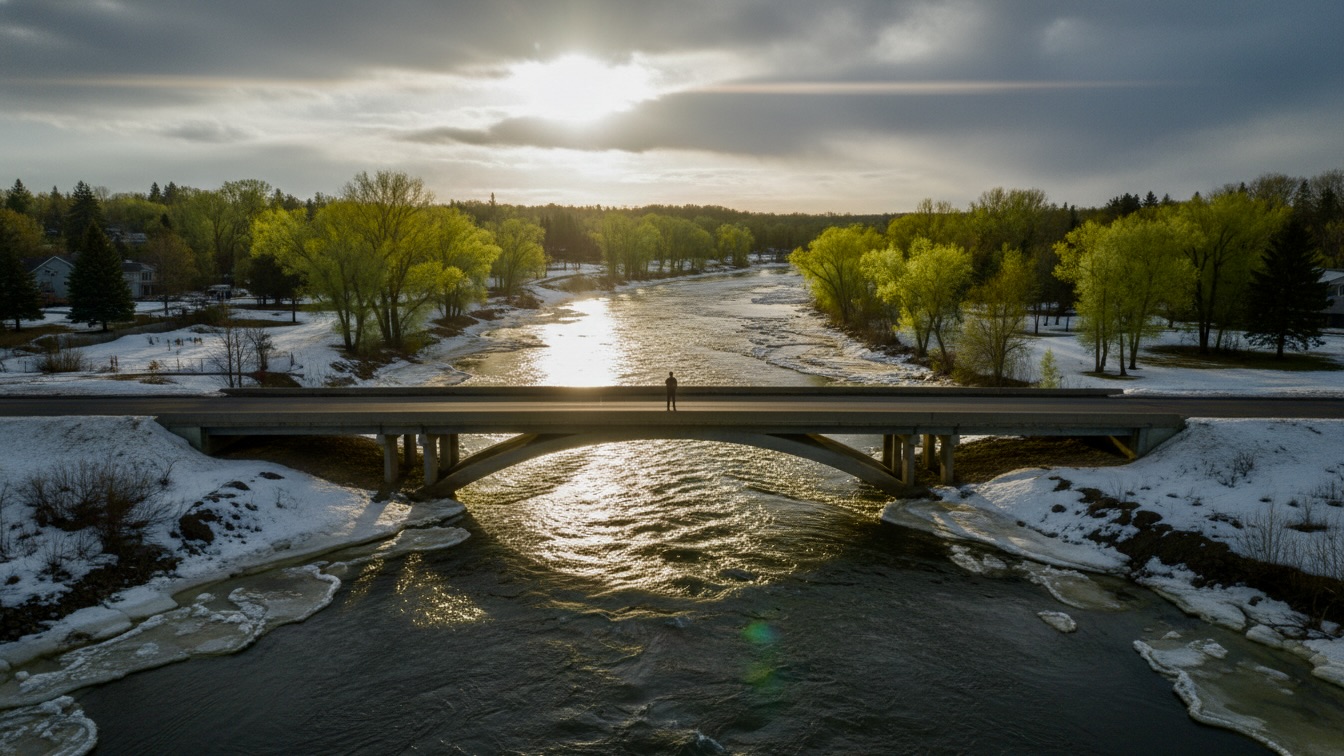
The Bridge: At the river, Ethan meets a bored young woman who takes the damp, singing envelope with a refreshing lack of theatricality or ritual. The moment the transfer occurs, the humming stops, leaving Ethan’s hand feeling unnervingly light and empty as the sound is swallowed by the water. He watches her disappear into the gray mist, the "resonance" now someone else’s burden to carry through the mud.
The Realization: Standing alone, Ethan looks at the glowing pollen under his fingernails and checks competing dinner texts from his separated parents. He watches the river ice move fast and grind against the shore like teeth, realizing the thaw is not a rescue but a messy exposure of hidden trash. The wind picks up, cold and sharp, confirming that the "new beginning" is simply the next stage of a total collapse.
The episode begins with a sense of "Heavy Stagnation," characterized by the physical weight of the mud and the annoying, persistent hum of the envelope. As Ethan enters the paint night, the mood shifts to "Claustrophobic Absurdity," where the tension between the neighbors' forced cheer and his parents' clinical coldness creates a peak of emotional dissonance. The finale transitions into "Cold Clarity," as the supernatural elements fade and Ethan is left with the stark, unvarnished reality of his fractured life, leaving the audience with a feeling of profound, quiet isolation.
The first season follows the "Warming Wind Relay" as it moves through various neighborhoods of Thunder Bay, with each episode focusing on a different "guardian" and their specific domestic crisis. As the relay progresses, the "resonance" within the envelope grows stronger, beginning to affect the physical reality of the town—causing localized thaws, structural failures, and auditory hallucinations. The overarching narrative tracks the slow realization that the ritual isn't bringing spring, but is actually a desperate, failing attempt to contain an ancient, geological grief that the town has suppressed for generations.
The season culminates in the "Great Melt," where the collective "resonance" of all the delivered notes is brought to the city center. Ethan’s journey evolves from a passive participant to a whistleblower who realizes that the "harmonious distance" of his parents is a microcosm of the town’s refusal to acknowledge its own decay. The finale sees the ritual finally fail, forcing the residents to confront the "trash" and "broken glass" of their history as the supernatural winter finally gives way to a raw, un-manifested reality.
The visual style is "Industrial Melancholy," characterized by a desaturated palette of slate grays, muddy browns, and bruised purples, punctuated by the unnatural, high-contrast glow of the "resonance" and the golden pollen. The camera work should be intimate and slightly unstable, utilizing handheld shots to capture the shivering, damp atmosphere of a Northern spring. Lighting should favor the orange glare of flickering streetlights and the flat, oppressive light of an overcast sky, creating a world that feels perpetually wet and cold.
Tonal influences include the clinical detachment of The Killing of a Sacred Deer mixed with the rural, low-fi supernatural elements of Tales from the Loop. The mood is one of "quiet apocalypse," where the world isn't ending with a bang, but with the sound of packing tape and grinding ice. The contrast between the neighbors' "manifesting" and the bleak reality of the trash-strewn melt creates a sense of cognitive dissonance that is both absurd and deeply tragic.
The target audience consists of adults and older teenagers (16-35) who gravitate toward atmospheric, "prestige" genre television like The Leftovers or Black Mirror. It appeals to viewers who enjoy slow-burn psychological drama, magical realism, and stories that use supernatural metaphors to explore complex family dynamics and divorce. The show is designed for a streaming environment where its high-concept visual style and melancholic tone can find a niche among fans of "elevated" horror and indie cinema.
The episode is paced as a "slow-thaw" narrative, beginning with a heavy, sluggish tempo that mimics Ethan’s struggle through the mud. The middle act at the paint night should feel claustrophobic and tense, with the rhythmic humming of the envelope providing a metronomic pressure that builds toward the "pollen strike." The final act on the bridge shifts to a more expansive, cold, and quiet tempo, allowing the emotional weight of the "collapse" to settle with the audience as the runtime concludes at approximately 12 minutes.
The "vibrating envelope" effect should be achieved through a combination of practical haptic props for the actor and a subtle, high-frequency sound design that increases in intensity as the relay progresses. The glowing pollen is a critical visual element that requires high-quality VFX to appear as "sparks of gold" rather than simple dust, reacting dynamically with the wet black paint on the canvas. The soundscape must be layered with the "rip-screech" of packing tape and the grinding of river ice to reinforce the theme of structural collapse.
Thunder Bay’s mud and slush should be treated as a character itself, requiring extensive use of practical "gray paste" and salt on set to ensure the physical toll on the characters is visible. The transition from the claustrophobic, tarp-covered paint night to the expansive, roaring bridge provides a necessary shift in scale. Special attention must be paid to the "mocktails" and "pedestals" to ensure they look slightly too clean and expensive for the muddy environment, highlighting the artifice of the parents' lifestyle.


