Format: Short Film / Anthology Episode | Est. Length: 10-12 minutes
Imagine a world where the digital apocalypse didn't end life, but accelerated it into a predatory, neon-hued nightmare. This episode serves as a frantic window into a reimagined Manitoba, where teenage scavengers navigate a landscape where geography is a weapon and the environment itself has gone viral.
The series explores a post-2026 Earth where a global server collapse—The Great Glitch—mangled the laws of biology and physics, creating a "hyper-growth" era where plants and animals evolve at the speed of software updates. Each episode follows different "Envirothon" squads—high schoolers trained in survivalist botany and dead-tech salvage—as they compete for Scav-Credits in a world that is half-wilderness and half-hallucination. The overarching narrative tracks the mystery of the "GPS Ghosts," digital signals that have manifested as physical phenomena, suggesting the Glitch was not an accident but a terraforming event.
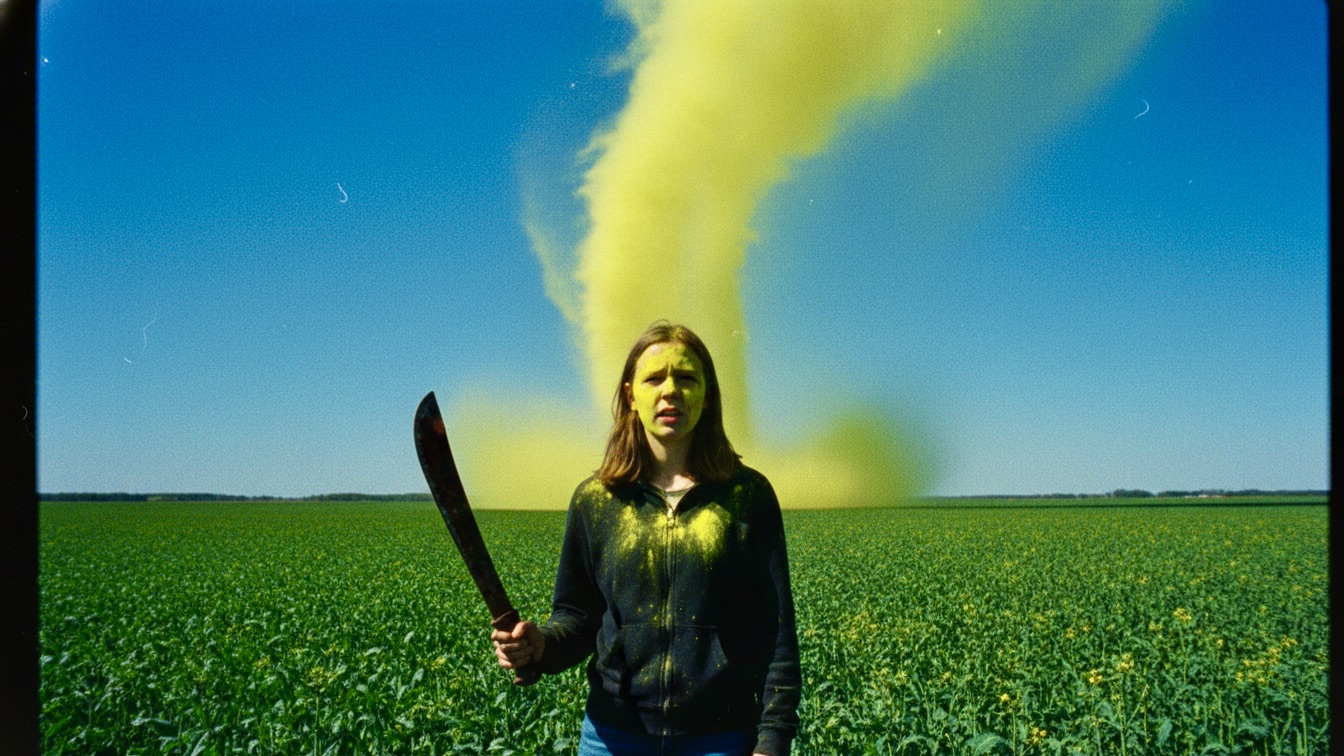
A vibrant, neon-yellow pollen tornado slams into a group of teenage scavengers, triggering high-voltage hallucinations that paint the GPS coordinates of their prize directly onto the sky for all their rivals to see.
In a world where nature has mutated into a hyper-aggressive predator, a teenage scavenger must choose between securing a life-saving battery or saving a hated rival from a pack of feral dogs. Survival in the new world requires more than just credits; it requires the one thing the Glitch couldn't rewrite: human empathy.
The central theme is the tension between altruism and survivalism in a resource-scarce environment. In a world where nature has been "overclocked" by human interference, the story asks whether humanity will revert to base predatory instincts or maintain the social constructs that define civilization. The "Whimsy" pollen serves as a metaphor for the overwhelming nature of information and the difficulty of discerning reality from digital-biological noise.
The secondary theme is the adaptation of the "Old World" to the "New World." Characters like Coach Chang represent the transition of academic knowledge into tactical survival skills, while the teenagers represent a generation that has never known a world that wasn't trying to actively consume them. This creates a genre blend of post-apocalyptic survival, eco-horror, and coming-of-age drama.
The immediate stakes are life and death, as the characters face predatory flora (the Hope Row) and fauna (feral heritage dogs). On a broader level, the survival of Kenzie’s settlement depends on the "Scav-Credits" earned from the battery, with the alternative being a month of starvation on dehydrated lichen. For Kenzie personally, the stakes involve her moral integrity; leaving Jasper to die ensures her team's safety and success, but at the cost of her own humanity.
The primary external conflict is the environment itself, specifically the "Hope Row" poplars and the feral dogs that hunt by sound and heat. Secondary conflict comes from the "Gophers," a rival scavenger squad led by Jasper, who represent the cutthroat competition inherent in the new economy. Internally, Kenzie struggles with the lingering effects of the "Whimsy" visions, which create a sense of cognitive dissonance and fear about a future she cannot control.
In the wake of "The Great Glitch," nature has accelerated into a predatory, hyper-vibrant ecosystem where high school students scavenge for tech relics to survive. Kenzie and her team are caught in a "Whimsy" pollen storm that grants them visions of the future but alerts rivals to their location by painting their coordinates in the sky. This leads to a tense standoff at a flooded bridge with a rival squad, where a biological trivia contest goes wrong, attracting a pack of feral heritage dogs.
When the rapidly growing "Hope Row" trees threaten to crush the rival leader, Jasper, Kenzie must choose between the scavenge-credits her settlement needs and his life. Despite the pressure to flee with the battery, she turns back to hack him free, narrowly escaping a massive Malamute with the help of her teammate Rat-Boy. They return to their settlement with the prize, but Kenzie is left haunted by a cryptic, leaking relic that suggests the environmental anomalies are only beginning to escalate.
Kenzie (Protagonist): A pragmatic and hardened scavenger who views the world through the lens of quotas and survival. Her psychological arc moves from cold utilitarianism to a reluctant hero as she realizes that "social constructs" like empathy are what keep them from becoming no better than the feral dogs. By the end, she is more observant and suspicious of the world’s underlying digital nature.
Rat-Boy (Supporting): A jittery, tech-obsessed scout who uses humor to mask his intense anxiety about the "dead grid." His arc is one of surprising bravery; starting as a shivering follower, he eventually stays behind to save Kenzie when he could have run. He represents the bridge between the old world’s logic and the new world’s chaos.
Coach Chang (Supporting): A former geography teacher turned tactical leader who treats environmental science like a military manual. He provides the "Old World" perspective, clinging to rules and grades as a way to maintain order in a lawless landscape. He remains largely static, serving as the anchor of authority for the teenagers.
Jasper (Antagonist): The arrogant leader of the Gophers who views scavenging as a game of dominance. His psychological state is one of fragile bravado, which completely shatters when he is physically trapped by the Hope Row. He ends the episode humbled and indebted to Kenzie, a position he clearly loathes.
Beat 1: Kenzie and Rat-Boy navigate the aggressive Manitoba brush under the strict eye of Coach Chang while avoiding the rapidly expanding "Hope Row" trees. A vibrant yellow pollen tornado known as "The Whimsy" slams into the group, inducing recursive neural loops and revealing the GPS coordinates of a rare battery in the sky. The team realizes the sky is now broadcasting their location to every scavenger in the region, forcing a desperate sprint to the bridge.
Beat 2: At the flooded creek, Kenzie’s squad is intercepted by the rival "Gophers" who demand a "Trivia or Tussle" standoff for the salvage rights. Mutated Echo-Blooms act as a biological lie detector, jeering at Jasper when he fails a technical question about solar capacitors. In a fit of rage, Jasper detonates a Snap-Dragon grenade, creating a neon smoke signal that calls a pack of feral heritage dogs to their position.
Beat 3: As the dogs emerge from the woods, Kenzie dives into a rusted Ford F-150 to retrieve the heavy marine battery while the Hope Row trees surge into a solid wall of thorns. Jasper becomes pinned by the rapidly growing wood, leaving him defenseless against a massive, starving Malamute. Kenzie faces a moral crossroads: flee with the credits that ensure her survival or risk her life to save a rival who just tried to sabotage her.
Beat 4: Kenzie hacks Jasper free with her machete just as the Malamute lunges, leading to a brutal struggle on the muddy bank. Rat-Boy intervenes by triggering a sonic feedback loop with the Echo-Blooms, creating a wall of sound that scatters the sensitive predators. The team retreats as the forest swallows the bridge, with Kenzie discovering a mysterious, leaking AA battery that hints at a deeper secret within the Glitch.
The episode begins with a sense of high-tension "normalcy," quickly escalating into the surreal, psychedelic horror of the pollen storm. The middle act shifts into a dark, satirical tension during the trivia standoff, highlighting the absurdity of their situation. The climax is a visceral, high-stakes action sequence that pivots from terror to a somber, reflective resolution, leaving the audience with a sense of lingering unease about the future.
The first season would follow Kenzie’s squad as they track the source of the "GPS Ghosts" across the changing Canadian landscape. Each episode introduces a new biological anomaly—from sentient fungal networks to magnetic storms—that brings them closer to a hidden government facility in Brandon. The season-long conflict involves a growing war between scavenger settlements and a mysterious faction that seems to be able to control the "Whimsy" pollen.
Thematic escalation would focus on the "recursive loops" Kenzie saw in her vision, suggesting that time or reality is beginning to stutter. As the characters grow, they must decide if they want to restore the old world or find a way to truly inhabit the new one. The season finale would reveal that the "Great Glitch" was a deliberate reboot of the planet’s OS, and Kenzie’s team holds the "admin key" in the form of the leaked batteries.
The visual style is "Bio-Neon Gothic," characterized by high-saturation colors (acid greens, electric yellows) contrasted against the rusted, grey decay of the old world. The camera work should be kinetic and handheld during action, but shift into a dreamlike, wide-angle perspective during the "Whimsy" visions. Tonal influences include the environmental dread of Annihilation mixed with the gritty, youthful survivalism of The 100.
Lighting should emphasize the unnatural brightness of the mutated flora, making the environment feel like it is glowing from within. Sound design is crucial, utilizing a mix of organic forest noises and digital "glitch" artifacts—static, humming, and distorted electronic frequencies. The "Echo-Blooms" and "Hope Row" should have distinct, unsettling auditory signatures that make the setting feel like a living, breathing character.
The target audience is Young Adult (16-30) and fans of "cli-fi" (climate fiction) and speculative survival dramas. It appeals to viewers who enjoy high-concept world-building, eco-horror, and stories featuring capable, resourceful youth. The blend of action, dark humor, and environmental commentary makes it suitable for streaming platforms looking for a visually distinct, episodic genre series.
The episode is designed for a lean 10-12 minute runtime, utilizing a rapid three-act structure. The first three minutes establish the world and the "Whimsy" threat; the middle four minutes cover the bridge standoff and trivia; and the final minutes focus on the dog attack and the moral choice. Pacing should be relentless, reflecting the "fast-grow" nature of the environment, with very few moments of stillness.
The "Whimsy" pollen tornado and the "Hope Row" growth spurt require a blend of practical dust effects and high-end CGI to ensure the plants feel physically present and threatening. The "Echo-Blooms" could be achieved through animatronics to allow the actors to interact with them during the trivia scene, enhancing the surreal comedy of the moment.
Filming should ideally take place in overgrown industrial or rural locations to minimize set construction costs. The feral dogs would require professional animal handlers and potentially some digital enhancement to give them the "vibrating" static look described in the visions. The "Snap-Dragon" explosion and "Glitter-Vine" fireworks offer opportunities for creative practical lighting and VFX overlays.


